The Perceptron: A Probabilistic Model for Information Storage and Organization in the Brain
The Perceptron: A Probabilistic Model for Information Storage and Organization in the Brain
Problem
Framing
Pattern-recognition theory lacked a quantitative model that could store associations in connection strengths and still generalize from partial stimulus overlap. The paper closes this gap with a layered stochastic perceptron whose random projection, association, and response units admit analytic learning curves for discrimination and generalization.
Currently Used Methods
Foundational
- "A logical calculus of the ideas immanent in nervous activity" — threshold neuron formalism for logical computation.
- Limitation in context: no quantitative learning law for changing associations.
- The Organization of Behavior — Hebbian association as synaptic strengthening.
- Limitation in context: lacks perceptron-level performance analysis for classification.
- Statistical theories of learning — reinforcement-style stimulus-response adaptation.
- Limitation in context: weak structural account of multilayer sensory projections.
- Topographic template matching — recognition by fixed stimulus layouts.
- Limitation in context: poor invariance to retinal displacement and overlap changes.
Proposed Method
Architecture
The perceptron maps a retina through random fixed projections into association units, then into competing response units. The figure shows the three-stage layout: retina projection area association area responses , with randomized inter-layer connections.

Loss / Objective
Learning increases the tendency of the correct response unit to dominate under reinforcement.A compact modern restatement is:
Algorithm
The response is the unit with largest net input from the active association set:
Training Procedure
- Random retina-to-association connectivity.
- Random association-to-response connectivity at initialization.
- Positive reinforcement for correct responses.
- Negative reinforcement for incorrect responses.
- Three value-dynamics variants: , , systems.
Evaluation
Datasets
- Synthetic retinal discrimination settings.
- Idealized random stimulus environments.
- Differentiated environments with multiple classes.
- Square-circle discrimination example.
Metrics
- : probability of correct association.
- : probability of correct response.
- : probability of correct generalization.
Headline results
- Retinal-overlap analysis: rises sharply with illuminated proportion when overlap is favorable.
- Learning dynamics: and approach common asymptotes in the square-circle setting.
- System comparison: outperforms and when source-set competition matters.
- Disjunct stimuli: correct classification can remain above chance despite zero shared retinal points.
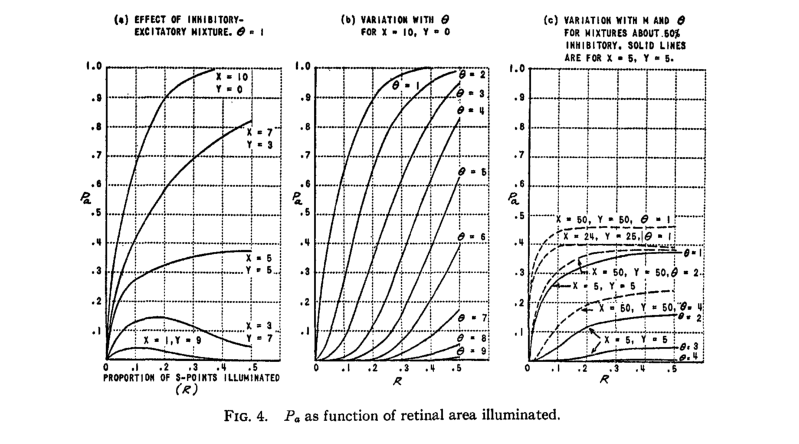
Ablations
- Illuminated fraction : larger illuminated area improves until saturation.
- Threshold : higher thresholds shift performance curves right and lower peak accuracy.
- Inhibitory mixture: more inhibitory content depresses association probability.
- Value dynamics: reduces bias effects better than or .
Method Strengths and Weaknesses
Strengths
- Gives a concrete layered architecture for learned classification.
- Derives analytic probabilities for association, response, and generalization.
- Handles random projections and partial stimulus overlap explicitly.
- Compares three learning dynamics instead of one update rule.
Weaknesses
- Evaluation is mostly analytic, not large-scale empirical.
- Random connectivity assumptions dominate the theory.
- Higher-order abstraction is admitted as difficult for the model.
- Performance depends strongly on overlap and threshold parameters.
Suggestions from the authors
- Extend perceptrons beyond statistical separability to higher-order abstraction.
- Add temporal dependence in association-unit activity.
- Learn selective symbolic responses such as naming object attributes.
- Connect perceptron laws more tightly to biological and physical mechanisms.
Links
Prior Papers
No prior vault papers identified yet.
Further Papers
- @rumelhartLearningRepresentationsBackpropagating1986 — replaces perceptron-era reinforcement heuristics with gradient-based multilayer representation learning.