A Style-Based Generator Architecture for Generative Adversarial Networks
A Style-Based Generator Architecture for Generative Adversarial Networks
Problem
Framing
Progressive GANs generate sharp high-resolution images, but a single input latent leaves semantics entangled across layers and scales. StyleGAN closes this gap with an intermediate latent , per-layer style control, and explicit noise inputs, reducing FFHQ FID from 8.04 to 4.40.
Currently Used Methods
Foundational
- @goodfellowGAN2014 — adversarial training for implicit generative modeling.
- Limitation in context: no mechanism for scale-specific latent control.
- @radfordDCGAN2015 — convolutional GAN design for image synthesis.
- Limitation in context: latent factors stay mixed through all generator layers.
- Progressive Growing of GANs for Improved Quality, Stability, and Variation — stable high-resolution GAN training by progressive layer growth.
- Limitation in context: generator semantics remain entangled across resolutions.
- Arbitrary Style Transfer in Real-Time with Adaptive Instance Normalization — AdaIN modulates features with channelwise affine parameters.
- Limitation in context: not a generative latent architecture with learned styles.
Proposed Method
Architecture
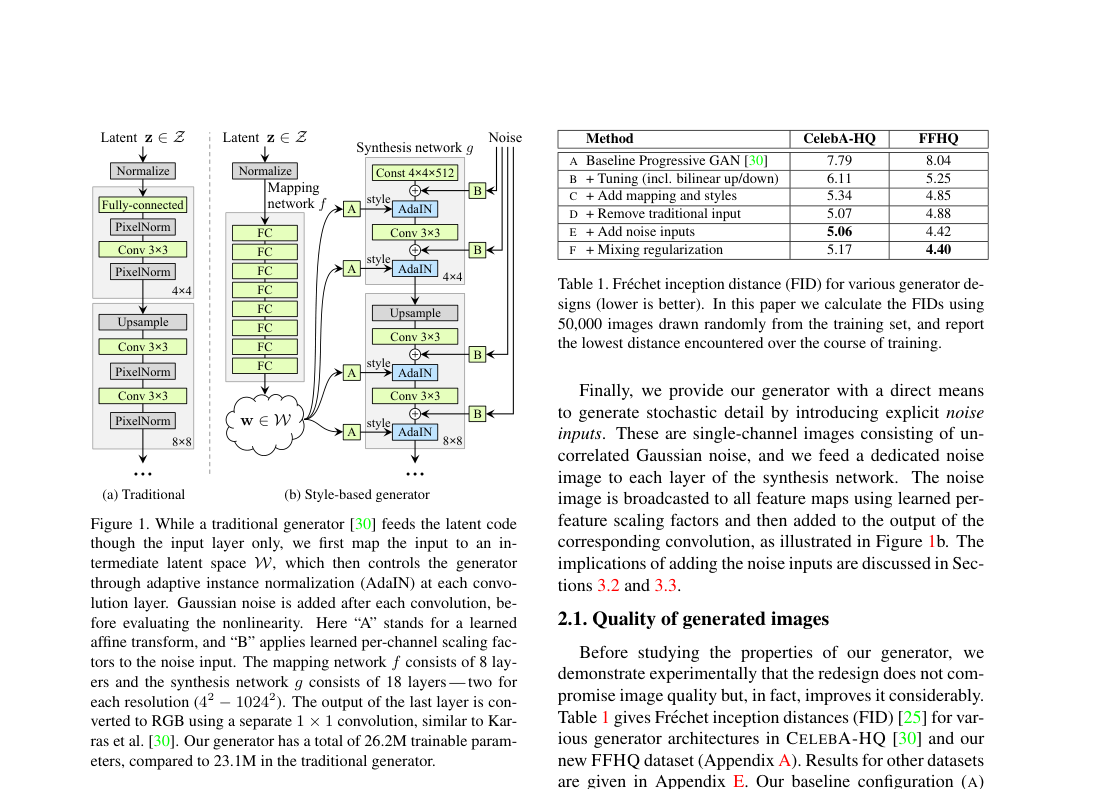
The generator maps through an 8-layer MLP into . A separate 18-layer synthesis network starts from a learned constant, applies AdaIN after each convolution, and injects single-channel Gaussian noise at every layer.
Loss / Objective
The paper keeps the GAN objective and changes the generator parameterization through adaptive instance normalization.
Sampling Rule / Algorithm
Sampling maps into layerwise styles, then synthesizes from a learned constant plus stochastic noise.
Training Procedure
- Mapping network depth: 8 fully connected layers.
- Intermediate latent dimensionality: 512.
- Synthesis network: 18 layers.
- Learned input constant: .
- Mixing regularization tested at 0%, 50%, 90%, 100%.
- CelebA-HQ loss: WGAN-GP.
- FFHQ loss: non-saturating logistic with R1 regularization.
Evaluation
Datasets
- CelebA-HQ
- FFHQ
- LSUN Bedroom
- LSUN Car
Metrics
- FID
- Perceptual path length
- Linear separability
Headline results
- CelebA-HQ: baseline 7.79 FID; full model 5.06 FID.
- FFHQ: baseline 8.04 FID; full model 4.40 FID.
- FFHQ tuned baseline: 5.25 FID.
- LSUN Bedroom at : 2.65 FID.
- LSUN Car at : 3.27 FID.
Table 1: FID for generator variants on CelebA-HQ and FFHQ
| Method | CelebA-HQ | FFHQ |
|---|---|---|
| A Baseline Progressive GAN [30] | 7.79 | 8.04 |
| B + Tuning (incl. bilinear up/down) | 6.11 | 5.25 |
| C + Add mapping and styles | 5.34 | 4.85 |
| D + Remove traditional input | 5.07 | 4.88 |
| E + Add noise inputs | 5.06 | 4.42 |
| F + Mixing regularization | 5.17 | 4.40 |
Ablations
- Mapping network plus styles sharply improves FID over the tuned baseline.
- Replacing the latent input with a learned constant helps CelebA-HQ more than FFHQ.
- Noise inputs improve CelebA-HQ FID from 5.07 to 5.06.
- Mixing regularization gives the best FFHQ FID and improves mixed-latent robustness.
Method Strengths and Weaknesses
Strengths
- Intermediate improves separability over direct input.
- Per-layer styles expose coarse-to-fine semantic control.
- Noise inputs isolate stochastic detail from global structure.
- Full design cuts FFHQ FID from 8.04 to 4.40.
Weaknesses
- Mixing regularization slightly worsens CelebA-HQ FID from 5.06 to 5.17.
- Gains come from several coupled changes, not one clean intervention.
- Evaluation centers on faces and two LSUN domains.
- The method still depends on GAN optimization stability.
Suggestions from the authors
- Analyze why the intermediate latent space improves disentanglement.
- Study truncation tradeoffs between fidelity, variation, and coverage.
- Characterize style control across coarse, middle, and fine scales.
- Extend the architecture to broader image domains.
Links
Prior Papers
- @goodfellowGAN2014 — foundational GAN objective retained while the generator parameterization is redesigned.
- @radfordDCGAN2015 — early convolutional GAN baseline that StyleGAN departs from architecturally.
Further Papers
No vault papers identified as further work yet.