3D Gaussian Splatting for Real-Time Radiance Field Rendering
3D Gaussian Splatting for Real-Time Radiance Field Rendering
Problem
Framing
Radiance fields reached high quality only with slow NeRF optimization and sub-real-time rendering. The paper replaces dense neural fields with optimized 3D Gaussians plus tile-based splatting, matching top view-synthesis quality while rendering at real-time rates. On Mip-NeRF360, it reports 1080p rendering above 30 fps and training in 24–51 minutes.
Currently Used Methods
Direct antecedents
- @mildenhallNeRF2020 — neural volume rendering with continuous radiance fields.
- Limitation in context: slow rendering and optimization block interactive view synthesis.
- Mip-NeRF 360 — high-quality unbounded-scene NeRF with strong reconstruction fidelity.
- Limitation in context: up to 48 hours training and sub-real-time rendering.
- Instant Neural Graphics Primitives with a Multiresolution Hash Encoding — fast NeRF training with hash grids.
- Limitation in context: speed gains come with lower visual quality on hard scenes.
- Plenoxels: Radiance Fields without Neural Networks — explicit sparse voxel radiance fields without MLPs.
- Limitation in context: structured grids waste resolution and limit quality-speed tradeoffs.
- Point-Based Neural Rendering variants — point primitives with learned appearance and splatting.
- Limitation in context: geometry control and visibility handling remain too weak for SOTA quality.
Proposed Method
Architecture
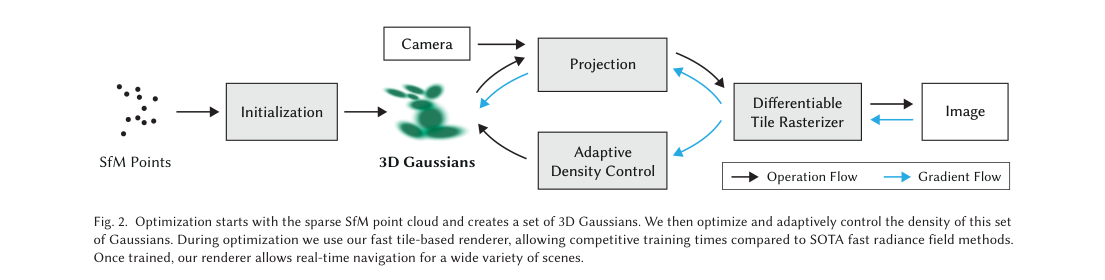
The scene is a set of 3D anisotropic Gaussians initialized from SfM points. Each Gaussian carries position, covariance, opacity, and spherical-harmonic color; rendering projects them to screen space and composites them with a differentiable tile rasterizer while adaptive density control splits, clones, and prunes primitives.
Loss / Objective
Training minimizes a photometric reconstruction loss between rendered and ground-truth views:
Sampling Rule / Algorithm
Rendering projects each Gaussian to screen space, evaluates alpha-weighted splats, and composites front-to-back:
Training Procedure
- 30K iterations for reported real-scene training.
- Intermediate quality already strong at 7K iterations.
- Initialize from sparse SfM points.
- Interleave optimization with density control.
- Optimize full anisotropic covariance.
- Use spherical harmonics for view-dependent color.
Evaluation
Datasets
- Mip-NeRF360
- Tanks and Temples
- Deep Blending
- Synthetic Blender scenes
Metrics
- SSIM
- PSNR
- LPIPS
- training time
- rendering FPS
- memory
Headline results
- Mip-NeRF360: SSIM 0.815, PSNR 27.21, LPIPS 0.214.
- Tanks and Temples: best reported quality with real-time rendering in many scenes.
- Deep Blending: competitive or better quality than prior radiance-field baselines.
- Synthetic scenes: 180–300 FPS after training.
- Real scenes: 1080p rendering at 30 fps or more.
Results table
Table 2: Aggregate metrics on Mip-NeRF360.
| SSIM↑ | PSNR↑ | LPIPS↓ |
|---|---|---|
| 0.626 | 23.08 | 0.463 |
| 0.671 | 25.30 | 0.371 |
| 0.699 | 25.59 | 0.331 |
| 0.792† | 27.69 | 0.237† |
| 0.770 | 25.60 | 0.279 |
| 0.815 | 27.21 | 0.214 |
Ablations
- Full anisotropic covariance beats isotropic splats on reconstruction quality.
- Adaptive densification is critical; fixed primitives underfit geometry.
- Quality at 7K iterations is already close to the 30K endpoint.
- Missing viewing angles produce artifacts, especially near scene corners.
Method Strengths and Weaknesses
Strengths
- Reaches NeRF-class quality with explicit, non-MLP scene parameters.
- Delivers real-time 1080p rendering instead of offline novel-view synthesis.
- Trains in under an hour on real scenes, far below Mip-NeRF360.
- Anisotropic Gaussians fit geometry and appearance better than isotropic splats.
Weaknesses
- Artifacts appear in poorly observed regions and missing-angle captures.
- Memory use exceeds NeRF-based methods on large scenes.
- Performance depends on SfM initialization quality.
- Static-scene formulation does not address dynamic content.
Suggestions from the authors
- Reduce memory footprint for large-scene training.
- Improve robustness in weakly observed scene regions.
- Handle challenging capture gaps and corner views.
- Extend the representation beyond static scenes.
Links
Prior Papers
- @mildenhallNeRF2020 — introduces NeRF, the core radiance-field baseline this paper seeks to replace in practice.
Further Papers
No vault papers identified as further work yet.