Generative Inverse Design of Metamaterials with Functional Responses by Interpretable Learning
Generative Inverse Design of Metamaterials with Functional Responses by Interpretable Learning
Problem
Framing
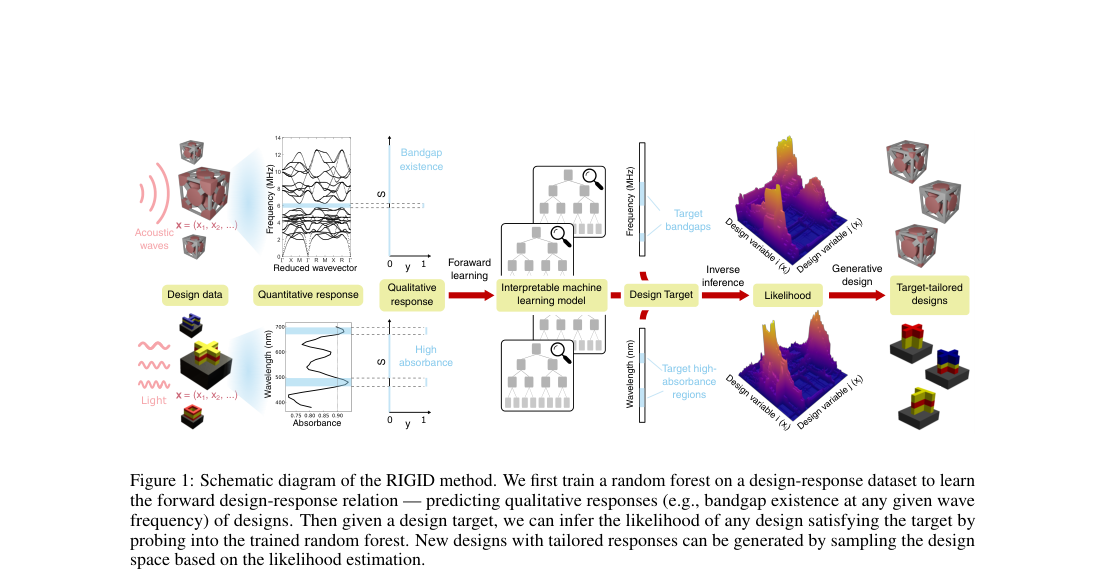
Inverse design for metamaterials with functional responses still relies on iterative search or one-to-one inverse maps, both of which break under non-unique targets and small datasets. The paper closes this gap with RIGID, which turns a random-forest forward model into an interpretable likelihood over designs and samples multiple valid solutions without retraining.
Currently Used Methods
Foundational
- "Tandem neural networks for inverse design of nanophotonic structures" — cascaded inverse and pretrained forward networks for inverse design.
- Limitation in context: still favors one output per target, so diversity stays weak.
- @DenoisingDiffusionProbabilisticModels2020 — conditional generative diffusion for one-to-many design synthesis.
- Limitation in context: higher data demand and lower interpretability on small metamaterial datasets.
- @kingmaVAE2013 — latent-variable generation adapted to conditional inverse design.
- Limitation in context: solution likelihood is not explicit in original design space.
- @goodfellowGAN2014 — adversarial generation behind cGAN inverse-design baselines.
- Limitation in context: unstable training and weak transparency for target satisfaction.
- "Interpretable machine learning for inverse design of metamaterials" — decision-tree rules expose feasible design regions.
- Limitation in context: needs an extra surrogate tree and lacks calibrated region likelihoods.
Proposed Method
Architecture
RIGID trains a random forest on , where are design variables, is frequency or wavelength, and marks qualitative target satisfaction. Inversion prunes each tree by the target domain , maps surviving leaves to design-space regions, and averages leaf probabilities across trees into a forest likelihood.
Loss / Objective
The objective is to find designs whose qualitative response stays positive over the target domain.
For tree , the target-satisfaction likelihood is
and the forest likelihood is
Sampling Rule / Algorithm
Generation samples designs in proportion to the estimated likelihood, using MCMC over the forest score.
Training Procedure
- Forward task: binary classification of qualitative functional responses.
- Inputs: design variables and auxiliary variable .
- Model: random forest with trees.
- Inversion: prune branches inconsistent with target interval(s) in .
- Region score: leaf positive-class proportion.
- Generation: MCMC sampling from .
Evaluation
Datasets
- Acoustic metamaterial bandgap design.
- Optical metasurface high-absorbance design.
- Synthetic SqExp benchmark.
- Synthetic SupSin benchmark.
Metrics
- Satisfaction rate.
- Average score.
- Selection rate.
- Forward-model test F1 score.
Headline results
- Acoustic forward model: test F1 .
- Optical forward model: test F1 .
- SqExp forward model: test F1 .
- SupSin forward model: test F1 .
- Real metamaterial studies: demonstrated with training sets in the regime.
Table 1: Optical metasurface inverse-design results and diagnostics from Figure 5 panels C-G.
| Panel | What it shows | Main takeaway |
|---|---|---|
| C | Target wavelength bands over an absorbance spectrum | Targets are interval constraints, not full-spectrum matching. |
| D | Estimated-likelihood densities for all, satisfied, and unsatisfied designs | Higher likelihood aligns with target satisfaction. |
| E | Sampling-threshold sweep of selection rate, satisfaction rate, and average score | Raising cuts yield but improves quality. |
| F | Example generated metasurfaces with dimensions and likelihoods | RIGID returns multiple distinct high-likelihood designs. |
| G | RIGID vs GA distributions over materials, geometry type, and thicknesses | RIGID covers a broader design space than GA. |
Ablations
- Sampling threshold : higher lowers selection rate and raises satisfaction rate.
- Sampling threshold : average score also rises with .
- Forest size: more trees improve likelihood estimation quality.
- RIGID vs GA: RIGID covers broader feasible regions on multimodal targets.
Method Strengths and Weaknesses
Strengths
- No separate inverse network is trained; inversion comes from the forward forest.
- Explicit gives interpretable target-satisfaction scores.
- Works on small-data real cases with sub-250-sample training sets.
- Covers broader feasible regions than GA on multimodal problems.
Weaknesses
- Handles binary qualitative targets, not full quantitative response matching.
- Likelihood is piecewise constant over leaf-defined regions.
- Generation still relies on MCMC rather than direct ancestral sampling.
- Baselines emphasize GA and synthetic tests, not stronger modern conditional generators.
Suggestions from the authors
- Extend RIGID to quantitative functional-response targets.
- Study higher-dimensional design spaces.
- Use the synthetic problems as standard inverse-design benchmarks.
- Expand design spaces when likelihood indicates poor target coverage.
Links
Prior Papers
- @DenoisingDiffusionProbabilisticModels2020 — diffusion is a cited conditional generative baseline for one-to-many inverse design.
- @goodfellowGAN2014 — adversarial generation underlies cGAN inverse-design baselines discussed by the paper.
- @kingmaVAE2013 — variational latent modeling underlies cVAE inverse-design baselines.
- @wuGroupNormalization2018 — normalization layers appear in the deep generative baselines surveyed here.
Further Papers
No vault papers identified as further work yet.