GPTQ: Accurate Post-Training Quantization for Generative Pre-trained Transformers
GPTQ: Accurate Post-Training Quantization for Generative Pre-trained Transformers
Problem
Framing
Accurate post-training quantization did not scale to 100B+ transformers; greedy second-order methods were too slow, and cheap rounding collapsed at 3 bits. GPTQ closes this gap with one-shot, row-wise Hessian-aware quantization that keeps OPT-175B near full precision: WikiText2 perplexity 8.37 at 4-bit versus 8.34 FP16.
Currently Used Methods
Direct antecedents
- "Post-Training Quantization for Vision Transformer" — adaptive rounding for accurate PTQ on vision backbones.
- Limitation in context: optimization-heavy PTQ is too slow for 100B-scale transformers.
- "BRECQ: Pushing the Limit of Post-Training Quantization by Block Reconstruction" — block reconstruction with second-order corrections.
- Limitation in context: designed for vision models, not full GPT-family quantization.
- "Optimal Brain Compression: A Framework for Accurate Post-Training Quantization and Pruning" — second-order greedy weight updates via inverse Hessian.
- Limitation in context: cubic input-dimension cost makes billion-parameter deployment impractical.
- "LLM.int8(): 8-bit Matrix Multiplication for Transformers at Scale" — 8-bit inference for large transformers.
- Limitation in context: lower compression and no 3-bit or 4-bit regime.
Proposed Method
Architecture
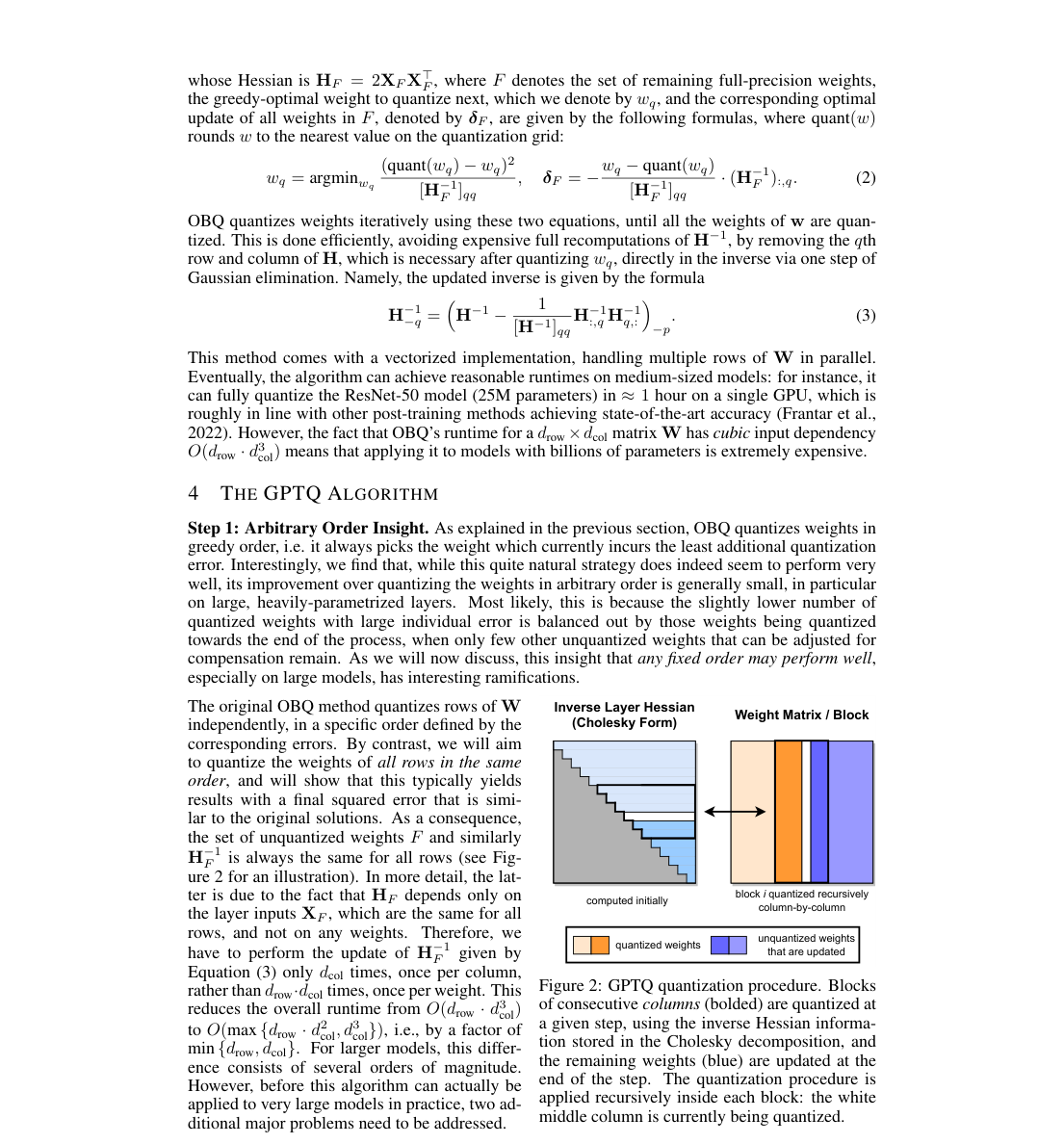
GPTQ is not a new transformer. It quantizes each linear layer row-wise, using a shared input Hessian across rows and processing columns in fixed-order blocks. The key systems change is a Cholesky-form inverse Hessian update plus batched column updates.
Loss / Objective
Each layer solves a reconstruction problem on calibration activations:
Algorithm
For the current unquantized set , GPTQ quantizes one weight and applies the optimal second-order compensation to the remaining weights:
The inverse Hessian is updated after each quantized coordinate by:
Training Procedure
- Post-training only; no weight retraining.
- Calibration data: a few thousand samples.
- Context length for perplexity evaluation: 2048 tokens.
- Target precisions: 3-bit and 4-bit.
- Grouped variants evaluated: , .
- Generation latency benchmark: batch size 1, output length 128.
Evaluation
Datasets
- WikiText2
- Penn Treebank
- C4
- LAMBADA
- ARC-easy
- ARC-challenge
- PIQA
- StoryCloze
Metrics
- Perplexity
- Accuracy
- Average per-token latency
- Quantization runtime
- GPU count reduction
Headline results
- OPT-175B, WikiText2, 4-bit: PPL 8.37; FP16 8.34; RTN 10.54.
- BLOOM-176B, WikiText2, 4-bit: PPL 8.21; FP16 8.11; RTN 8.37.
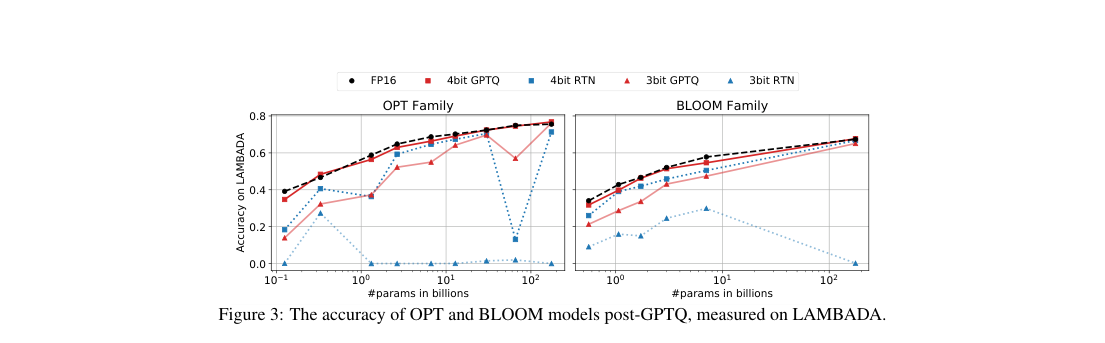
- OPT-175B, LAMBADA, 4-bit: 76.80%; FP16 75.59%; RTN 71.34%.
- OPT-175B, 3-bit on A100-80GB: 71 ms/token, 3.24 speedup, 51 GPUs.
- A6000-48GB, OPT-175B, 3-bit: 130 ms/token, 4.53 speedup, 82 GPUs.
Table 2: GPTQ runtime for full quantization of the 4 largest OPT and BLOOM models.
| Model family | 13B / 1.7B | 30B / 3B | 66B / 7.1B | 175B / 176B |
|---|---|---|---|---|
| OPT Runtime | 20.9m | 44.9m | 1.6h | 4.2h |
| BLOOM Runtime | 2.9m | 5.2m | 10.0m | 3.8h |
Ablations
- Bit-width: 4-bit stays near FP16; 3-bit remains usable for GPTQ but collapses for RTN.
- Model size: larger models are usually easier to quantize.
- Group size: improves 3-bit perplexity by about 0.2 on average.
- Finer grouping: adds another roughly 0.1 perplexity gain.
Method Strengths and Weaknesses
Strengths
- Preserves OPT-175B WikiText2 perplexity at 4-bit: 8.37 versus 8.34 FP16.
- 3-bit remains functional where RTN collapses on perplexity and zero-shot tasks.
- Full 175B-model quantization finishes in 4.2 hours for OPT.
- Enables real latency gains, not just memory savings.
Weaknesses
- Depends on second-order Hessian approximations from calibration activations.
- C4 calibration samples come from the C4 training set.
- Kernel speedups target low-batch generative inference, mainly matrix-vector workloads.
- 3-bit still degrades smaller and medium models substantially.
Suggestions from the authors
- Extend kernels beyond low-batch generative inference.
- Combine GPTQ with improved distribution strategies and faster attention kernels.
- Explore alternative quantization grids and grouping schemes.
- Study even lower-bit settings with extra stabilization tricks.
Links
Prior Papers
- @dettmersQLoRA2023 — follows the same compression agenda for LLM deployment, but adds low-rank finetuning after quantization.
Further Papers
- @dettmersQLoRA2023 — builds directly on 4-bit LLM quantization as a practical foundation for parameter-efficient finetuning.
- @kwonvLLM2023 — extends the low-bit LLM inference line with system-level optimizations for serving.