Efficient Memory Management for Large Language Model Serving with PagedAttention
Efficient Memory Management for Large Language Model Serving with PagedAttention
Problem
Framing
LLM serving wastes KV-cache memory through reservation, fragmentation, and duplicate prefixes, which caps batch size before FLOPs saturate. The paper closes this systems gap with PagedAttention: it virtualizes KV storage into fixed-size blocks with block tables and sharing, cutting waste to under and raising serving throughput by up to over Hugging Face Transformers.
Currently Used Methods
Foundational
- @vaswaniAttentionAllNeed2017 — standard autoregressive self-attention with per-token KV caching.
- Limitation in context: assumes contiguous cache layout, causing serving-time fragmentation.
- @brownGPT3_2020 — large decoder-only LMs that make KV cache dominant at inference.
- Limitation in context: does not address multi-request cache allocation efficiency.
- @daoFlashAttention2022 — IO-aware exact attention kernel for faster training and inference.
- Limitation in context: optimizes attention compute, not KV-cache placement or sharing.
- @daoFlashAttention2_2023 — improved work partitioning for faster attention kernels.
- Limitation in context: leaves serving throughput bottlenecked by memory waste.
- @leviathanSpeculativeDecoding2023 — reduces decoding latency with draft-and-verify generation.
- Limitation in context: orthogonal to KV memory management during serving.
Proposed Method
Architecture
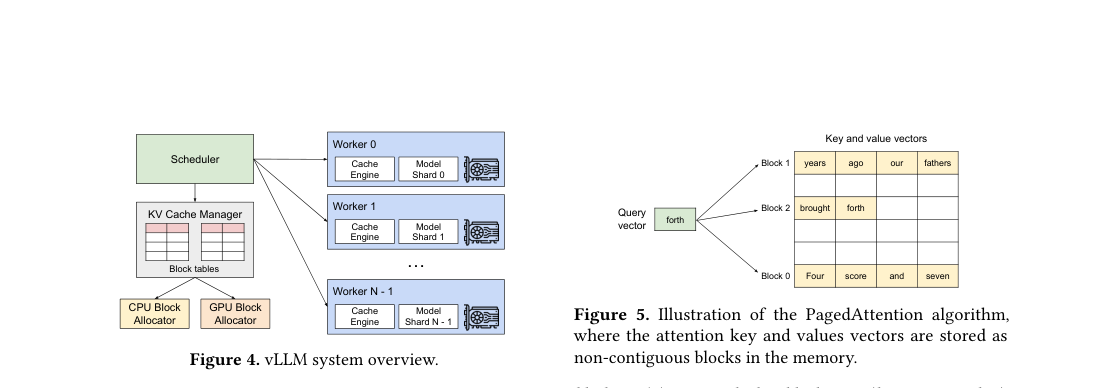
vLLM splits serving into a scheduler, a KV cache manager, CPU/GPU block allocators, and worker processes that host model shards plus cache engines. PagedAttention stores each sequence's KV cache as logical blocks mapped by a block table to non-contiguous physical blocks, enabling prefix sharing and near-zero external compaction pressure.
Loss / Objective
The paper is a serving-systems design, not a training objective paper.Its core attention computation rewrites standard attention over paged KV blocks:
where and are block-wise KV tensors.
Sampling Rule / Algorithm
PagedAttention computes attention blockwise, then reduces partial results across KV blocks:
This preserves exact attention while decoupling logical token order from physical memory contiguity.
Training Procedure
- No model training.
- Fixed-size KV block granularity .
- CPU and GPU block allocators.
- Reference-counted shared blocks for parallel sampling and beam search.
- Copy-on-write when shared prefixes diverge.
- CPU-resident blocks support swapping under memory pressure.
Evaluation
Datasets
- ShareGPT conversation traces.
- Alpaca instruction traces.
Metrics
- Serving throughput.
- Tokens per second.
- Request latency.
- KV-cache memory waste.
- Swapping and recomputation overhead.
Headline results
- Hugging Face Transformers: up to higher throughput.
- Text Generation Inference: up to higher throughput.
- KV-cache waste: under .
- ShareGPT and Alpaca workloads: latency stays lower until higher request rates.
- Parallel sampling and beam search: shared-prefix memory usage drops substantially with copy-on-write.
Ablations
- Block size: smaller blocks reduce waste but raise lookup overhead.
- Parallel sampling: block sharing sharply cuts memory versus naive duplication.
- Beam width: shared prefixes keep memory growth sublinear early in decoding.
- Swapping vs recomputation: both incur overhead; choice depends on block reuse distance.
Method Strengths and Weaknesses
Strengths
- Targets the real serving bottleneck: KV-cache capacity, not only attention FLOPs.
- Preserves exact attention semantics despite non-contiguous physical layout.
- Supports prefix sharing for parallel sampling and beam search with copy-on-write.
- Reports large end-to-end gains: up to over Hugging Face Transformers.
Weaknesses
- Adds block-table indirection and allocator complexity to the serving stack.
- Gains depend on cache-bound workloads with variable sequence lengths.
- Swapping and recomputation still impose measurable latency overhead under pressure.
- Paper focuses on inference systems; training-time implications are outside scope.
Suggestions from the authors
- Extend memory virtualization across multiple GPUs and nodes.
- Improve eviction and recovery policies for swapped KV blocks.
- Co-design decoding algorithms with KV sharing and paging.
- Reduce block-management overhead at extreme batch sizes.
Links
Prior Papers
- @leviathanSpeculativeDecoding2023 — alternative inference-time acceleration; useful contrast because it attacks decoding steps, not KV memory waste.
Further Papers
- @daoFlashAttention2_2023 — complementary systems optimization for attention kernels that pairs naturally with paged KV management.
- @jiangMixtral2024 — later high-throughput LLM serving workloads make KV-cache efficiency even more central.
- @dettmersQLoRA2023 — memory-efficiency work on LLM deployment complements vLLM's serving-side memory virtualization.