FlashAttention-2: Faster Attention with Better Parallelism and Work Partitioning
FlashAttention-2: Faster Attention with Better Parallelism and Work Partitioning
Problem
Framing
FlashAttention removes quadratic memory traffic, but still leaves GPU throughput far below GEMM efficiency. FlashAttention-2 closes that gap with better work partitioning, fewer non-matmul operations, and sequence-parallel attention, reaching 50–73% of peak A100 FLOPs and 225 TFLOPs/s per GPU in GPT training.
Currently Used Methods
Foundational
- @vaswaniAttentionAllNeed2017 — standard exact attention for Transformers.
- Limitation in context: quadratic memory traffic blocks long-context efficiency.
- @daoFlashAttention2022 — tiled exact attention with linear-memory IO complexity.
- Limitation in context: poor warp and block partitioning leaves low occupancy.
- "Longformer: The Long-Document Transformer" — sparse local-global attention for long contexts.
- Limitation in context: changes the operator instead of accelerating exact attention.
- "Self-attention Does Not Need O(n²) Memory" — memory-efficient recomputation for exact attention.
- Limitation in context: less optimized for GPU kernel throughput.
- "GQA: Training Generalized Multi-Query Transformer Models from Multi-Head Checkpoints" — shares KV heads to reduce cache cost.
- Limitation in context: inference-memory savings do not fix attention kernel efficiency.
Proposed Method
Architecture
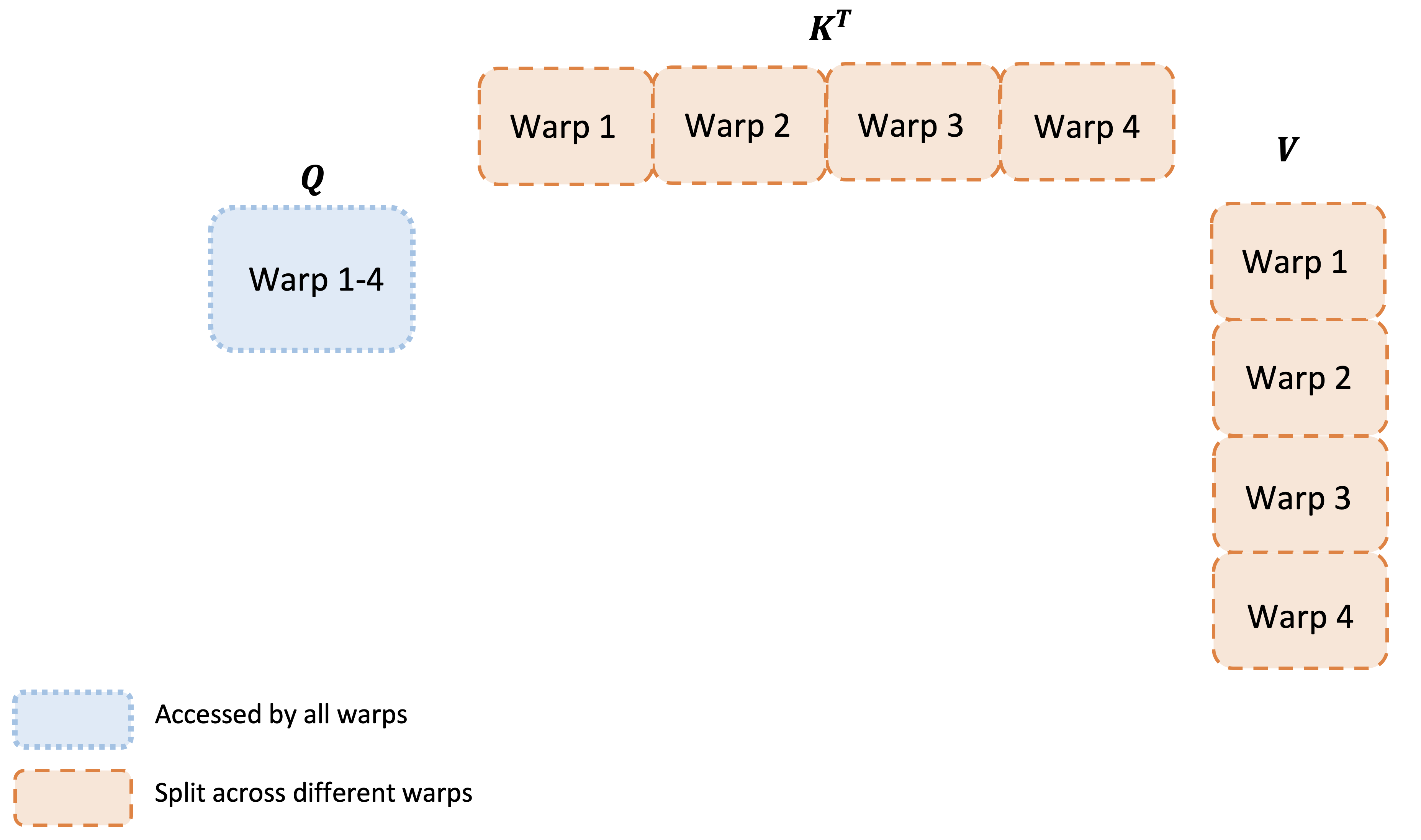
The kernel keeps exact attention but changes how GPU work is assigned. It parallelizes a single head across sequence-length blocks and repartitions warps so stays shared while and tiles are split across warps, reducing shared-memory traffic.
Loss / Objective
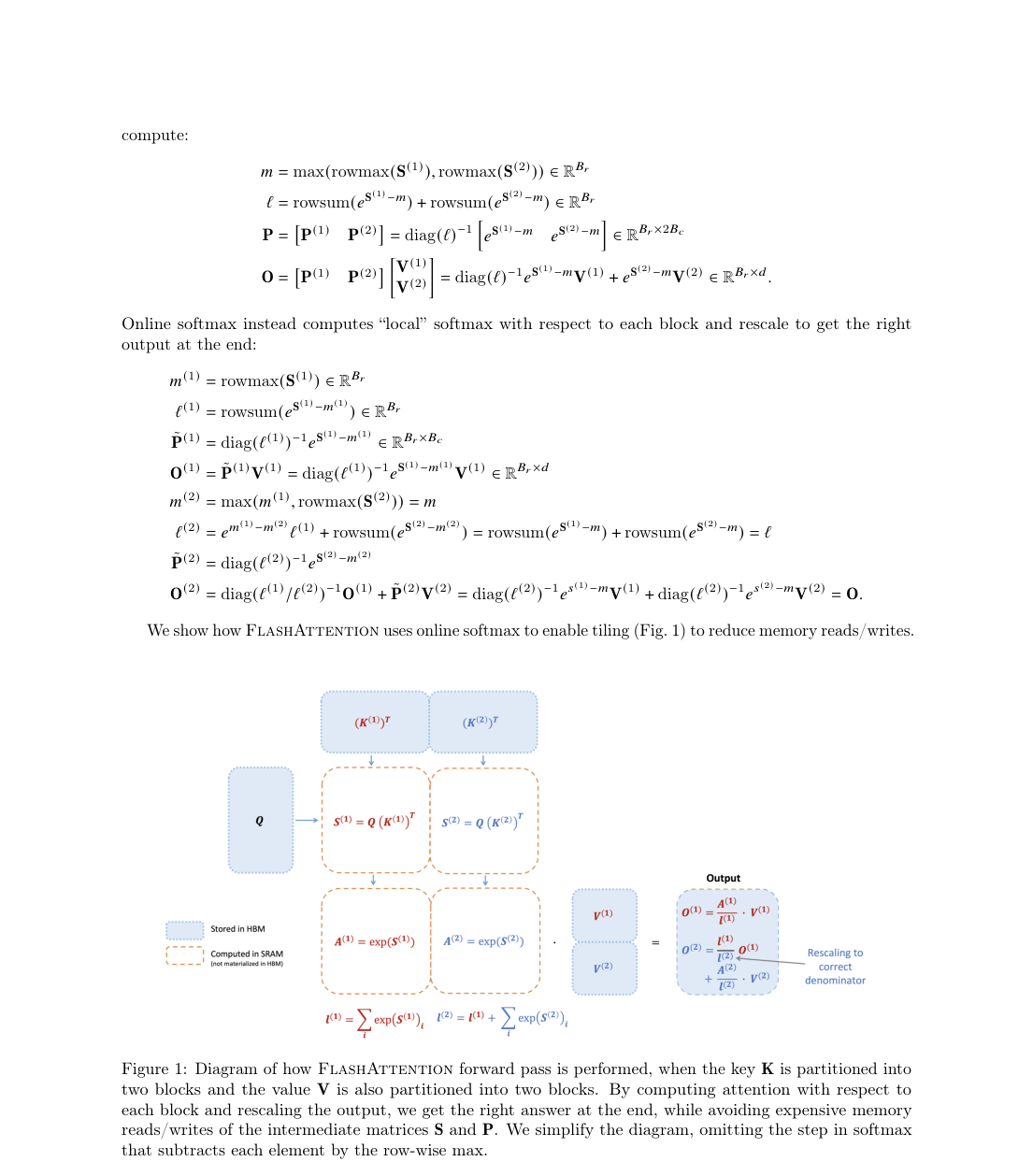
The method is an exact kernel rewrite.Its core forward update uses online softmax with fewer rescalings:
Sampling Rule / Algorithm
The exact attention target remains unchanged:
FlashAttention-2 computes this by tiling over sequence blocks and parallelizing those blocks across thread blocks and warps.
Training Procedure
- Hardware: 8\times A100 80GB SXM for end-to-end GPT training.
- Models: GPT-style 1.3B and 2.7B.
- Context lengths: 2k and 8k.
- Benchmarks: causal and non-causal attention.
- Head dimensions: 64, 128, 256.
- Variants supported: MQA and GQA.
Evaluation
Datasets
- Synthetic attention benchmarks on A100 80GB SXM4.
- GPT-style language-model training, 1.3B and 2.7B parameters.
- Context lengths: 512 to 16k in kernel benchmarks.
- End-to-end training at 2k and 8k context.
Metrics
- Attention throughput: TFLOPs/s.
- Device efficiency: percent of theoretical max FLOPs/s.
- End-to-end training throughput: TFLOPs/s per GPU.
- Relative speedup over PyTorch, FlashAttention, xFormers, and Triton baselines.
Headline results
- A100 forward pass: up to 73% theoretical max throughput.
- A100 backward pass: up to 63% theoretical max throughput.
- Attention benchmarks: 1.7–3.0\times faster than FlashAttention.
- GPT training: up to 1.3\times faster than FlashAttention.
- GPT training: up to 225 TFLOPs/s per A100, 72% model FLOPs utilization.
Ablations
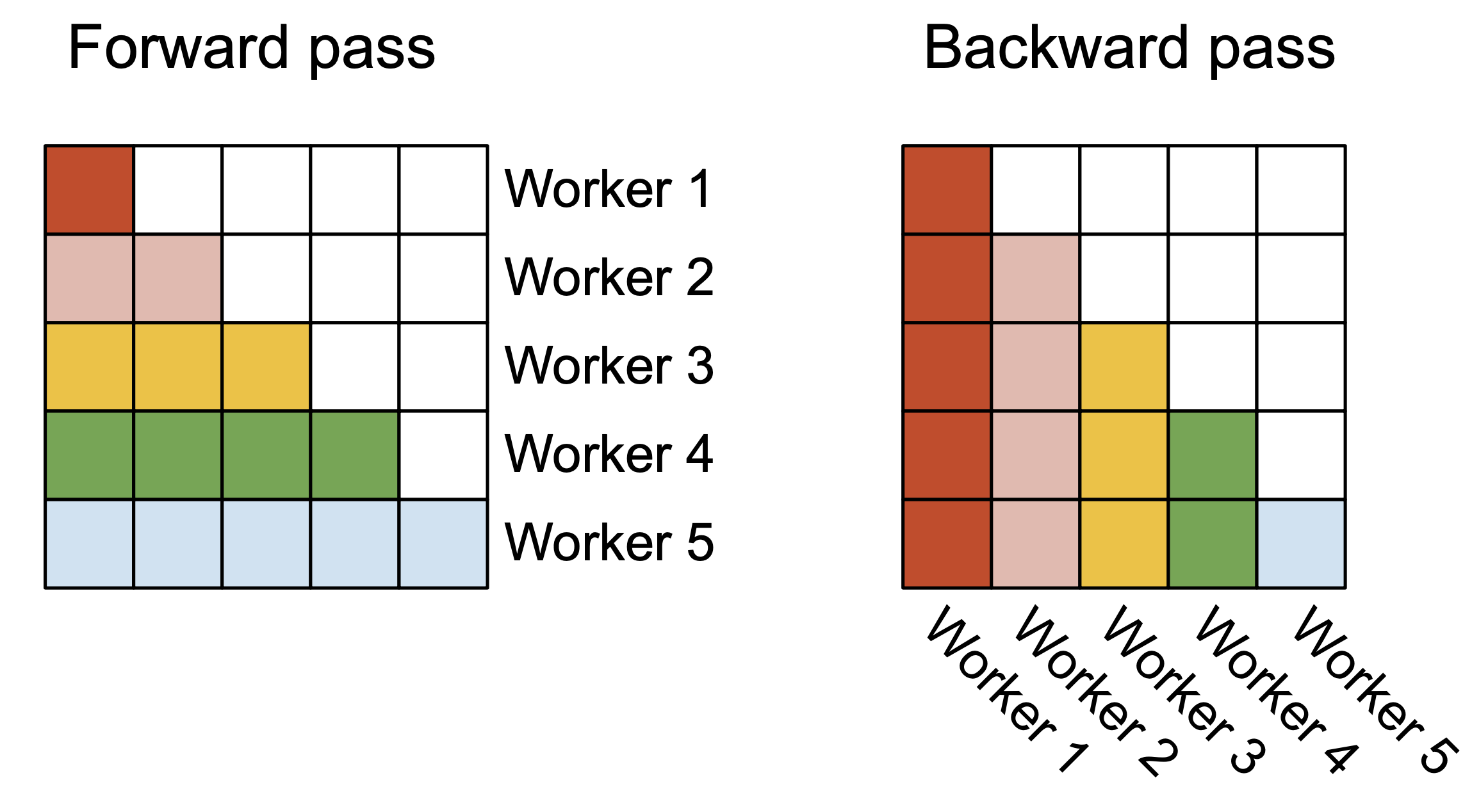
- Work partitioning across sequence length raises occupancy when batch size or head count is small.
- Warp repartitioning avoids split- accumulation and cuts shared-memory reads and writes.
- Algorithmic rescaling changes reduce non-matmul FLOPs without changing exact outputs.
- The kernel extends to head dimension 256, MQA, and GQA.
Method Strengths and Weaknesses
Strengths
- Exact attention, not an approximation.
- Up to 2\times faster than FlashAttention on kernel benchmarks.
- Reaches 225 TFLOPs/s per A100 in GPT training.
- Supports causal, non-causal, MQA, GQA, and head dimension 256.
Weaknesses
- Gains depend on GPU-specific kernel engineering.
- End-to-end speedup is smaller than kernel-level speedup.
- Evaluation centers on A100; cross-hardware portability is unclear.
- The contribution is systems-heavy, not a new modeling capability.
Suggestions from the authors
- Train 16k-context models at the cost of prior 8k-context runs.
- Push exact attention closer to GEMM-level efficiency.
- Extend long-context training to books, high-resolution images, and video.
- Explore new applications unlocked by cheaper long-context Transformers.
Links
Prior Papers
- @vaswaniAttentionAllNeed2017 — introduces the exact scaled dot-product attention kernel that FlashAttention-2 accelerates.
- @daoFlashAttention2022 — immediate predecessor; FlashAttention-2 improves its work partitioning and throughput.
Further Papers
- @chameleonTeam2024 — large multimodal Transformer training benefits directly from faster exact long-context attention.
- @luUnifiedIO2_2024 — broad multimodal sequence modeling overlaps with the same systems bottleneck FlashAttention-2 addresses.