Unified-IO 2: Scaling Autoregressive Multimodal Models with Vision, Language, Audio, and Action
Unified-IO 2: Scaling Autoregressive Multimodal Models with Vision, Language, Audio, and Action
Problem
Framing
Prior multimodal autoregressive models cover at most two modalities or specialize to narrow task families. Unified-IO 2 closes this gap with one encoder–decoder model that ingests and generates text, images, audio, and actions through a shared discrete-token interface.
Currently Used Methods
Foundational
- @wuNExTGPT2023 — multimodal instruction-tuned generator with text, image, and audio outputs.
- Limitation in context: lacks a unified four-modality pretraining and action interface.
- @alayracFlamingo2022 — few-shot vision-language model with strong interleaved image-text understanding.
- Limitation in context: understanding-heavy design, not a unified multimodal generator.
- @liBLIP2_2023 — bridges frozen vision encoders to language models efficiently.
- Limitation in context: does not natively generate images, audio, or actions.
- @rameshDALLE2021 — autoregressive text-to-image generation with discrete visual tokens.
- Limitation in context: image generation only, without cross-modal generality.
- @raffelT5_2020 — text-to-text encoder–decoder scaling recipe for multitask transfer.
- Limitation in context: text-only abstraction misses multimodal tokenization and decoding.
Proposed Method
Architecture
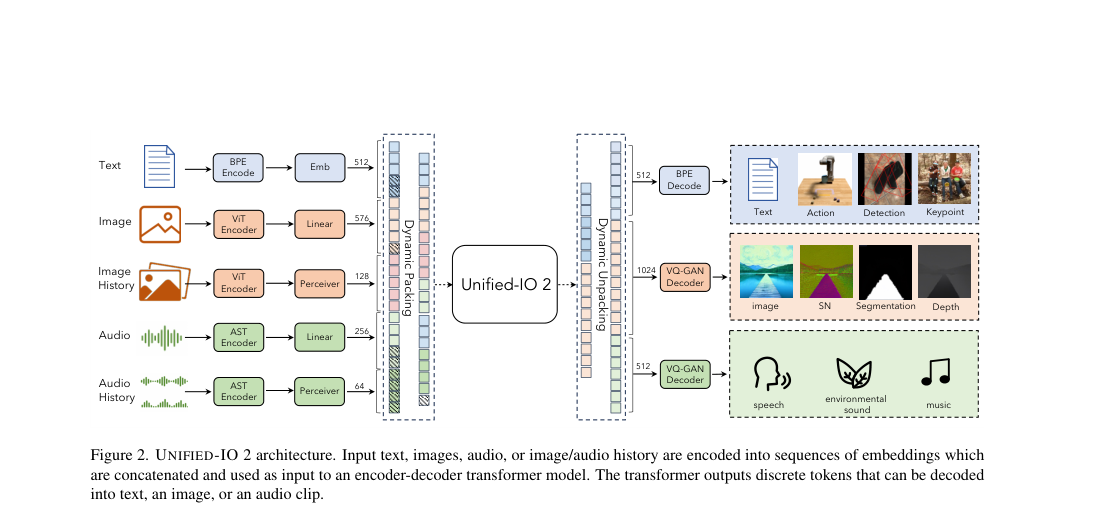
Text passes through BPE embeddings. Images use a ViT encoder, audio uses an AST encoder, and image/audio history use Perceiver resamplers before concatenation into one encoder sequence. A shared encoder–decoder transformer emits discrete tokens, then modality-specific decoders map them to text, image, audio, or action outputs.
Loss / Objective
Training uses standard autoregressive next-token prediction over the target token sequence.
Algorithm
Inference autoregressively decodes modality-specific discrete tokens conditioned on the packed multimodal input.
Training Procedure
- Batch size: 512
- Model sizes: 1.1B, 3.2B, 6.8B parameters
- Optimizer: Adam-style with
- Second moment:
- Packing: dynamic packing for multimodal sequences
- Image input pretraining size:
- Audio sample rate: Hz
Evaluation
Datasets
- Vision-language: VQAv2, OKVQA, ScienceQA, Tally-QA, RefCOCO, RefCOCO+, RefCOCO-g, COCO Caption, POPE, SEED, MMB
- Video/audio: Kinetics-400, MSR-VTT, MSVD-QA, SEED-T, VGG-Sound, AudioCaps
- Action: robotic manipulation benchmarks including VIMA-style tasks
Metrics
- Accuracy / Exact Match for QA and classification
- CIDEr for captioning
- Task success or normalized scores for action tasks
- FID and TIFA for generative image evaluation
Headline results
- VQAv2: UIO-2XXL 79.4, UIO-2XL 78.1, UIO-2L 75.3
- OKVQA: UIO-2XXL 55.5, UIO-2XL 53.7, UIO-2L 50.2
- ScienceQA: UIO-2XL 88.8, UIO-2XXL 88.7
- RefCOCO-g: UIO-2XXL 86.6, UIO-2XL 84.0, UIO-2L 79.0
- MMB: UIO-2XXL 71.5, UIO-2XL 68.1, UIO-2L 62.1
Table 4: Vision-language generalist comparison across question answering, referring expression, captioning, hallucination, and multimodal benchmarks.
| Method | VQAv2 | OKVQA | SQA | SQAI | Tally-QA | RefCOCO | RefCOCO+ | RefCOCO-g | COCO-Cap. | POPE | SEED | MMB |
|---|---|---|---|---|---|---|---|---|---|---|---|---|
| InstructBLIP (8.2B) | - | - | - | 79.5 | 68.2† | - | - | - | 102.2 | - | 53.4 | 36 |
| Shikra (7.2B) | 77.4 | 47.2 | - | - | - | 87.0 | 81.6 | 82.3 | 117.5 | 84.7 | - | 58.8 |
| Ferret (7.2B) | - | - | - | - | - | 87.5 | 80.8 | 83.9 | - | 85.8 | - | - |
| Qwen-VL (9.6B) | 78.8 | 58.6 | - | 67.1* | - | 89.4 | 83.1 | 85.6 | 131.9 | - | - | 38.2 |
| mPLUG-Owl2 (8.2B) | 79.4 | 57.7 | - | 68.7* | - | - | - | - | 137.3 | 86.2 | 57.8 | 64.5 |
| LLaVa-1.5 (7.2B) | 78.5 | - | - | 66.8* | - | - | - | - | - | 85.9 | 58.6 | 64.3 |
| LLaVa-1.5 (13B) | 80.0 | - | - | 71.6* | 72.4† | - | - | - | - | 85.9 | 61.6 | 67.7 |
| Single Task SoTA | 86.0 [29] | 66.8 [77] | 90.9 [119] | 90.7 [34] | 82.4 [77] | 92.64 [202] | 88.77 [187] | 89.22 [187] | 149.1 [29] | - | - | - |
| UIO-2L (1.1B) | 75.3 | 50.2 | 81.6 | 78.6 | 69.1 | 84.1 | 71.7 | 79.0◇ | 128.2 | 77.8 | 51.1 | 62.1 |
| UIO-2XL (3.2B) | 78.1 | 53.7 | 88.8 | 87.4 | 72.2 | 88.2 | 79.8 | 84.0◇ | 130.3 | 87.2 | 60.2 | 68.1 |
| UIO-2XXL (6.8B) | 79.4 | 55.5 | 88.7 | 86.2 | 75.9 | 90.7 | 83.1 | 86.6◇ | 125.4 | 87.7 | 61.8 | 71.5 |
Ablations
- Modality mixture: balanced mixtures reduce loss and stabilize gradient norms.
- Scale: larger models improve next-token accuracy across modalities.
- Packing: dynamic packing supports efficient large-batch multimodal pretraining.
- Image modeling paradigm: the paper compares autoregressive, masked, and diffusion-style choices.
Method Strengths and Weaknesses
Strengths
- One token interface spans text, image, audio, and action generation.
- Scale helps consistently: 6.8B beats 1.1B on most reported multimodal benchmarks.
- Strong breadth: one model handles QA, captioning, grounding, audio, and robotics.
- Shared architecture reuses standard encoder–decoder machinery across modalities.
Weaknesses
- Still trails single-task specialists by large margins on several benchmarks.
- Autoregressive decoding over visual and audio tokens is computationally expensive.
- Performance is uneven across tasks; COCO captioning drops from XL to XXL.
- System complexity is pushed into tokenizers, resamplers, and modality-specific decoders.
Suggestions from the authors
- Improve modality balancing during large-scale multimodal pretraining.
- Expand instruction tuning coverage for harder cross-modal reasoning tasks.
- Strengthen action modeling and embodied control beyond current benchmark settings.
- Refine image and audio generation tokenizers for higher-fidelity outputs.
Links
Prior Papers
- @wuNExTGPT2023 — Another unified multimodal generative model spanning text, image, and audio, serving as a direct antecedent.
- @alayracFlamingo2022 — A strong multimodal generalist baseline for interleaved visual-language understanding.
- @liBLIP2_2023 — Relevant as an efficient vision-language connector design that contrasts with full end-to-end unification.
- @rameshDALLE2021 — Important precursor for autoregressive generation over discrete image tokens.
- @raffelT5_2020 — Encoder–decoder transfer and scaling recipe underlying the model family design.
Further Papers
- @chameleonTeam2024 — Another 2024 large multimodal autoregressive model with closely overlapping unification goals.