NExT-GPT: Any-to-Any Multimodal LLM
NExT-GPT: Any-to-Any Multimodal LLM
Problem
Framing
Multimodal LLMs mostly stop at understanding or call external generators in a brittle cascade. NExT-GPT closes this gap by aligning one LLM to both multimodal encoders and diffusion decoders, enabling any-to-any input and output with only about 1% trainable parameters.
Currently Used Methods
Direct antecedents
- @brownGPT3_2020 — large language modeling establishes the central autoregressive reasoning backbone.
- Limitation in context: text-only pretraining cannot ingest or emit image, audio, or video.
- @alayracFlamingo2022 — cross-attention adapters connect frozen visual encoders to frozen LLMs.
- Limitation in context: focuses on perception; it does not natively generate multimodal outputs.
- @liBLIP2_2023 — Q-Former aligns frozen vision encoders with frozen LLMs efficiently.
- Limitation in context: one-way image-to-text bridging, not unified any-to-any generation.
- @radfordCLIP2021 — contrastive image-text alignment supplies transferable visual semantics.
- Limitation in context: retrieval-style embeddings are not an instruction-following multimodal interface.
- @rombachLatentDiffusion2022 — latent diffusion gives strong controllable image synthesis backbones.
- Limitation in context: standalone generators lack unified cross-modal reasoning and dialogue control.
Proposed Method
Architecture
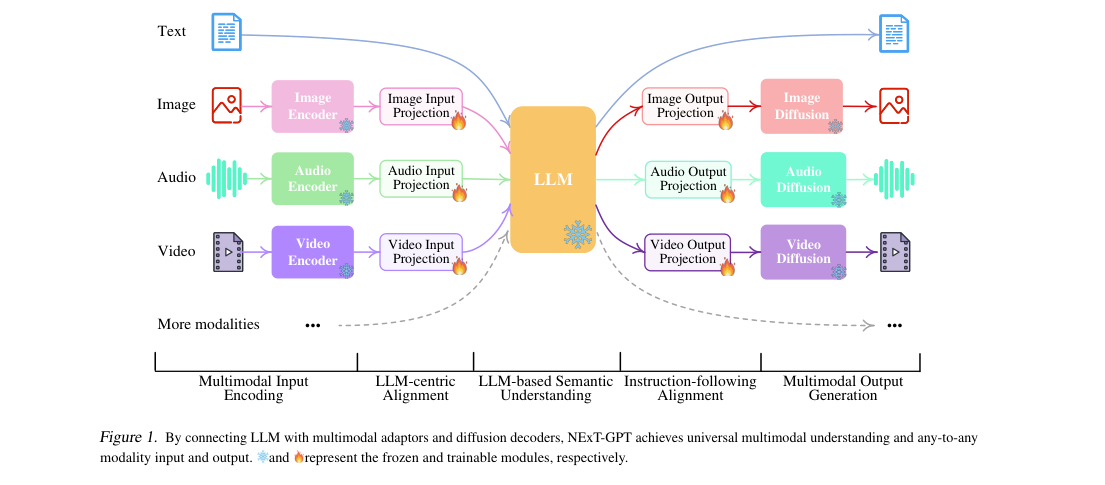
NExT-GPT connects modality encoders, lightweight projection layers, a Vicuna-7B LLM, modality-specific output projectors, and frozen diffusion decoders. Image, audio, and video inputs are encoded by ImageBind; outputs are generated by Stable Diffusion, AudioLDM, and Zeroscope. Only the grouping/projection modules and LoRA adapters are updated.
Loss / Objective
Training uses cross-entropy captioning and instruction-following losses across three stages.
Sampling Rule / Algorithm
Inference maps LLM output representations into modality-specific signal tokens, then invokes the matched diffusion decoder.
Training Procedure
- Three stages: encoding-side alignment, decoding-side alignment, end-to-end instruction tuning.
- Optimizer: Adam.
- Trainable modules: input projections, output projections, LoRA adapters.
- Frozen modules: ImageBind encoder, diffusion U-Nets, most LLM weights.
- LLM: Vicuna-7B with 33M LoRA parameters.
- Input projection: grouping block, 28M parameters.
- Output projections: 31M for image, 31M for audio, 32M for video.
Evaluation
Datasets
- COCO, NoCaps, Flickr30K.
- VQAv2, VizWiz, OKVQA.
- MSRVTT, MSVD-QA, MSRVTT-QA, NExT-QA.
- AudioCaps.
- MMBench, SEED-Bench.
Metrics
- CIDEr, BLEU-4, METEOR.
- Accuracy.
- FID, CLIPSim.
- FD, IS.
- Human evaluation scale.
Headline results
- NoCaps zero-shot captioning: CIDEr 123.7.
- Flickr30K zero-shot captioning: CIDEr 84.5.
- COCO zero-shot captioning: CIDEr 124.9.
- VQAv2 zero-shot QA: 66.7.
- VizWiz / OKVQA zero-shot QA: 48.4 / 52.1.
- MMBench / SEED-Bench: 58.0 / 57.5.
Table 4: Zero-shot multimodal understanding results across image captioning, question answering, and evaluation-only benchmarks.
| Method | LLM | NoCaps | Flickr30K | COCO | VQAv2 | VizWiz | OKVQA | MMB | SEED |
|---|---|---|---|---|---|---|---|---|---|
| NExT-GPT | Vicuna-7B | 123.7 | 84.5 | 124.9 | 66.7 | 48.4 | 52.1 | 58.0 | 57.5 |
Ablations
- Training only caption-style alignment underuses instruction-following ability.
- Decoding-side alignment is required for multimodal generation.
- End-to-end instruction tuning improves complex multi-turn multimodal behavior.
- Grouping-based projection keeps adaptation lightweight at about 1% updated parameters.
Method Strengths and Weaknesses
Strengths
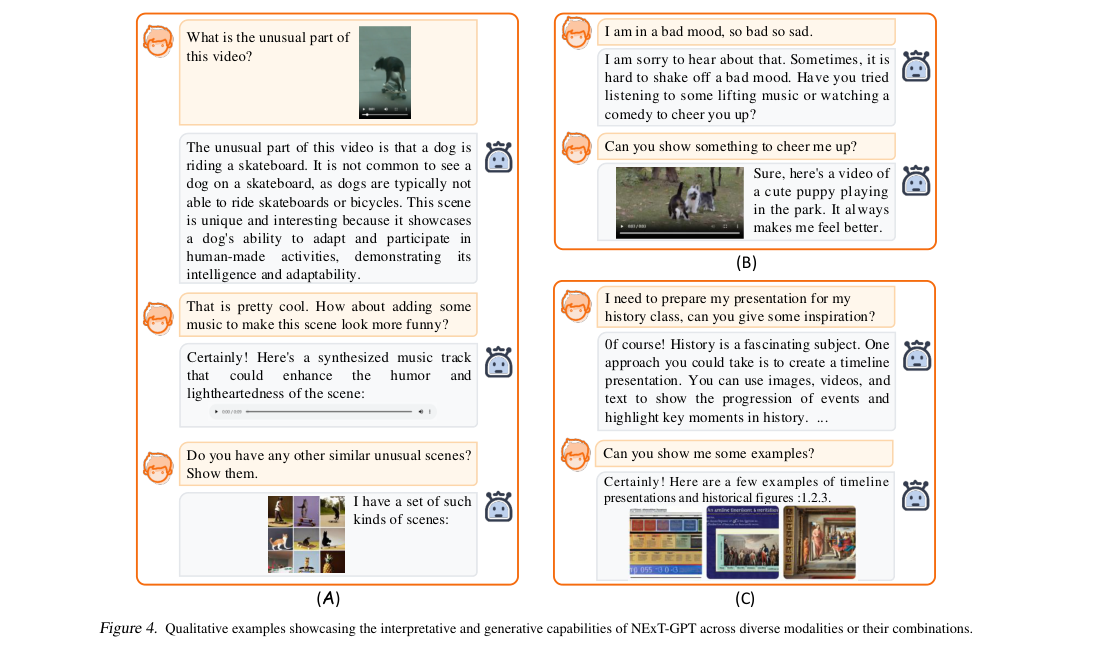
- One LLM handles multimodal understanding and generation in a unified interface.
- Lightweight tuning updates about 1% of parameters.
- Covers image, audio, and video on both input and output sides.
- Strong zero-shot captioning and QA scores across several benchmarks.
Weaknesses
- Generation still depends on separate frozen diffusion backbones.
- Modality coverage excludes tighter token-level joint generation inside the LLM.
- Training requires a staged pipeline, not a single simple objective.
- Video and audio generation quality trails specialized standalone generators.
Suggestions from the authors
- Build richer multimodal instruction-tuning datasets with more modality combinations.
- Reduce error accumulation between LLM planning and downstream generators.
- Improve end-to-end updating across understanding and generation modules.
- Extend the system to more modalities and more complex interactions.
Links
Prior Papers
- @brownGPT3_2020 — establishes the LLM backbone paradigm that NExT-GPT turns into a multimodal hub.
- @alayracFlamingo2022 — an early frozen-LLM multimodal adapter design that NExT-GPT extends toward generation.
- @liBLIP2_2023 — lightweight encoder-to-LLM alignment is a direct precursor to NExT-GPT's projection strategy.
- @radfordCLIP2021 — supplies the aligned visual-semantic representation tradition behind multimodal bridging.
- @rombachLatentDiffusion2022 — provides the diffusion-decoder style that NExT-GPT plugs into its output side.
Further Papers
- @chameleonTeam2024 — pursues tighter multimodal generation with a unified model instead of external modality decoders.
- @luUnifiedIO2_2024 — extends the any-to-any multimodal ambition with a broader unified I/O formulation.