Chameleon: Mixed-Modal Early-Fusion Foundation Models
Chameleon: Mixed-Modal Early-Fusion Foundation Models
Problem
Framing
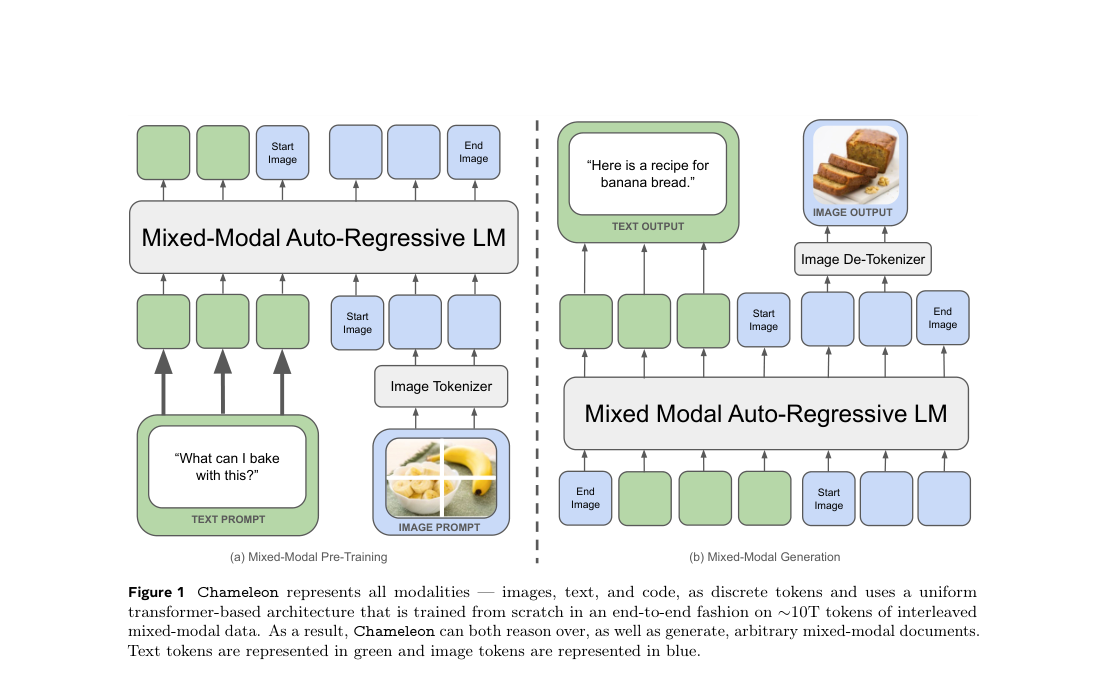
Late-fusion multimodal models still split text and images across separate encoders or decoders, which weakens arbitrary interleaved generation and cross-modal reasoning. Chameleon closes this by tokenizing images into the same autoregressive stream as text and training one transformer end-to-end on mixed-modal data.
Currently Used Methods
Foundational
- @alayracFlamingo2022 — frozen language model with visual resampling for few-shot vision-language tasks.
- Limitation in context: late fusion blocks full mixed-modal token generation.
- @rameshDALLE2021 — autoregressive image generation from discrete visual tokens.
- Limitation in context: not a unified image-text reasoning model.
- @luUnifiedIO2_2024 — unified seq2seq modeling across many perception and language tasks.
- Limitation in context: still relies on modality-specific I/O design.
- @wuNExTGPT2023 — multimodal LLM with external encoders and decoders.
- Limitation in context: separate modules weaken native early fusion.
- @brownGPT3_2020 — large autoregressive transformer for pure text next-token prediction.
- Limitation in context: no native image token stream.
Proposed Method
Architecture
Chameleon maps text and images into one discrete token stream, then runs a LLaMA-2-style autoregressive transformer over the joint sequence. Images are quantized into codebook tokens; the tokenizer uses a 65,536-word BPE vocabulary that includes 8,192 image tokens. Stability comes from QK-normalization and reordered residual norms.
Loss / Objective
Pre-training uses standard autoregressive next-token prediction over mixed text-image sequences.
SFT masks prompt tokens and optimizes only answer tokens.
Algorithm
The main architectural update reorders normalization around the residual branches:
Training Procedure
- Vocabulary size: 65,536, including 8,192 image codebook tokens.
- Optimizer: AdamW with , , .
- Warmup: 4,000 steps.
- LR schedule: exponential decay to .
- Weight decay: .
- Gradient clipping: .
- Dropout: for 7B; none for 34B pre-training.
- Batch size: 7B uses tokens; 34B uses tokens.
- Total training: 2.1 epochs, 9.2T tokens seen.
Evaluation
Datasets
- Text: PIQA, SIQA, HellaSwag, WinoGrande, ARC-E, ARC-C, OBQA, MMLU, GSM8K, MATH.
- Image-to-text: COCO, Flickr30k, VQAv2.
- Human evaluation: mixed-modality and text-only prompt sets against Gemini and GPT-4V variants.
Metrics
- Text benchmarks: accuracy or exact match.
- Captioning: CIDEr.
- VQA: accuracy.
- Human evaluation: task-fulfillment and pairwise win rate.
Headline results
- COCO captioning: Chameleon-MultiTask 139.1 CIDEr.
- Flickr30k captioning: Chameleon-MultiTask 76.2.
- VQAv2: Chameleon-MultiTask 69.6.
- MMLU: Chameleon-34B 70.6.
- PIQA: Chameleon-34B 83.6.
Ablations
- QK-normalization: removing it makes 7B diverge after about 20% of an epoch.
- Dropout: needed for 7B stability, but does not fix 34B divergence.
- Norm reordering: stabilizes 34B where LLaMA-2 ordering diverges.
- Image generation objective: disabling it avoids one instability mode in 34B.
Results figure
Table 4: Training-loss ablation for norm reordering.
| Setting | Outcome |
|---|---|
| w/o norm reordering | Loss becomes unstable with sharp spikes and divergence. |
| w/ norm reordering | Loss decays smoothly and remains stable. |
Method Strengths and Weaknesses
Strengths
- One token stream supports arbitrary text-image interleaving.
- Strong image-to-text results: 139.1 COCO CIDEr after multitask SFT.
- Text ability stays competitive: 70.6 MMLU at 34B.
- Stability recipe is concrete: QK-norm plus norm reordering.
Weaknesses
- Training stability is fragile without bespoke normalization changes.
- Image tokenization adds a learned bottleneck before generation.
- VQAv2 score 69.6 trails the strongest specialist systems.
- 34B training cost is high: 9.2T tokens seen.
Suggestions from the authors
- Improve identification and reasoning failure modes in human evaluation.
- Push alignment methods tailored to mixed-modal generation.
- Extend efficient inference for interleaved autoregressive decoding.
- Study scaling laws for early-fusion mixed-modal training.
Links
Prior Papers
- @luUnifiedIO2_2024 — another unified multimodal model, useful for contrasting early fusion against broader task-unification designs.
- @wuNExTGPT2023 — representative modular multimodal LLM that Chameleon departs from with end-to-end early fusion.
- @alayracFlamingo2022 — strong late-fusion baseline for image-conditioned text generation.
- @rameshDALLE2021 — antecedent for discrete visual-token autoregressive generation.
- @brownGPT3_2020 — text-only autoregressive transformer baseline that Chameleon extends to mixed-modal tokens.
Further Papers
- @luUnifiedIO2_2024 — closely related 2024 multimodal foundation model for comparison on unified modeling choices.
- @jiangMixtral2024 — useful text-only contemporary baseline because Chameleon claims competitive unimodal language performance.