Mixtral of Experts
Mixtral of Experts
Problem
Framing
Dense decoder LMs trade quality for inference cost: matching 70B-class performance usually requires activating 70B-class parameters on every token. Mixtral closes this gap with top-2 sparse MoE feedforward blocks, giving each token access to 47B parameters while activating only 13B, and still reaching 70.6% MMLU plus 58.4% GSM8K.
Currently Used Methods
Foundational
- @vaswaniAttentionAllNeed2017 — decoder transformer backbone for autoregressive language modeling.
- Limitation in context: dense FFNs activate all parameters for every token.
- @fedusSwitchTransformer2021 — sparse expert routing to raise parameter count cheaply.
- Limitation in context: top-1 routing drops expert diversity per token.
- @brownGPT3_2020 — large dense scaling improves few-shot language performance.
- Limitation in context: serving cost scales with total parameter count.
- @hoffmannChinchilla2022 — compute-optimal dense scaling laws for transformers.
- Limitation in context: scaling remains dense, so inference stays expensive.
- @chameleonTeam2024 — competitive open multimodal MoE-style scaling in a large foundation model.
- Limitation in context: not a compact open text-only 8x7B serving point.
Proposed Method
Architecture
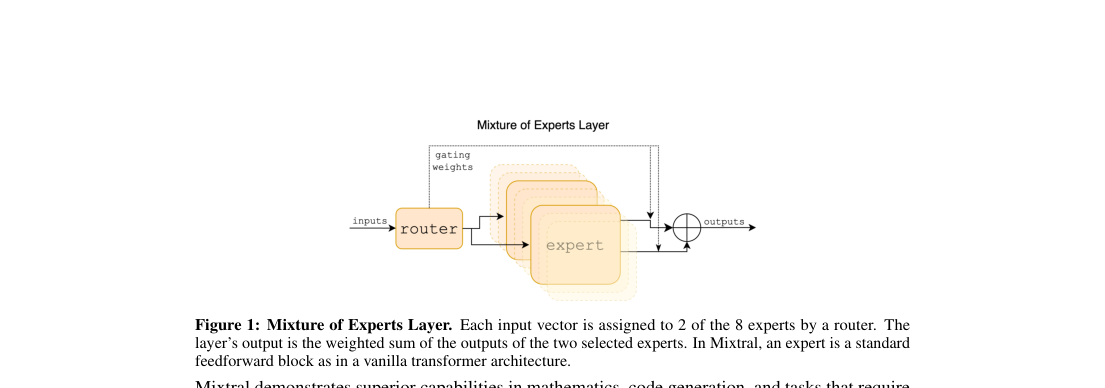
Mixtral keeps the Mistral decoder stack and replaces every FFN with an 8-expert MoE layer. The model uses 32 layers, , hidden size , 32 attention heads, 8 KV heads, and context length . Each token is routed to 2 experts, so compute stays near a 13B dense model while total parameters rise to 47B.
Loss / Objective
The MoE block replaces the dense FFN with sparse gated expert aggregation:
Sampling Rule / Algorithm
Autoregressive decoding uses the standard next-token factorization over the sparse decoder:
Training Procedure
- Context length:
- Layers:
- Model dimension:
- Hidden dimension per expert:
- Attention heads:
- KV heads:
- Experts per layer:
- Active experts per token:
Evaluation
Datasets
- Reasoning: MMLU, HellaSwag, ARC Challenge, Winogrande, PIQA, SIQA, OpenBookQA, CommonsenseQA
- World knowledge: NaturalQuestions, TriviaQA
- Reading comprehension: BoolQ, QuAC
- Math: GSM8K, MATH
- Code: HumanEval, MBPP
- Multilingual: French, German, Spanish, Italian variants of ARC-c, HellaSwag, MMLU
- Long context: passkey retrieval, proof-pile perplexity
- Instruction following: MT-Bench, LMSys human eval
- Bias: BBQ, BOLD
Metrics
- Accuracy for classification and QA benchmarks
- pass@1 for HumanEval and MBPP
- maj@8 for GSM8K
- maj@4 for MATH
- Retrieval accuracy for passkey task
- Perplexity on proof-pile
- MT-Bench score for instruct models
Headline results
- MMLU: 70.6%
- ARC Challenge: 85.8%
- MBPP (pass@1): 60.7%
- GSM8K (maj@8): 58.4%
- MT-Bench, Instruct: 8.30
- Passkey retrieval: 100% accuracy across tested context lengths and positions
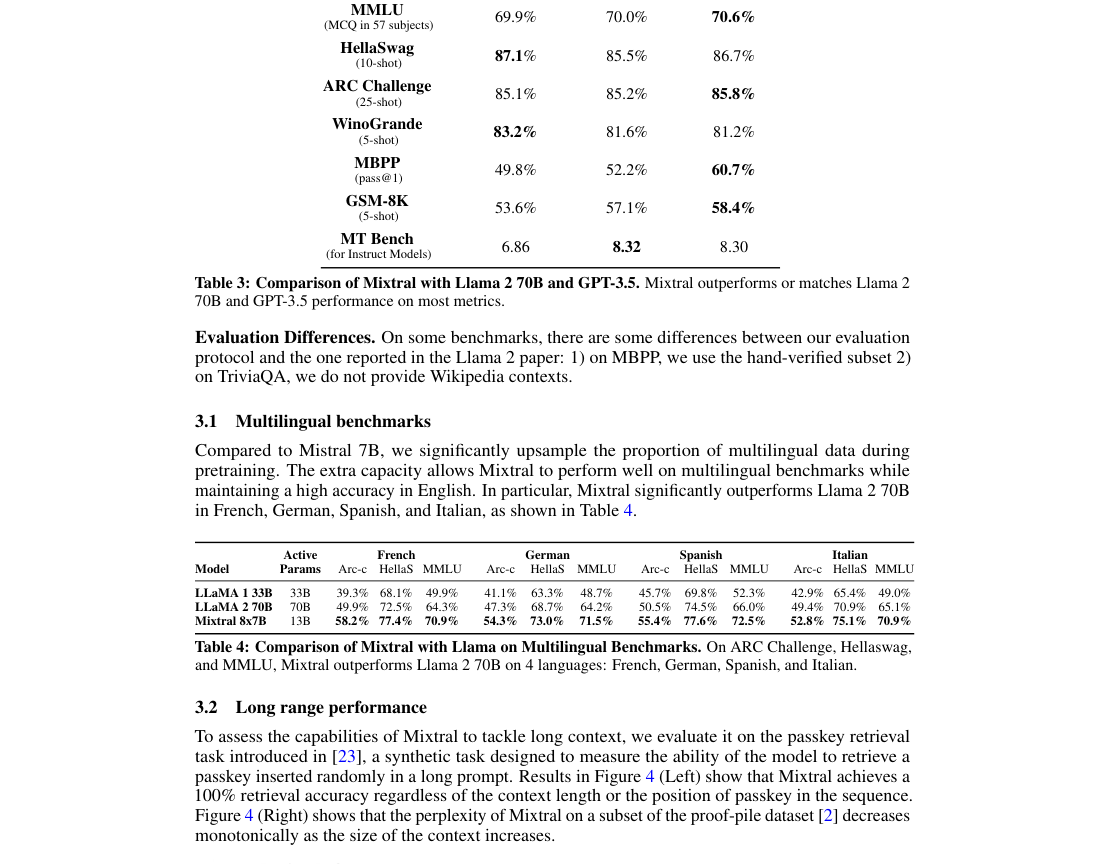
Table 1: Comparison of Mixtral with Llama 2 70B and GPT-3.5
| Benchmark | Llama 2 70B | GPT-3.5 | Mixtral 8x7B |
|---|---|---|---|
| MMLU (MCQ in 57 subjects) | 69.9% | 70.0% | 70.6% |
| HellaSwag (10-shot) | 87.1% | 85.5% | 86.7% |
| ARC Challenge (25-shot) | 85.1% | 85.2% | 85.8% |
| WinoGrande (5-shot) | 83.2% | 81.6% | 81.2% |
| MBPP (pass@1) | 49.8% | 52.2% | 60.7% |
| GSM-8K (5-shot) | 53.6% | 57.1% | 58.4% |
| MT Bench (for Instruct Models) | 6.86 | 8.32 | 8.30 |
Ablations
- Context position in passkey retrieval: accuracy stays at 100%.
- Context length in passkey retrieval: accuracy stays at 100%.
- Longer proof-pile context: perplexity decreases monotonically.
- Multilingual data upsampling: gains appear across French, German, Spanish, and Italian benchmarks.
Method Strengths and Weaknesses
Strengths
- 13B active parameters still beat Llama 2 70B on MMLU, ARC-c, MBPP, and GSM8K.
- Top-2 routing preserves expert diversity without dense 47B compute.
- 32k context is usable, with 100% passkey retrieval.
- Apache 2.0 release makes the model practically reusable.
Weaknesses
- WinoGrande trails Llama 2 70B: 81.2% versus 83.2%.
- HellaSwag also trails Llama 2 70B: 86.7% versus 87.1%.
- MT-Bench slightly trails GPT-3.5 for instruct tuning: 8.30 versus 8.32.
- Training recipe details are sparse, which limits reproducibility.
Suggestions from the authors
- Study expert specialization across domains and layers.
- Optimize expert-parallel serving under router locality and load imbalance.
- Leverage routing locality for caching during training and inference.
- Correct residual bias and sentiment issues with stronger preference tuning.
Links
Prior Papers
- @fedusSwitchTransformer2021 — establishes sparse expert routing, the direct architectural precedent for Mixtral's MoE FFN replacement.
- @vaswaniAttentionAllNeed2017 — provides the transformer decoder backbone that Mixtral keeps outside the FFN blocks.
- @brownGPT3_2020 — serves as a dense large-model baseline for capability versus inference-cost tradeoffs.
- @hoffmannChinchilla2022 — frames dense scaling efficiency, which Mixtral challenges with sparse activation.
- @chameleonTeam2024 — another vault MoE-related foundation model relevant to sparse scaling comparisons.
Further Papers
- @shaoGRPO2024 — later open LLM work on post-training and alignment that can build on Mixtral-class backbones.
- @luUnifiedIO2_2024 — contemporary multimodal scaling work that intersects with efficient large-model design.
- @chameleonTeam2024 — overlapping 2024 foundation-model scaling paper with adjacent MoE and deployment concerns.