DeepSeekMath: Pushing the Limits of Mathematical Reasoning in Open Language Models
DeepSeekMath: Pushing the Limits of Mathematical Reasoning in Open Language Models
Problem
Framing
Open open-source LLMs lag badly on competition math, and PPO-style RL adds a full value model that inflates memory cost. DeepSeekMath closes both gaps with 120B curated math tokens and GRPO, a critic-free PPO variant. The 7B RL model reaches 51.7% on MATH, rising to 60.9% with 64-sample self-consistency.
Currently Used Methods
Foundational
- @brownGPT3_2020 — large-scale autoregressive pretraining establishes few-shot language modeling.
- Limitation in context: generic web data leaves math reasoning far below specialist systems.
- @weiCoT2022 — chain-of-thought supervision elicits multi-step reasoning traces.
- Limitation in context: supervision alone does not close the competition-math gap.
- @schulmanPPO2017 — clipped policy optimization becomes the standard RLHF optimizer.
- Limitation in context: actor-critic training doubles model memory with a value network.
- @ouyangInstructGPT2022 — instruction tuning plus PPO aligns language models to preferences.
- Limitation in context: preference RL is not specialized for math correctness signals.
- @rafailovDPO2023 — preference optimization removes online rollout and critic training.
- Limitation in context: offline pairwise updates weaken exploration on hard reasoning tasks.
Proposed Method
Architecture
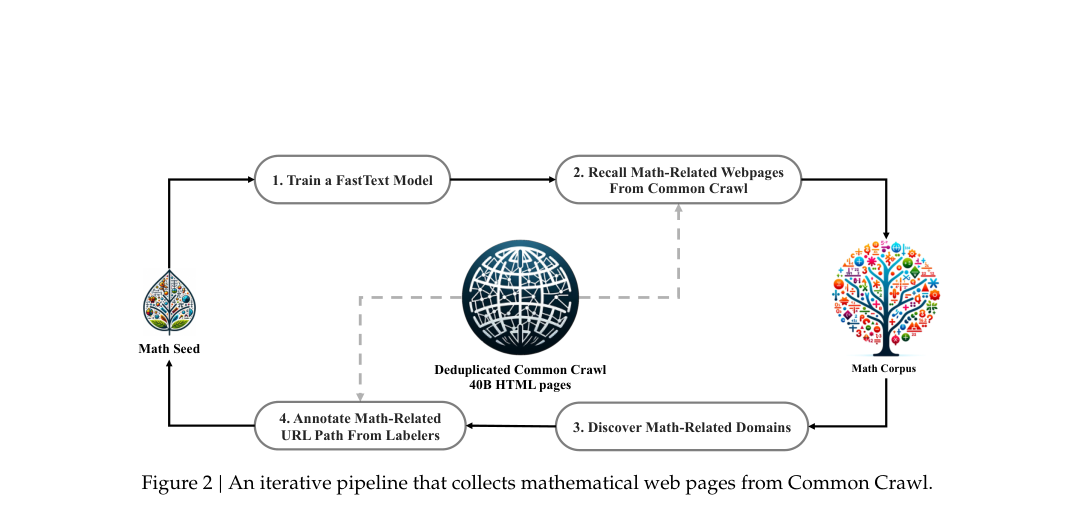
The system has three stages: continual pretraining from DeepSeek-Coder-Base-v1.5 7B, mathematical instruction tuning, then RL with GRPO. The data pipeline iteratively trains a fastText retriever, mines Common Crawl, discovers math-heavy domains, and expands the seed set to 35.5M pages and 120B tokens.
Loss / Objective
GRPO replaces PPO's learned baseline with group-relative normalization over sampled completions.
Sampling Rule / Algorithm
Each prompt draws a group of completions from the old policy, scores them, normalizes rewards within the group, then updates the policy with clipped ratios and a KL penalty.
Training Procedure
- Continual pretraining: 500B tokens.
- Math corpus: 120B tokens from 35.5M web pages.
- Continual pretraining mix: 56% DeepSeekMath, 4% AlgebraicStack, 10% arXiv, 20% code, 10% natural language.
- Context length: 4K.
- SFT: 500 steps.
- SFT batch size: 256.
- SFT learning rate: .
- RL data: about 144K GSM8K and MATH questions.
Evaluation
Datasets
- English math: GSM8K, MATH, SAT, OCW, MMLU-STEM.
- Chinese math: MGSM-zh, CMATH, Gaokao-MathCloze, Gaokao-MathQA.
- General reasoning: BBH, MMLU.
- Coding: HumanEval, MBPP.
- Formal math: miniF2F with Isabelle.
Metrics
- Accuracy for benchmark question answering.
- Top1 accuracy for single-sample decoding.
- Self-consistency / majority vote at larger sample counts.
- Pass@K and Maj@K for sampling analyses.
Headline results
- MATH, DeepSeekMath-RL 7B: 51.7% Top1.
- MATH, DeepSeekMath-RL 7B with 64-sample self-consistency: 60.9%.
- GSM8K, RL gain over instruct: 82.9% → 88.2%.
- MATH, RL gain over instruct: 46.8% → 51.7%.
- CMATH, RL gain over instruct: 84.6% → 88.8%.
Ablations
- Math-corpus choice: DeepSeekMath Corpus dominates MathPile, OpenWebMath, and Proof-Pile-2 across GSM8K, MATH, CMATH, and BBH.
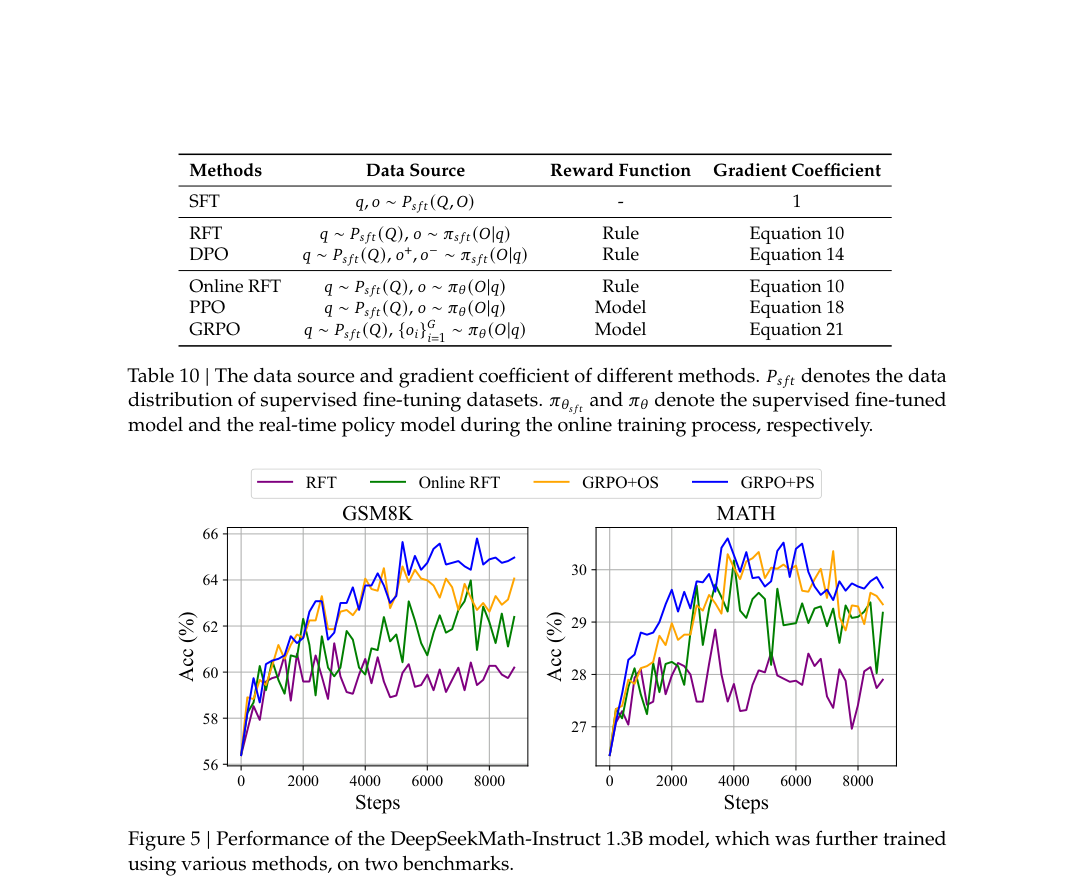
- Online vs offline RL: online variants outperform offline RFT as training proceeds.
- Outcome vs process supervision: GRPO with process supervision is competitive but not uniformly superior.
- Iterative RL: refreshing reward models during training improves late-stage benchmark accuracy.
Method Strengths and Weaknesses
Strengths
- Strong data curation: 120B math tokens let a 7B base rival far larger math models.
- GRPO removes the value model, cutting PPO-style memory overhead.
- RL improves both in-domain and out-of-domain math benchmarks.
- Unified view of SFT, RFT, DPO, PPO, and GRPO clarifies design tradeoffs.
Weaknesses
- Gains rely on a trained reward model, which can drift as policy outputs change.
- RL uses only about 144K math questions, narrowing supervision diversity.
- Performance still trails top closed models on MATH.
- The paper mixes two contributions, making GRPO's standalone impact harder to isolate.
Suggestions from the authors
- Improve reward-model generalization to out-of-distribution questions and stronger decoded solutions.
- Study iterative reward-model updates as policy distributions shift during RL.
- Design richer process-level rewards for long mathematical derivations.
- Explore better combinations of data source, algorithm, and reward function in the unified RL paradigm.
Links
Prior Papers
- @brownGPT3_2020 — establishes large-scale autoregressive pretraining as the base recipe DeepSeekMath specializes.
- @weiCoT2022 — provides chain-of-thought supervision used in the instruction-tuning stage.
- @schulmanPPO2017 — supplies the clipped policy objective that GRPO modifies by removing the critic.
- @ouyangInstructGPT2022 — anchors RL fine-tuning of LLMs with PPO and reward models.
- @rafailovDPO2023 — serves as a comparison point in the paper's unified view of post-SFT optimization.
Further Papers
No vault papers identified as further work yet.