Direct Preference Optimization: Your Language Model is Secretly a Reward Model
Direct Preference Optimization: Your Language Model is Secretly a Reward Model
Problem
Framing
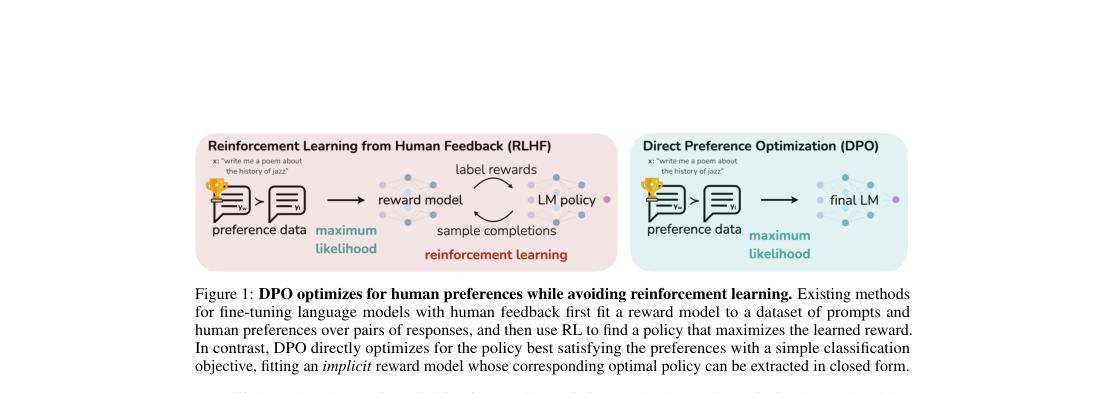
RLHF alignment needs a reward model, on-policy sampling, and PPO tuning. DPO removes that stack by reparameterizing the KL-constrained reward objective as a single preference-classification loss. On TL;DR, it reaches about 61% GPT-4 win rate, above PPO's 57%.
Currently Used Methods
Foundational
- @christianoRLHF2017 — preference learning via reward modeling plus reinforcement learning.
- Limitation in context: two-stage pipeline adds reward-model error and RL instability.
- @schulmanPPO2017 — clipped policy-gradient optimization for constrained policy improvement.
- Limitation in context: needs rollout sampling and sensitive KL-target tuning.
- @ouyangInstructGPT2022 — large-scale RLHF for instruction-following language models.
- Limitation in context: alignment still depends on separate reward fitting and PPO engineering.
Proposed Method
Architecture
DPO keeps the standard causal LM policy and a frozen reference policy . The only new ingredient is a preference dataset and a classifier-style objective over sequence log-probability ratios.
Loss / Objective
The paper optimizes preferred responses against rejected responses through the policy-relative log-ratio:
Sampling Rule / Algorithm
Its key change-of-variables gives the optimal policy for a reward under a KL penalty:
Training Procedure
- by default.
- TL;DR uses .
- Batch size: 64.
- Optimizer: RMSprop.
- Learning rate: .
- Linear warmup: 150 steps.
Evaluation
Datasets
- IMDb sentiment generation.
- Reddit TL;DR summarization with human preferences.
- Anthropic Helpful-Harmless single-turn dialogue.
- CNN/DailyMail for out-of-distribution summarization.
Metrics
- Reward versus frontier.
- GPT-4 win rate against baseline summaries or responses.
- Human agreement with GPT-4 judgments.
Headline results
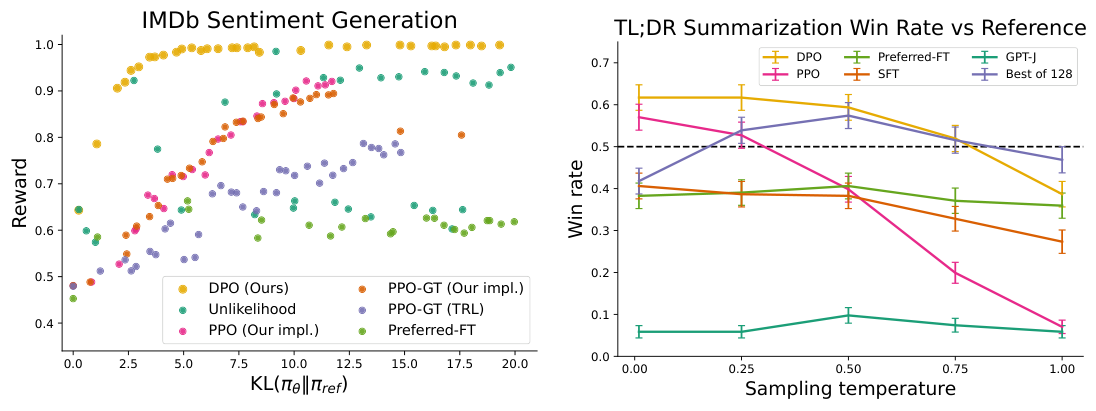
- IMDb sentiment: DPO gives the best reward-KL frontier, beating PPO and PPO-GT.
- TL;DR summarization: about 61% win rate at temperature 0.0; PPO peaks near 57%.
- Anthropic-HH dialogue: DPO is the only efficient method that beats chosen responses.
- CNN/DailyMail OOD: DPO 0.36 win rate at temp 0, PPO 0.26.
- TL;DR human eval: DPO samples beat PPO samples 58% of the time.
Ablations
- Sampling temperature: DPO is more robust than PPO on TL;DR.
- Conservativeness parameter: DPO sweeps and still dominates PPO.
- Distribution shift: DPO transfers better than PPO from Reddit to CNN/DailyMail.
- Evaluation prompt: concise GPT-4 prompting matches human judgments better.
Method Strengths and Weaknesses
Strengths
- Replaces reward-model fitting and PPO with one closed-form objective.
- Beats PPO on TL;DR: 61% versus 57% win rate.
- Dominates PPO and PPO-GT on the reward-KL frontier.
- Stays strong under distribution shift: 0.36 versus 0.26 on CNN/DailyMail.
Weaknesses
- Still needs pairwise preference data .
- Depends on a frozen reference policy and tuned .
- Main large-scale evaluations rely on GPT-4 win rates.
- Dialogue comparison lacks a strong reproduced PPO baseline.
Suggestions from the authors
- Extend DPO beyond binary preferences to richer ranking feedback.
- Study broader preference models beyond Bradley-Terry.
- Test larger language models and more alignment tasks.
- Analyze generalization and robustness under larger distribution shifts.
Links
Prior Papers
- @christianoRLHF2017 — establishes the preference-learning and reward-modeling template that DPO simplifies.
- @schulmanPPO2017 — provides the PPO optimizer that DPO replaces in RLHF pipelines.
- @ouyangInstructGPT2022 — exemplifies the modern LM alignment stack of SFT, reward modeling, and PPO.
Further Papers
- @shaoGRPO2024 — another preference-optimization method for post-training LMs without standard PPO-style RLHF.