Inductive Representation Learning on Large Graphs
hamiltonGraphSAGE2017
Problem
Framing
Most node-embedding methods were transductive: they optimized one vector per node and could not infer embeddings for unseen nodes or new graphs. GraphSAGE closes this gap by learning neighborhood aggregation functions over node features, then applying them inductively at test time. On unseen-node classification, it reports up to 0.954 micro-F1 on Reddit.
Currently Used Methods
Foundational
- @kipfGCN2017 — graph convolutions for semi-supervised node prediction on fixed graphs.
- Limitation in context: tied to transductive training and simple neighborhood averaging.
- DeepWalk — random-walk embeddings with per-node latent vectors.
- Limitation in context: unseen nodes need fresh optimization and cannot align across graphs.
- node2vec — biased random walks for flexible neighborhood similarity.
- Limitation in context: still learns node identities, not an inductive embedding function.
- LINE: Large-scale Information Network Embedding — scalable proximity-preserving graph embeddings.
- Limitation in context: depends on fixed-node embeddings and misses feature-based generalization.
- Planetoid — neural prediction with graph context and node features.
- Limitation in context: adaptations to unseen nodes remain computationally expensive.
Proposed Method
Architecture
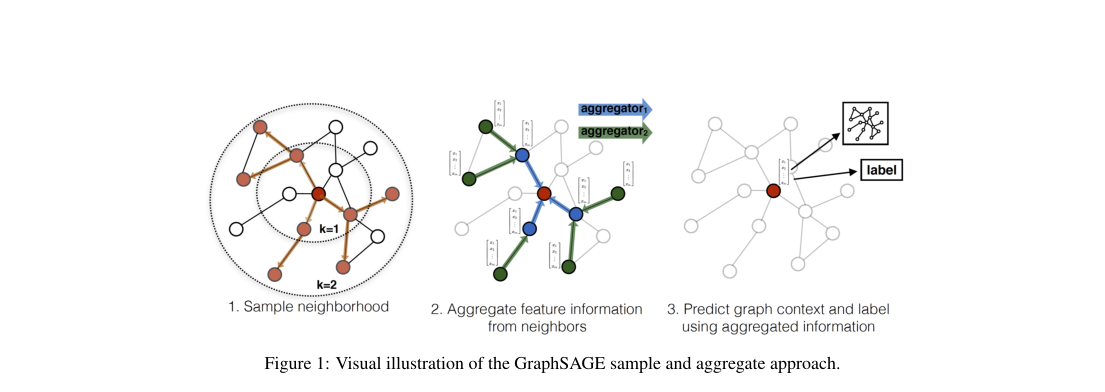
GraphSAGE learns hop-specific aggregators. At layer , node samples neighbors, aggregates their previous-layer states, concatenates that summary with its own state, then applies a shared linear map and nonlinearity. The paper studies mean, GCN-style, LSTM, and max-pooling aggregators.
Loss / Objective
The unsupervised objective pulls random-walk neighbors together and pushes sampled negatives apart.
Algorithm
Forward propagation alternates neighbor aggregation and node-state updates, then -normalizes the result.
Training Procedure
- Depth: .
- Neighborhood samples: , .
- Nonlinearity: ReLU.
- Optimizer: Adam.
- Training batch size in runtime study: 512.
- Unsupervised context pairs: 50 random walks per node, walk length 5.
- Learning-rate sweep, supervised: .
- Learning-rate sweep, unsupervised: .
Evaluation
Datasets
- Citation: Web of Science, 302,424 nodes, average degree 9.15, six biology fields.
- Reddit: 232,965 posts, average degree 492, 50 subreddits.
- PPI: 24 tissue graphs, average 2,373 nodes per graph, average degree 28.8, 121 labels.
Metrics
- Micro-averaged F1.
- Macro-averaged F1 in supplement.
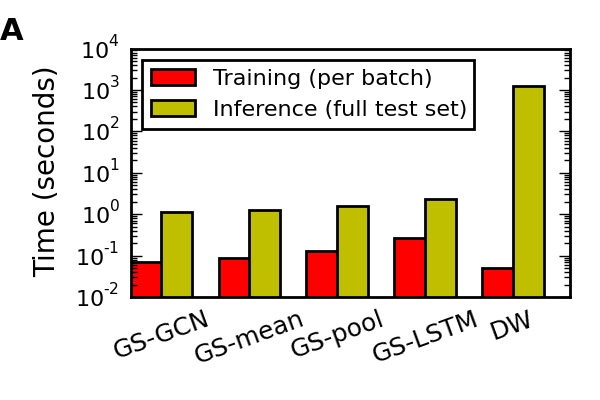
- Runtime in seconds for training batches and full-test inference.
Headline results
- Citation, supervised: GraphSAGE-pool 0.839 micro-F1; best baseline 0.701.
- Citation, unsupervised: GraphSAGE-pool 0.798 micro-F1; best baseline 0.701.
- Reddit, supervised: GraphSAGE-LSTM 0.954 micro-F1; GraphSAGE-mean 0.950.
- Reddit, unsupervised: GraphSAGE-GCN 0.908 micro-F1; DeepWalk + features 0.691.
- PPI, supervised: GraphSAGE-LSTM 0.612 micro-F1; GraphSAGE-pool 0.600.
Ablations
- Aggregator choice: LSTM and pooling beat mean and GCN across most settings.
- Hop count : moving from to adds about 10–15% accuracy.
- Larger : gains shrink to 0–5% while runtime rises by 10–100.
- Neighborhood size: larger samples show diminishing returns.
Results figure
DeepWalk has similar training cost but far slower inductive inference because unseen nodes require new random walks and SGD.
Method Strengths and Weaknesses
Strengths
- Solves unseen-node inference directly by learning an embedding function, not per-node parameters.
- Beats DeepWalk + features on Citation and Reddit by large F1 margins.
- Generalizes across disjoint PPI graphs, where transductive embeddings cannot align.
- Sampling keeps computation bounded while preserving strong accuracy at .
Weaknesses
- Performance depends on informative node or structural features.
- Larger hop depth raises runtime sharply, with only marginal gains beyond .
- LSTM aggregator is about slower than pooling.
- Unsupervised PPI gains are modest: 0.502 micro-F1 with pooling.
Suggestions from the authors
- Design stronger trainable aggregators beyond mean, GCN, LSTM, and pooling.
- Improve scalability with better neighborhood sampling and minibatch schemes.
- Study richer structural-role learning beyond clustering-coefficient-style motifs.
- Optimize GraphSAGE variants for domain-specific tasks such as PPI.
Links
Prior Papers
- @kipfGCN2017 — GraphSAGE extends GCN-style neighborhood aggregation from fixed-graph transduction to inductive embedding generation.
Further Papers
- @velickovicGAT2018 — replaces fixed aggregation with learned attention weights over neighbors, a direct evolution of message aggregation on graphs.