Momentum Contrast for Unsupervised Visual Representation Learning
Momentum Contrast for Unsupervised Visual Representation Learning
Problem
Framing
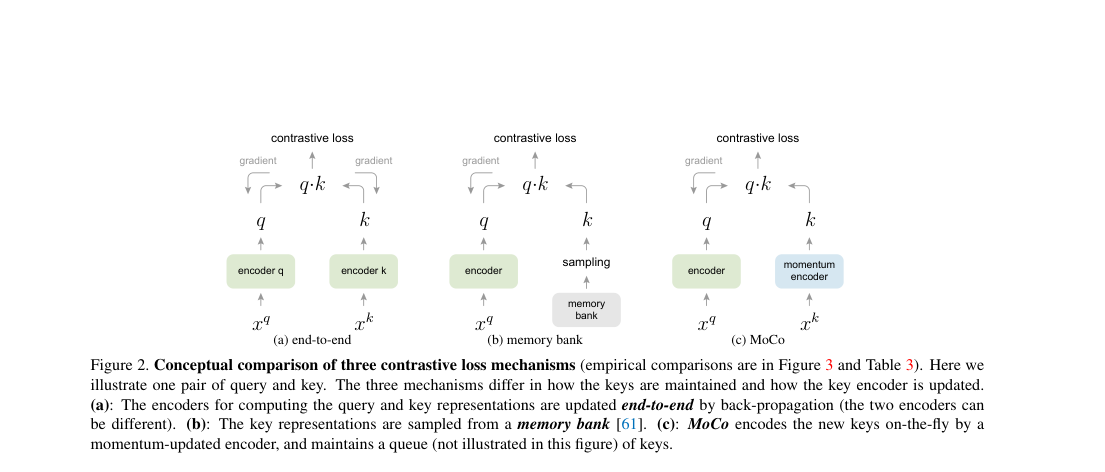
Contrastive visual pretraining faced a trade-off: end-to-end dictionaries were small, while memory banks were stale. MoCo closes it with a queue-based dictionary and a momentum key encoder that keeps many negatives usable without exploding batch size. On ImageNet linear evaluation, ResNet-50 reaches 60.6% top-1.
Currently Used Methods
Foundational
- @heDeepResidualLearning2016 — ResNet supplies the backbone used for all MoCo encoders.
- Limitation in context: architecture alone gives no unsupervised dictionary-learning mechanism.
- @chenSimCLR2020 — large-batch end-to-end contrastive learning with in-batch negatives.
- Limitation in context: dictionary size scales with batch size, raising memory cost sharply.
- "Unsupervised Feature Learning via Non-Parametric Instance Discrimination" — memory-bank contrastive learning with many stored negatives.
- Limitation in context: stored keys become stale as the encoder changes.
- "Contrastive Predictive Coding" — InfoNCE-style contrastive prediction for representation learning.
- Limitation in context: does not solve large, consistent negative dictionaries for vision pretraining.
Proposed Method
Architecture
MoCo uses two encoders with identical architecture: a query encoder and a key encoder . The current mini-batch produces queries and positive keys, while older keys remain in a FIFO queue, so dictionary size is decoupled from batch size.
Loss / Objective
The objective is InfoNCE over one positive key and dictionary negatives.
Sampling Rule / Algorithm
The key encoder evolves by exponential moving average of the query encoder.
Training Procedure
- Backbone: ResNet-50.
- Batch size: 256 on 8 GPUs.
- Epochs: 200 on ImageNet-1M.
- Optimizer: SGD, lr .
- Weight decay: .
- SGD momentum: .
- LR drops: at epochs 120 and 160 by .
- Queue size: .
- Momentum coefficient: .
- Temperature: .
Evaluation
Datasets
- ImageNet-1M linear classification.
- Instagram-1B pretraining transfer.
- PASCAL VOC detection and segmentation.
- COCO detection, instance segmentation, and keypoint detection.
Metrics
- ImageNet: top-1 linear classification accuracy.
- Detection: , , .
- Instance segmentation: , , .
- Keypoints: , , .
Headline results
- ImageNet linear, ResNet-50, 200 epochs: 60.6% top-1.
- ImageNet linear, larger queue : 60.4% top-1.
- VOC/COCO transfer: MoCo beats supervised pretraining on 7 detection/segmentation tasks.
- COCO keypoints: MoCo remains slightly below supervised pretraining.
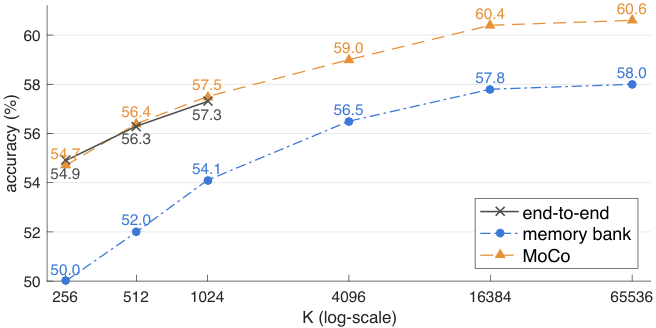
Table 3: Scaling ImageNet linear accuracy against model size, compared with prior unsupervised methods.
| Method | #parameters (M) | accuracy (%) |
|---|---|---|
| Colorization | 24 | 39.7 |
| Jigsaw | 28 | 45.7 |
| DeepCluster | 26 | 48.3 |
| CPCv1 | 28 | 48.7 |
| InstDisc | 28 | 51.5 |
| RelativePosition | 28 | 51.8 |
| LocalAgg | 28 | 52.6 |
| Rotation | 28 | 55.4 |
| BigBiGAN-R50 | 28 | 56.6 |
| Exemplar | 28 | 57.0 |
| AMDIM-small | 28 | 61.7 |
| CMC-R50 | 46 | 56.0 |
| CPCv2 | 61 | 63.8 |
| BigBiGAN-Rv50x4 | 86 | 61.3 |
| CMC-R50w2x | 188 | 68.4 |
| AMDIM-large | 626 | 68.1 |
| MoCo-R50 | 28 | 60.6 |
| MoCo-R50w2x | 86 | 65.4 |
| MoCo-R50w4x | 375 | 68.6 |
Ablations
- Dictionary size : larger queues improve accuracy, saturating near .
- Contrastive mechanism: MoCo beats memory bank and end-to-end at matched dictionary size.
- Momentum encoder: slow key updates stabilize a large queue.
- Model width: wider ResNets improve linear accuracy, reaching 68.6% with R50w4x.
Method Strengths and Weaknesses
Strengths
- Decouples negative-set size from batch size through a FIFO queue.
- Momentum encoder reduces representation drift in stored keys.
- Reaches 60.6% ImageNet linear accuracy with standard ResNet-50.
- Transfer beats supervised pretraining on seven detection and segmentation tasks.
Weaknesses
- Still trails strongest large-model unsupervised baselines in some linear-probe comparisons.
- Depends on a hand-set momentum coefficient and queue size.
- Uses a separate key encoder, adding state and implementation complexity.
- COCO keypoint detection does not surpass better supervised pretraining.
Suggestions from the authors
- Apply MoCo to pretext tasks beyond instance discrimination.
- Study larger-scale pretraining on web-scale image collections.
- Improve unsupervised features for tasks where supervision still leads.
- Analyze stronger object-detection fine-tuning schedules and backbones.
Links
Prior Papers
- @heDeepResidualLearning2016 — ResNet is the encoder backbone MoCo instantiates for contrastive pretraining.
Further Papers
- @chenSimCLR2020 — SimCLR is the direct large-batch contrastive alternative MoCo is commonly compared against.
- @grillBYOL2020 — BYOL keeps the momentum-encoder idea but removes explicit negative pairs.