Bootstrap Your Own Latent: A New Approach to Self-Supervised Learning
Bootstrap Your Own Latent: A New Approach to Self-Supervised Learning
Problem
Framing
Contrastive SSL depended on negative pairs, large batches, or memory banks to avoid collapse. BYOL replaces negatives with bootstrap regression between two augmented views, using an online predictor and an EMA target network. On ImageNet linear evaluation, it reaches 74.3% top-1 with ResNet-50 and 79.6% with ResNet-200 (2).
Currently Used Methods
Foundational
- @chenSimCLR2020 — contrastive learning with strong augmentations and large-batch negatives.
- Limitation in context: needs negatives and degrades sharply with smaller batches.
- Momentum Contrast for Unsupervised Visual Representation Learning — momentum encoder and memory bank for contrastive SSL.
- Limitation in context: still depends on negative-pair discrimination.
- Unsupervised Learning of Visual Features by Contrasting Cluster Assignments — cross-view prediction via online clustering.
- Limitation in context: bootstraps cluster assignments, not continuous representations.
- Mean teachers are better role models: Weight-averaged consistency targets improve semi-supervised deep learning results — EMA teacher stabilizes student targets.
- Limitation in context: needs labels; removing supervision collapses in this setting.
Proposed Method
Loss / Objective
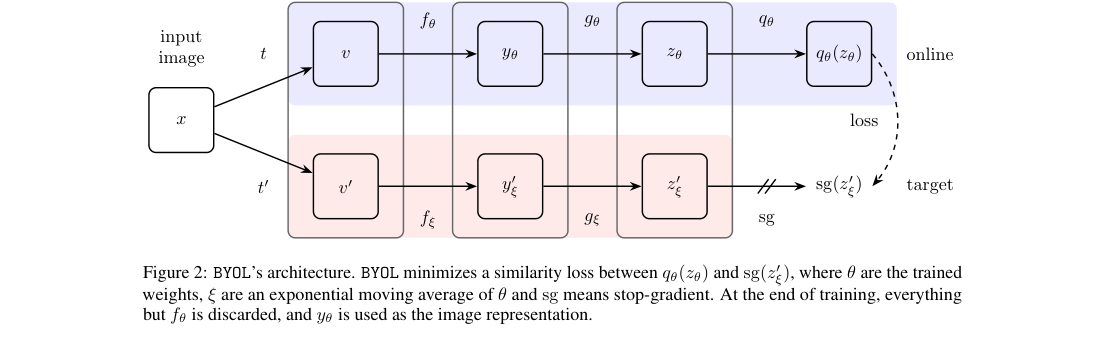
BYOL uses two branches. The online branch is encoder , projector , predictor ; the target branch is encoder and projector with no predictor. The target parameters follow an EMA of the online weights, and only is kept after training.
Loss / Objective
The objective regresses the normalized online prediction to the normalized target projection, then symmetrizes across the two views.
Sampling Rule / Algorithm
Each step updates the online network by gradient descent and the target network by EMA.
Training Procedure
- Encoder: ResNet-50 v1 by default; representation dim .
- Projector: MLP, hidden size , output size .
- Predictor: MLP on top of projector output.
- Optimizer: LARS.
- Epochs: .
- Batch size: .
- Learning rate: with cosine decay.
- Warm-up: epochs.
- Weight decay: .
- Target EMA base: .
Evaluation
Datasets
- ImageNet ILSVRC-2012.
- ImageNet semi-supervised splits: and labels.
- Places365.
- VOC2012 segmentation.
- Object detection and depth-estimation transfer benchmarks.
Metrics
- ImageNet top-1, top-5 linear-eval accuracy.
- Semi-supervised top-1, top-5 accuracy.
- Transfer classification accuracy.
- Segmentation mIOU.
- Detection AP metrics.
- Depth metrics including RMSE and related error measures.
Headline results
- ImageNet linear eval, ResNet-50: top-1 , top-5 .
- ImageNet linear eval, ResNet-200 (2): top-1 .
- Places365 linear eval from ImageNet pretraining: top-1 , top-5 .
- VOC2012 segmentation transfer: mIOU .
- Transfer classification from ImageNet pretraining: Food101 , CIFAR-10 .
Ablations
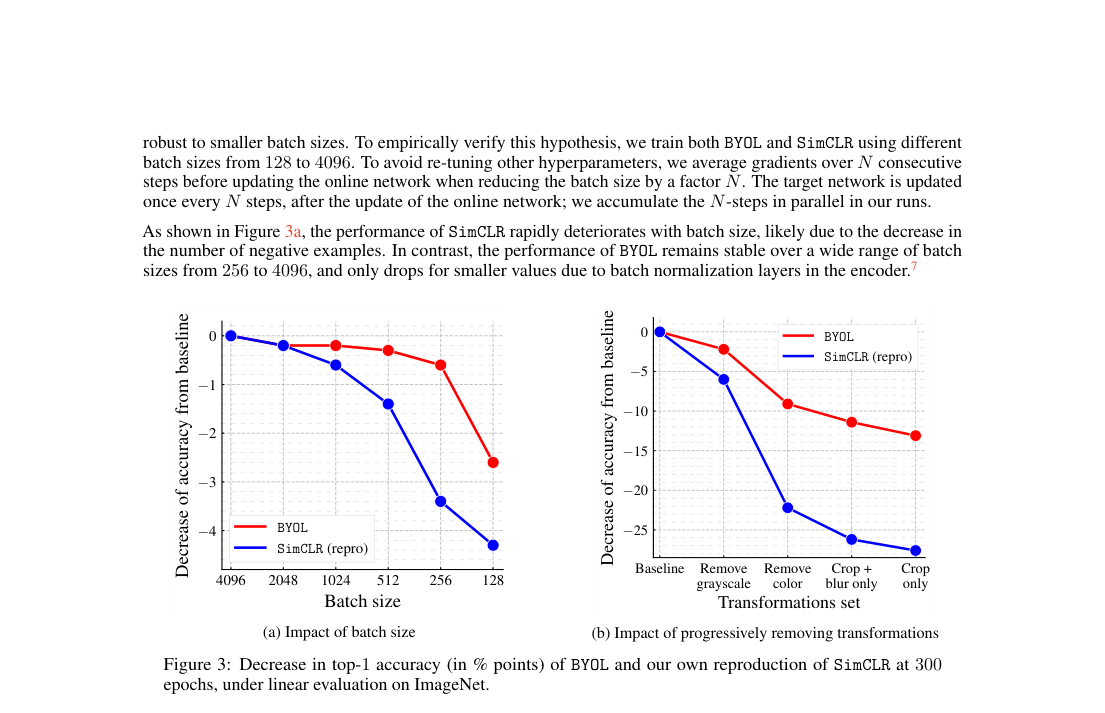
- Batch size: BYOL stays stable from to ; SimCLR drops much faster.
- Augmentations: BYOL is more resilient when grayscale, color, blur, or all but crops are removed.
- Target network: fixed random targets avoid collapse but only reach top-1.
- Predictor or EMA removal: representations collapse unless the predictor is made near-optimal.
Method Strengths and Weaknesses
Strengths
- Removes negative pairs without losing SOTA ImageNet linear-eval accuracy.
- Strong robustness to smaller batches than SimCLR.
- Stronger resilience to weaker augmentation sets.
- Transfers well across classification, segmentation, and detection.
Weaknesses
- Collapse prevention remains empirical; theory is incomplete.
- Relies on architectural asymmetry from predictor plus EMA target.
- Training is long: epochs on ImageNet.
- Uses large-batch LARS pretraining in the main setup.
Suggestions from the authors
- Explain why predictor plus EMA target avoids collapse.
- Clarify whether negatives are ever necessary in SSL.
- Test the bootstrap mechanism in other self-supervised domains.
- Study which augmentations remain essential once negatives are removed.
Links
Prior Papers
- @chenSimCLR2020 — BYOL is framed against SimCLR’s contrastive objective and removes its dependence on negatives.
Further Papers
- @caronDINO2021 — extends non-contrastive self-distillation in vision with teacher-student targets.
- @heMAE2021 — another major 2021 vision pretraining method, useful as a descendant comparison point.
- @radfordCLIP2021 — later representation learning baseline for transfer, complementary to BYOL-style SSL.