Masked Autoencoders Are Scalable Vision Learners
Masked Autoencoders Are Scalable Vision Learners
Problem
Framing
Vision self-supervision had not matched supervised ViT pre-training at scale, and masked prediction looked too easy on redundant images. MAE closes this gap with heavy patch masking and an asymmetric encoder-decoder that reconstructs pixels from only visible patches. On ImageNet-1K, ViT-H reaches 87.8% top-1.
Currently Used Methods
Foundational
- @chenSimCLR2020 — contrastive pre-training with augmented view agreement.
- Limitation in context: needs strong augmentations and still trails MAE in transfer.
- @grillBYOL2020 — non-contrastive bootstrap self-distillation without negatives.
- Limitation in context: learns invariances, not explicit missing-content prediction.
- @caronDINO2021 — self-distilled ViT features with strong linear separability.
- Limitation in context: weaker end-to-end transfer than MAE at larger scales.
- @dosovitskiyViT2020 — pure transformer backbone for image patches.
- Limitation in context: supervised pre-training demands labels and large compute.
Proposed Method
Architecture
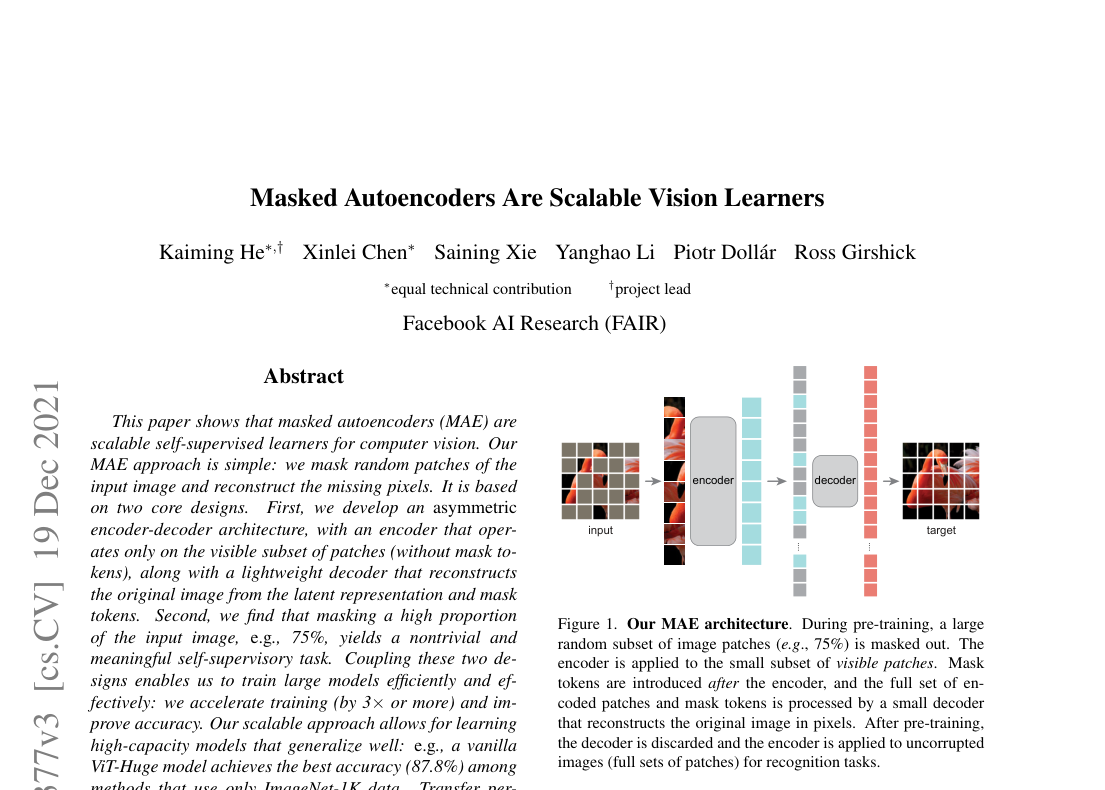
MAE splits an image into patches, masks about 75%, and feeds only visible patches to the ViT encoder. Mask tokens are inserted only after the encoder, then a small decoder reconstructs all patches; the decoder is discarded for downstream use. The default decoder has depth 8 and width 512.
Loss / Objective
The training target is pixel reconstruction on masked patches only.
Algorithm
Pre-training samples a random mask set, encodes visible patches, decodes the full sequence, and optimizes masked-patch MSE.
Training Procedure
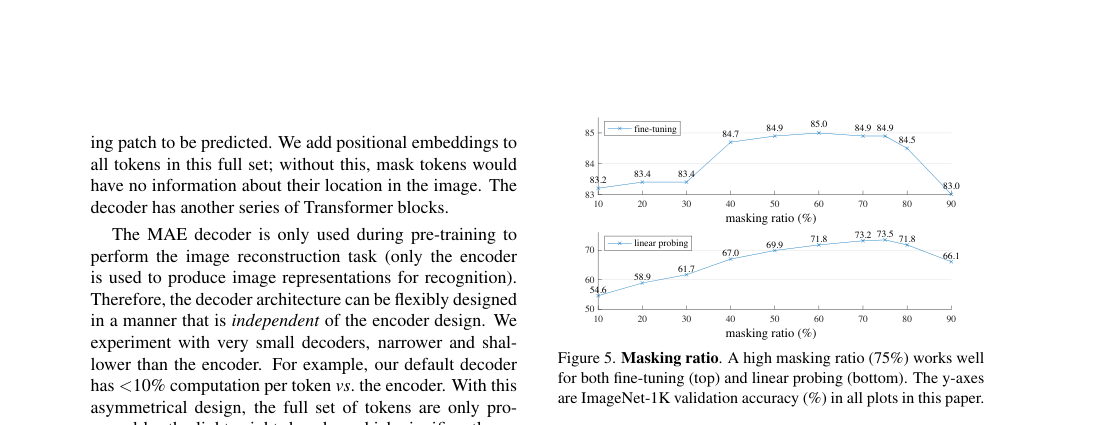
- Masking ratio: 75% default.
- Pre-training length: 800 epochs default; 1600 for strongest models.
- Optimizer: AdamW.
- Base learning rate: .
- Weight decay: 0.05.
- Decoder depth: 8.
- Decoder width: 512.
- Data augmentation: random resized crop.
Evaluation
Datasets
- ImageNet-1K pre-training and validation.
- COCO for detection and instance segmentation transfer.
- ADE20K for semantic segmentation transfer.
- iNaturalist 2017/2018/2019 for classification transfer.
- Places205 for scene classification transfer.
Metrics
- ImageNet top-1 accuracy.
- Linear probing accuracy.
- COCO .
- COCO .
- ADE20K mIoU.
Headline results
- ImageNet-1K fine-tuning (ViT-H): 87.8% top-1.
- ImageNet-1K fine-tuning (ViT-L, 1600 epochs): 85.9% top-1.
- COCO detection (ViT-L): .
- COCO instance segmentation (ViT-L): .
- iNat2018 transfer (ViT-H448): 86.8% top-1.
Ablations
- Masking ratio: 75% is best; low masking under-trains the representation.
- Decoder depth: deeper helps linear probing more than fine-tuning.
- Decoder width: larger width improves linear probing, small effect on fine-tuning.
- Mask tokens in encoder: removing them cuts encoder FLOPs by about .
Method Strengths and Weaknesses
Strengths
- High masking makes prediction nontrivial and improves accuracy.
- Asymmetric design cuts pre-training cost by or more.
- Scaling is strong: ViT-H reaches 87.8% with ImageNet-1K only.
- Transfer beats supervised pre-training on detection and segmentation.
Weaknesses
- Linear probing is weaker than DINO-style features.
- Pixel reconstruction target may under-emphasize semantic abstraction.
- Best accuracy needs long pre-training up to 1600 epochs.
- Method depends on ViT patch tokenization and large-model capacity.
Suggestions from the authors
- Study why pixel reconstruction yields strong transfer despite weak linear probing.
- Scale masked autoencoding to larger models and longer training.
- Explore reconstruction targets beyond raw pixels.
- Extend masked autoencoding to broader vision tasks and data regimes.
Links
Prior Papers
- @caronDINO2021 — DINO is a strong contemporary ViT self-supervision baseline that MAE compares against.
- @chenSimCLR2020 — SimCLR anchors the contrastive-learning baseline family that MAE departs from.
- @grillBYOL2020 — BYOL is a key non-contrastive baseline for representation learning before MAE.
- @dosovitskiyViT2020 — ViT provides the transformer backbone that makes masked patch modeling practical.
Further Papers
- @kirillovSAM2023 — SAM uses MAE-pretrained ViT-style encoders in large-scale vision foundation modeling.
- @liuSwinTransformer2021 — Swin is a later overlapping vision-transformer direction for scalable representation learning.
- @peeblesDiT2022 — DiT extends transformer-based image modeling and inherits the ViT scaling context MAE helped normalize.