Scalable Diffusion Models with Transformers
Scalable Diffusion Models with Transformers
Problem
Framing
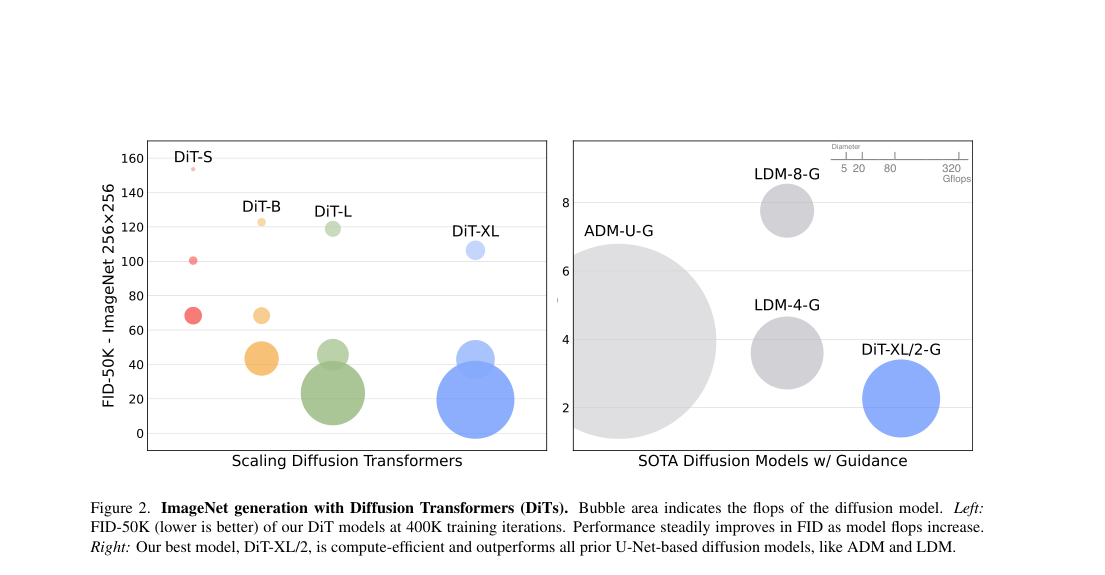
U-Net backbones had driven diffusion progress, but scaling laws for transformer backbones in diffusion were unclear. DiT closes this gap by patchifying latent inputs and scaling a class-conditional transformer directly with compute, reaching ImageNet 256256 FID 2.27 and 512512 FID 3.04 with guidance.
Currently Used Methods
Foundational
- @DenoisingDiffusionProbabilisticModels2020 — Gaussian diffusion with learned reverse denoising objective.
- Limitation in context: backbone scaling focused on convolutional U-Nets, not transformers.
- @nicholImprovedDDPM2021 — stronger DDPM training and faster sampling refinements.
- Limitation in context: keeps the same U-Net-centered design space.
- @dhariwalDiffusionBeatGANs2021 — classifier guidance pushes diffusion to top ImageNet FID.
- Limitation in context: high quality still relies on large convolutional U-Nets.
- @rombachLatentDiffusion2022 — latent diffusion cuts pixel-space cost with a VAE.
- Limitation in context: uses latent U-Nets, not transformer backbones.
- @dosovitskiyViT2020 — patchified transformers scale cleanly for vision tasks.
- Limitation in context: does not show they work inside diffusion denoisers.
Proposed Method
Architecture
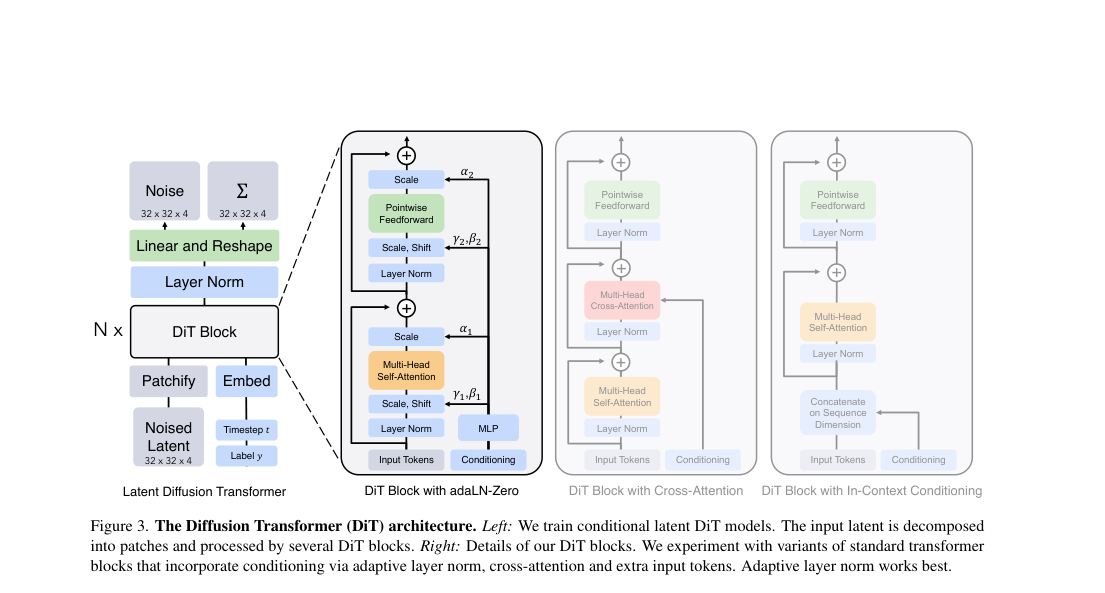
DiT runs diffusion in Stable-Diffusion-style latent space. A latent of size is patchified into tokens, processed by transformer blocks at hidden size , then projected back to predict noise and diagonal covariance. Conditioning on timestep and class label enters each block through adaLN-Zero; this beats cross-attention and token concatenation.
Loss / Objective
The model keeps the standard diffusion training target in latent space.
Sampling Rule / Algorithm
For class-conditional sampling, DiT uses classifier-free guidance.
Training Procedure
- Latent VAE downsample factor: .
- Input latent shape at 256 resolution: .
- Learning rate: .
- Weight decay: .
- Batch size: .
- Sampling for reported FID-50K: DDPM steps.
- Largest 256 and 512 DiT-XL/2 runs continue to M steps.
Evaluation
Datasets
- ImageNet class-conditional, 256256.
- ImageNet class-conditional, 512512.
Metrics
- FID-50K.
- sFID.
- Inception Score.
- Precision.
- Recall.
Headline results
- ImageNet 256256 (DiT-XL/2-G): FID 2.27.
- ImageNet 512512 (DiT-XL/2-G): FID 3.04.
- ImageNet 256256: DiT-XL/2-G beats ADM-U-G and LDM variants in Figure 2.
- Scaling from DiT-S to DiT-XL monotonically improves FID at 400K steps.
Ablations
- Conditioning block: adaLN-Zero gives the best FID among tested conditioning schemes.
- Model size: larger backbones improve FID across training.
- Patch size: smaller patches improve quality by increasing token count and Gflops.
- Training compute: larger models are more compute-efficient at a fixed target FID.
Method Strengths and Weaknesses
Strengths
- Clean result: transformer Gflops strongly predict diffusion quality.
- Strong headline numbers: FID 2.27 at 256 and 3.04 at 512.
- Simple swap: replaces U-Net with a standard ViT-style backbone.
- adaLN-Zero improves conditioning without cross-attention overhead.
Weaknesses
- Reported wins depend on classifier-free guidance at sampling time.
- Best quality needs very large DiT-XL/2 compute budgets.
- Evaluation centers on ImageNet; cross-domain robustness is untested.
- Latent VAE quality constrains the final sample ceiling.
Suggestions from the authors
- Study larger transformer backbones and longer training regimes.
- Test DiT scaling beyond ImageNet class-conditional generation.
- Improve latent-space diffusion components beyond the fixed VAE.
- Explore transformer design choices specialized for diffusion.
Links
Prior Papers
- @DenoisingDiffusionProbabilisticModels2020 — establishes the base diffusion objective DiT keeps while changing the backbone.
- @nicholImprovedDDPM2021 — supplies the improved DDPM setup and faster sampling conventions used for comparison.
- @dhariwalDiffusionBeatGANs2021 — the main U-Net diffusion baseline that DiT surpasses on ImageNet.
- @rombachLatentDiffusion2022 — provides the latent-diffusion formulation and VAE compression DiT adopts.
- @dosovitskiyViT2020 — motivates patchified transformer scaling, which DiT imports into diffusion.
Further Papers
- @karrasEDM2022 — studies improved diffusion design choices and remains a strong comparison point for generative quality.
- @albergoStochasticInterpolants2023 — extends continuous-time generative transport methods that overlap with diffusion-style modeling.
- @songConsistencyModels2023 — targets faster diffusion-family sampling, a direct downstream concern for large DiT models.