Elucidating the Design Space of Diffusion-Based Generative Models
Elucidating the Design Space of Diffusion-Based Generative Models
Problem
Framing
Diffusion models mixed solver choice, noise schedule, stochasticity, and network parameterization into monolithic recipes. This paper factorizes that design space, then replaces each weak choice with a better one: Heun-based sampling, tuned noise schedules, and score-network preconditioning. It reaches FID 1.79 on class-conditional CIFAR-10 and 1.36 on ImageNet-64 with 35 NFE.
Currently Used Methods
Foundational
- @DenoisingDiffusionProbabilisticModels2020 — discrete-time diffusion with weighted variational training.
- Limitation in context: fixed design bundle hides sampler and preconditioning tradeoffs.
- @songScoreSDE2020 — score-SDE framework with predictor-corrector and probability-flow ODE.
- Limitation in context: default discretization and schedules are not sampling-efficient.
- @DenoisingDiffusionImplicitModels2020 — deterministic DDIM trajectories for faster generation.
- Limitation in context: Euler discretization leaves quality on the table at low NFE.
- @nicholImprovedDDPM2021 — improved DDPM with learned variances and cosine schedule.
- Limitation in context: training and sampling choices remain tightly coupled.
- @dhariwalDiffusionBeatGANs2021 — ADM architecture that pushes diffusion to GAN-level fidelity.
- Limitation in context: architecture improves quality, but solver design stays underexplored.
Proposed Method
Architecture
EDM keeps the backbone family unchanged: DDPM++ for VP, NCSN++ for VE, and ADM for ImageNet. The main architectural change is external preconditioning: the denoiser is expressed as a skip-connected wrapper around a noise-conditioned backbone .
Loss / Objective
The objective trains the preconditioned denoiser over noise levels sampled from a log-normal distribution.
Sampling Rule / Algorithm
For deterministic sampling, EDM integrates the probability-flow ODE with Heun's second-order method on a noise schedule .
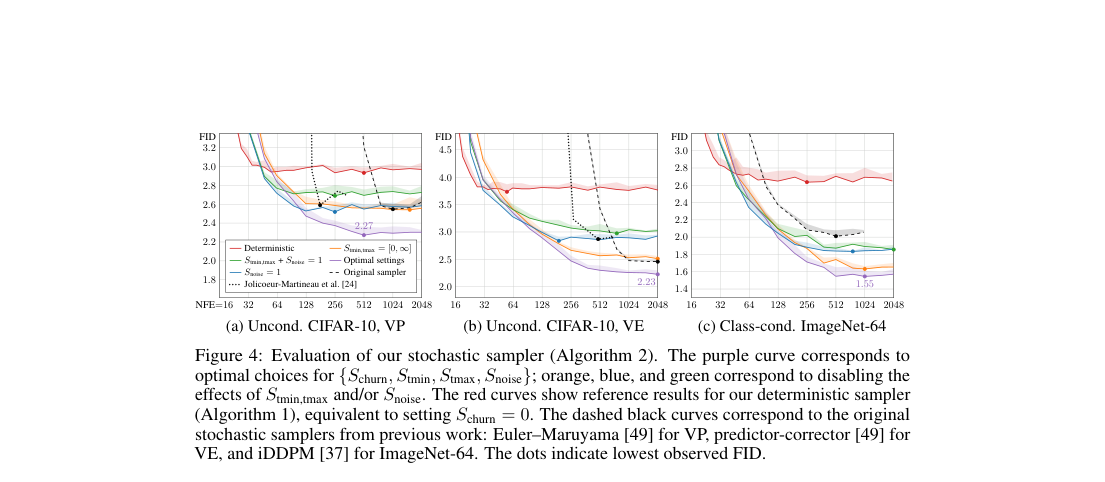
EDM then adds optional stochastic "churn" between selected noise levels to improve low-NFE sampling.
Training Procedure
- ,
- Noise schedule exponent
- Log-normal noise sampling: ,
- CIFAR-10 training duration: 200 M images
- CIFAR-10 batch size: 512
- CIFAR-10 learning rate: 0.001
- EMA half-life: 0.5 Mimages
- Data augmentation probability: 0.12
Evaluation
Datasets
- CIFAR-10, 3232
- FFHQ, 6464
- AFHQv2, 6464
- ImageNet-64, class-conditional
Metrics
- FID
- NFE for near-best FID
- Qualitative sample quality
Headline results
- CIFAR-10 class-conditional: FID 1.79.
- CIFAR-10 unconditional: FID 1.97.
- ImageNet-64 pre-trained model + EDM sampler: FID 1.55.
- ImageNet-64 retrained with EDM: FID 1.36.
- CIFAR-10/ImageNet-64 sampling: near-SOTA quality at 35 NFE.
Ablations
- Deterministic solver: Heun beats Euler and black-box RK45 at matched NFE.
- Time-step schedule: larger concentrates steps near low noise and improves FID.
- Stochasticity: tuned churn improves low-NFE FID over pure ODE sampling.
- Training configuration: preconditioning, noise sampling, and augmentation each reduce FID.
Method Strengths and Weaknesses
Strengths
- Separates diffusion design axes cleanly: solver, schedule, stochasticity, and preconditioning.
- Heun sampler cuts NFE sharply without sacrificing FID.
- Preconditioning yields stable loss scaling across noise levels.
- Works as a drop-in sampler improvement for pre-trained models.
Weaknesses
- Core backbones are inherited, not architecturally novel.
- Strongest gains rely on careful hand-tuned sampler hyperparameters.
- Main image results remain at low resolution: 3232 and 6464.
- Design-space study is empirical; optimality is not theoretically settled.
Suggestions from the authors
- Explore wider combinations of modular diffusion design choices.
- Analyze why low-noise discretization errors dominate sample quality.
- Study whether overshooting variants of Heun improve sampling more broadly.
- Extend the framework beyond current score-network parameterizations.
Links
Prior Papers
- @lipmanFlowMatching2022 — studies continuous-time transport parameterizations closely related to diffusion trajectory design.
- @liuRectifiedFlow2022 — revisits transport ODE design, making it a natural companion to EDM's solver-focused perspective.
- @DenoisingDiffusionProbabilisticModels2020 — baseline DDPM formulation that EDM re-expresses and improves.
- @songScoreSDE2020 — provides the score-SDE and probability-flow framework EDM systematizes.
- @nicholImprovedDDPM2021 — supplies improved DDPM design choices that EDM reanalyzes in a common notation.
- @dhariwalDiffusionBeatGANs2021 — strong ADM baseline whose pre-trained models benefit from EDM sampling.
Further Papers
- @songConsistencyModels2023 — pursues faster diffusion-family sampling, a direct continuation of EDM's efficiency agenda.
- @peeblesDiT2022 — advances diffusion generative modeling with new backbones after EDM's training and sampling refinements.
- @albergoStochasticInterpolants2023 — extends the continuous-time generative transport view that EDM helps clarify.