Flow Straight and Fast: Learning to Generate and Transfer Data with Rectified Flow
Flow Straight and Fast: Learning to Generate and Transfer Data with Rectified Flow
Problem
Framing
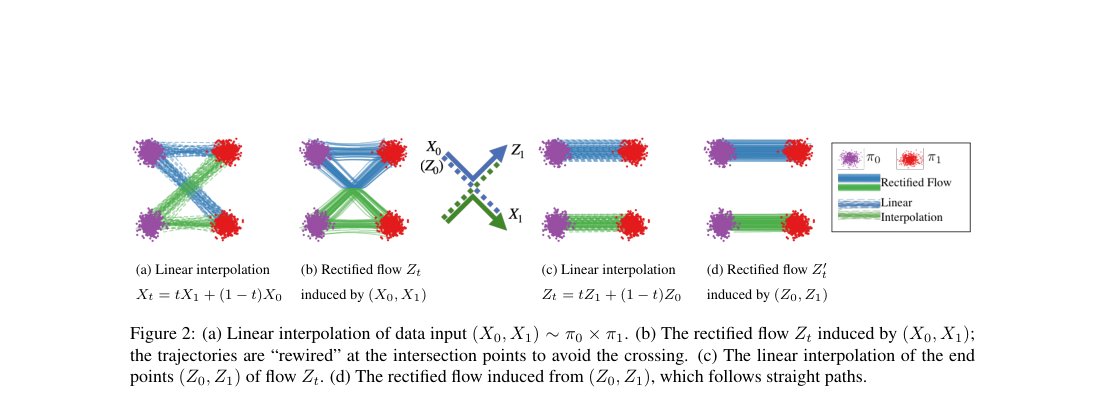
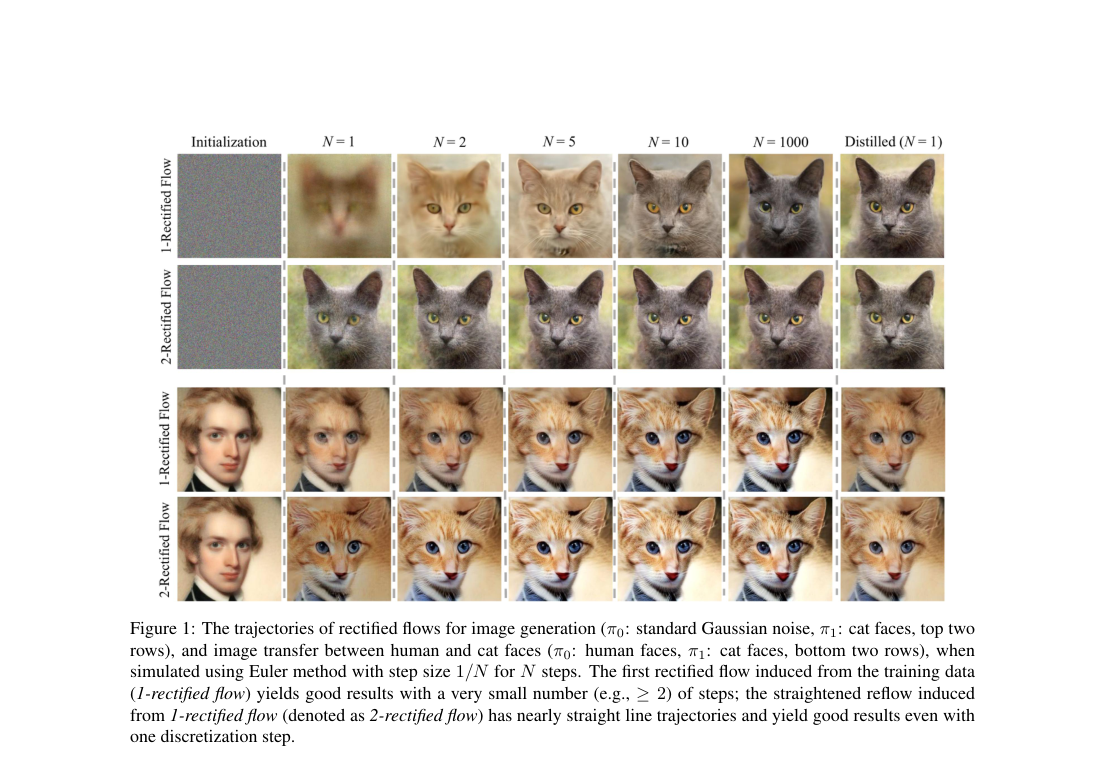
Continuous-time generative transport had strong quality but expensive inference, while one-step models lacked a clean ODE view. The paper closes this gap by learning velocity fields that follow straight interpolation directions, then recursively straightening them with reflow. On CIFAR-10, the distilled 2-rectified flow reaches FID 4.85 with one Euler step.
Currently Used Methods
Foundational
- @goodfellowGAN2014 — adversarial training for implicit high-fidelity generation.
- Limitation in context: unstable optimization and no reversible transport dynamics.
- @kingmaVAE2013 — likelihood-based latent-variable generation with variational inference.
- Limitation in context: approximate inference constrains sample sharpness and transport flexibility.
- @songScoreSDE2020 — score-based SDE generation with continuous-time denoising.
- Limitation in context: inference needs many solver steps and schedule choices.
- @DenoisingDiffusionImplicitModels2020 — deterministic DDIM sampling from diffusion-trained models.
- Limitation in context: induced paths remain curved and weak in one-step regimes.
- @lipmanFlowMatching2022 — direct regression of continuous-time vector fields for generative transport.
- Limitation in context: this paper adds reflow to reduce transport cost and straighten trajectories.
Proposed Method
Architecture
The method learns a time-dependent velocity field for the ODE . For image generation, it uses the DDPM++ U-Net backbone from @songScoreSDE2020; the paper changes the training target, not the backbone.
Loss / Objective
The core objective regresses the velocity on straight-line interpolation directions between paired endpoints.
The exact population optimum is
Sampling Rule / Algorithm
After fitting , sampling solves the learned ODE forward from ; reflow retrains on the induced endpoint coupling.
Training Procedure
- .
- CIFAR-10: DDPM++ U-Net.
- Optimizer: Adam.
- EMA decay: .
- Inference: Euler with step size or adaptive RK45.
- Distillation target: one-step map .
Evaluation
Datasets
- CIFAR-10, unconditional generation.
- LSUN Bedroom, LSUN Church, CelebA-HQ, AFHQ Cat, generation.
- AFHQ, MetFace, CelebA-HQ for unpaired image translation.
- OfficeHome, DomainNet for domain adaptation.
Metrics
- FID.
- Inception Score.
- Recall.
- NFE for inference cost.
- Classification accuracy for domain adaptation.
Headline results
- CIFAR-10, RK45, 1-rectified flow: FID 2.58, IS 9.60, Recall 0.57, NFE 127.
- CIFAR-10, RK45, 2-rectified flow: FID 3.36, IS 9.24, Recall 0.54, NFE 110.
- CIFAR-10, one-step distilled 2-rectified flow: FID 4.85, Recall 0.50.
- CIFAR-10, one-step distilled 3-rectified flow: FID 5.21, Recall 0.51.
- OfficeHome domain adaptation: 69.2 0.5 accuracy.
Results table
Table 2: Domain adaptation accuracy on transferred testing data
| Method | ERM | IRM | ARM | Mixup | MLDG | CORAL | Ours |
|---|---|---|---|---|---|---|---|
| OfficeHome | 66.5 \pm 0.3 | 64.3 \pm 2.2 | 64.8 \pm 0.3 | 68.1 \pm 0.3 | 66.8 \pm 0.6 | 68.7 \pm 0.3 | 69.2 \pm 0.5 |
| DomainNet | 40.9 \pm 0.1 | 33.9 \pm 2.8 | 35.5 \pm 0.2 | 39.2 \pm 0.1 | 41.2 \pm 0.1 | 41.5 \pm 0.2 | 41.4 \pm 0.1 |
Ablations
- Reflow depth: one reflow sharply improves small-step generation; too many reflows hurt large-step accuracy.
- Solver steps : rectified flow degrades gracefully at low ; VP and sub-VP ODEs collapse faster.
- Distillation: one-step performance improves strongly after distilling reflowed models.
- Straightness: reflow lowers the straightness metric and makes endpoint extrapolations nearly time-invariant.
Method Strengths and Weaknesses
Strengths
- One regression loss replaces adversarial games and diffusion score matching.
- Reflow targets inference efficiency directly by straightening trajectories.
- One-step distilled 2-rectified flow reaches FID 4.85 on CIFAR-10.
- Same framework handles generation, translation, and domain adaptation.
Weaknesses
- Best FID still trails full SDE solvers on CIFAR-10.
- Repeated reflow accumulates estimation error and can hurt large-step quality.
- Training relies on sampled couplings from previous flows, adding extra stages.
- Theory assumes exact regression and well-behaved ODE solutions.
Suggestions from the authors
- Study nonlinear interpolations with non-Euclidean geometry constraints.
- Improve one-step inference with final-stage distillation schemes.
- Combine rectified flow with augmentation or GAN-style refinements.
- Extend theory beyond exact regression and idealized rectifiable flows.
Links
Prior Papers
- @lipmanFlowMatching2022 — both learn transport vector fields directly; rectified flow adds reflow-based trajectory straightening.
- @songScoreSDE2020 — rectified flow reinterprets probability-flow ODEs against simpler straight-path interpolation.
- @DenoisingDiffusionImplicitModels2020 — the paper contrasts rectified straight paths with DDIM-style curved deterministic sampling.
Further Papers
- @albergoStochasticInterpolants2023 — extends the interpolation view of transport and generative dynamics beyond the paper's linear rectification setup.
- @songConsistencyModels2023 — pursues the same fast-sampling goal with direct few-step or one-step generation.
- @karrasEDM2022 — studies diffusion design choices that also target improved solver efficiency and sample quality.