Flow Matching for Generative Modeling
Flow Matching for Generative Modeling
Problem
Framing
Continuous normalizing flows train by simulation through ODE solves, which makes large-scale image modeling slow and brittle. The paper replaces simulation-based CNF training with Flow Matching: regress a vector field that generates a chosen probability path, then choose paths that are easier to learn and sample from.
Currently Used Methods
Direct antecedents
- @dinhNVP2017 — exact normalizing flows with tractable Jacobians for likelihood-based generation.
- Limitation in context: discrete invertible layers restrict path flexibility and architecture choices.
- "Neural Ordinary Differential Equations" — continuous-time flows trained through ODE simulation.
- Limitation in context: training requires repeated solves, which dominates CNF cost.
- @songScoreSDE2020 — score-based diffusion with continuous-time stochastic dynamics.
- Limitation in context: strong generation quality, but sampling and likelihood use expensive integration.
- @DenoisingDiffusionProbabilisticModels2020 — diffusion training via denoising objectives.
- Limitation in context: objective is tied to diffusion paths, not arbitrary transport paths.
- "Score-Based Generative Modeling through Stochastic Differential Equations" — probability-flow ODE view for diffusion models.
- Limitation in context: inherits diffusion-path constraints rather than optimizing path geometry.
Proposed Method
Architecture
For images, the model uses the U-Net from @dhariwalDiffusionBeatGANs2021 with minimal changes and predicts a time-conditioned CNF vector field . The method changes the training target and path, not the backbone.
Loss / Objective
Flow Matching trains the CNF by direct vector-field regression.
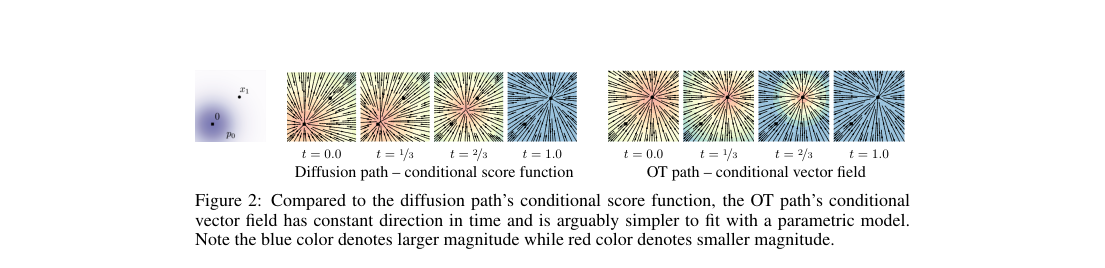
The paper then uses the conditional form with Gaussian paths
and conditional vector field
Sampling Rule / Algorithm
Sampling solves the learned CNF ODE from base noise at to data at .
Training Procedure
- Optimizer: Adam, , , weight decay , .
- Precision: FP32 for CIFAR-10 and ImageNet-32; mixed FP16 for ImageNet-64/128/256.
- Likelihood solver: dopri5 with .
- Image backbone: Dhariwal-Nichol U-Net.
- Time sampling uses with .
Evaluation
Datasets
- CIFAR-10
- ImageNet 3232
- ImageNet 6464
- ImageNet 128128
- ImageNet 256 upsampling
Metrics
- Bits per dimension (NLL/BPD)
- FID
- Inception Score
- NFE
- PSNR
- SSIM
Headline results
- CIFAR-10 unconditional: FM matches diffusion baselines in likelihood and improves low-NFE sampling.
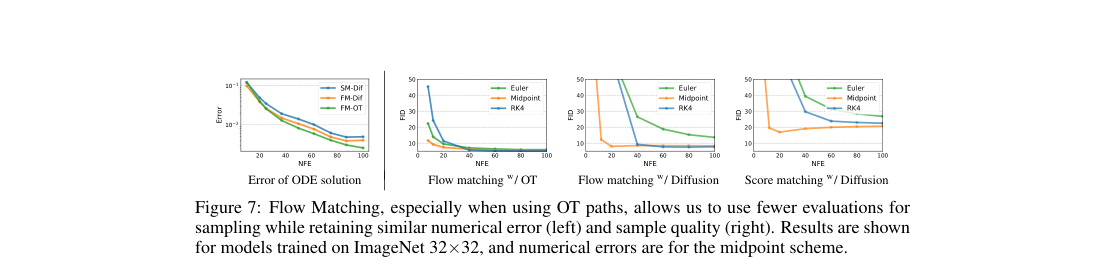
- ImageNet 3232: FM-OT gives the best speed-quality tradeoff among compared CNF objectives.
- ImageNet 6464: FM-OT remains competitive in FID while using fewer function evaluations.
- ImageNet 128128: the paper reports strong likelihood and FID with the same U-Net backbone.
- ImageNet 64256 upsampling: FM supports conditional generation with reported FID, IS, PSNR, and SSIM.
Ablations
- Path choice: OT paths are easier to fit than diffusion paths.
- Solver choice: midpoint and RK4 improve the NFE-quality tradeoff over Euler.
- Objective choice: FM outperforms score matching on low-NFE sampling.
- Likelihood estimation: increasing the number of Hutchinson samples improves BPD.
Method Strengths and Weaknesses
Strengths
- Removes ODE simulation from CNF training.
- Unifies diffusion and CNF training through probability-path regression.
- OT paths reduce sampling NFE at similar FID.
- Keeps the standard diffusion U-Net backbone unchanged.
Weaknesses
- Gains depend strongly on choosing a good probability path.
- Sampling still requires ODE solving at test time.
- Main image results reuse diffusion-era U-Net design.
- Likelihood computation still needs divergence estimation and adaptive solvers.
Suggestions from the authors
- Design probability paths directly instead of starting from stochastic diffusions.
- Study path families beyond Gaussian diffusion and OT constructions.
- Extend the framework to broader conditional generation settings.
- Improve efficient CNF likelihood and sampling solvers.
Links
Prior Papers
- @dhariwalDiffusionBeatGANs2021 — supplies the U-Net image backbone and evaluation baseline family.
- @DenoisingDiffusionProbabilisticModels2020 — provides the diffusion objective that FM reinterprets through vector-field regression.
- @songScoreSDE2020 — connects diffusion models to continuous-time dynamics and probability-flow ODEs.
- @dinhNVP2017 — represents the exact-flow lineage that FM extends toward continuous normalizing flows.
Further Papers
- @liuRectifiedFlow2022 — studies straight transport paths for fast generative ODE sampling, closely aligned with FM's path-design view.
- @albergoStochasticInterpolants2023 — generalizes interpolation-based training objectives for transport and diffusion-style generative models.
- @karrasEDM2022 — optimizes diffusion design choices and remains relevant to FM's claim that path design matters.
- @songConsistencyModels2023 — pursues few-step generation, the same efficiency target highlighted by FM's low-NFE results.