Score-Based Generative Modeling through Stochastic Differential Equations
Score-Based Generative Modeling through Stochastic Differential Equations
Problem
Framing
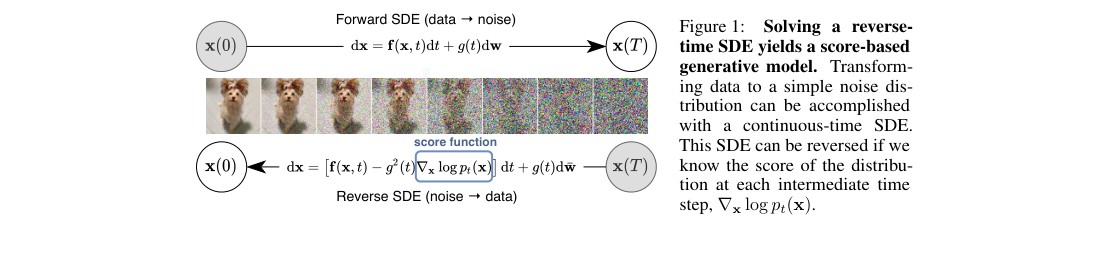
Discrete score models and DDPMs used fixed noise ladders, separate sampler derivations, and no exact likelihood path. The paper unifies them as continuous-time SDEs, then generates with reverse-time SDEs, predictor-corrector sampling, and a probability-flow ODE. On CIFAR-10, it reports FID 2.20 and 2.99 bits/dim.
Currently Used Methods
Foundational
- @DeepUnsupervisedLearningusing2015 — annealed score matching with Langevin dynamics over discrete noise scales.
- Limitation in context: fixed noise ladder, with no continuous-time formulation.
- @DenoisingDiffusionProbabilisticModels2020 — discrete diffusion with a learned reverse Markov chain.
- Limitation in context: tied to one discretization, without exact ODE likelihoods.
- @dinhNVP2017 — invertible flows with exact likelihood computation.
- Limitation in context: weaker image sample quality than score-SDE models.
- Improved Techniques for Training Score-Based Generative Models — stronger score-network training and sampling heuristics.
- Limitation in context: still discrete in noise scale and sampler design.
Proposed Method
Architecture
The framework has three parts: a forward SDE, a time-conditioned score network , and a reverse-time solver. Experiments use DDPM backbones and NCSN++, which adds FIR up/downsampling, skip rescaling, BigGAN-style residual blocks, and progressive input/output paths.
Loss / Objective
Training fits the time-dependent score along SDE marginals.
Sampling Rule / Algorithm
Generation solves the reverse-time SDE; the paper also uses a deterministic probability-flow ODE.
Training Procedure
- Noise scales for discrete counterparts: 1000.
- Default training length: 1.3M iterations.
- Checkpoints: every 50k iterations.
- Batch size: 128 on CIFAR-10.
- Batch size: 64 on LSUN.
- CelebA-HQ 10241024 batch size: 8.
- CelebA-HQ 10241024 EMA: 0.9999.
Evaluation
Datasets
- CIFAR-10, 3232.
- CelebA, 6464.
- LSUN bedroom, 256256.
- LSUN church outdoor, 256256.
- CelebA-HQ, 256256 and 10241024.
Metrics
- FID.
- Inception Score.
- Test NLL / bits per dimension.
Headline results
- CIFAR-10 unconditional: FID 2.20, IS 9.89.
- CIFAR-10 sub-VP ODE likelihood: 2.99 bits/dim.
- CIFAR-10 VE SDE + NCSN++ + PC: FID 2.45.
- CIFAR-10 VP or sub-VP continuous model: FID 2.41.
- CelebA-HQ 10241024: high-fidelity score-model samples.
Table 1: CIFAR-10 FID for reverse-time samplers under VE-SDE and VP-SDE parameterizations.
| Predictor | VE P1000 | VE P2000 | VE C2000 | VE PC1000 | VP P1000 | VP P2000 | VP C2000 | VP PC1000 |
|---|---|---|---|---|---|---|---|---|
| ancestral sampling | 4.98 .06 | 4.88 .06 | 3.62 .03 | 3.24 .02 | 3.24 .02 | 3.21 .02 | ||
| reverse diffusion | 4.79 .07 | 4.74 .08 | 20.43 .07 | 3.60 .02 | 3.21 .02 | 3.19 .02 | 19.06 .06 | 3.18 .01 |
| probability flow | 15.41 .15 | 10.54 .08 | 3.51 .04 | 3.59 .04 | 3.23 .03 | 3.06 .03 |
Ablations
- Sampler choice: predictor-corrector beats predictor-only at matched score evaluations.
- ODE solver: probability flow stays competitive while enabling likelihood computation.
- Architecture components: FIR, skip rescaling, BigGAN blocks, and progressive paths improve VE-SDE FID.
- EMA rate: larger EMA materially improves VE-SDE performance.
Method Strengths and Weaknesses
Strengths
- Unifies SMLD and DDPM as VE and VP SDE discretizations.
- Adds exact likelihoods through the probability-flow ODE.
- Predictor-corrector sampling improves FID at similar evaluation budgets.
- Reaches CIFAR-10 FID 2.20 with 2.99 bits/dim in one framework.
Weaknesses
- High-quality sampling still needs many score evaluations.
- Continuous denoising objective needs tractable perturbation kernels.
- Best results rely on substantial architecture tuning beyond the SDE abstraction.
- 10241024 training uses batch size 8 and very long runs.
Suggestions from the authors
- Reduce the sampling cost of reverse-time solvers.
- Extend the framework to general SDEs with state-dependent diffusion.
- Broaden conditional generation to harder inverse problems.
- Improve architectures and objectives for better likelihood and FID.
Links
Prior Papers
- @DeepUnsupervisedLearningusing2015 — annealed score matching is one discrete ancestor recast by the SDE view.
- @DenoisingDiffusionProbabilisticModels2020 — the paper shows DDPM as a VP-SDE discretization.
- @dinhNVP2017 — flow-based exact likelihoods are the comparison point for the probability-flow ODE.
Further Papers
- @dhariwalDiffusionBeatGANs2021 — pushes the score/diffusion line to stronger image synthesis quality.
- @ClassifierFreeDiffusionGuidance2022 — adds a simple guidance rule used across later diffusion samplers.
- @DenoisingDiffusionProbabilisticModels2020 — remains directly linked because the VP-SDE formulation clarifies its dynamics.