Segment Anything
Segment Anything
Problem
Framing
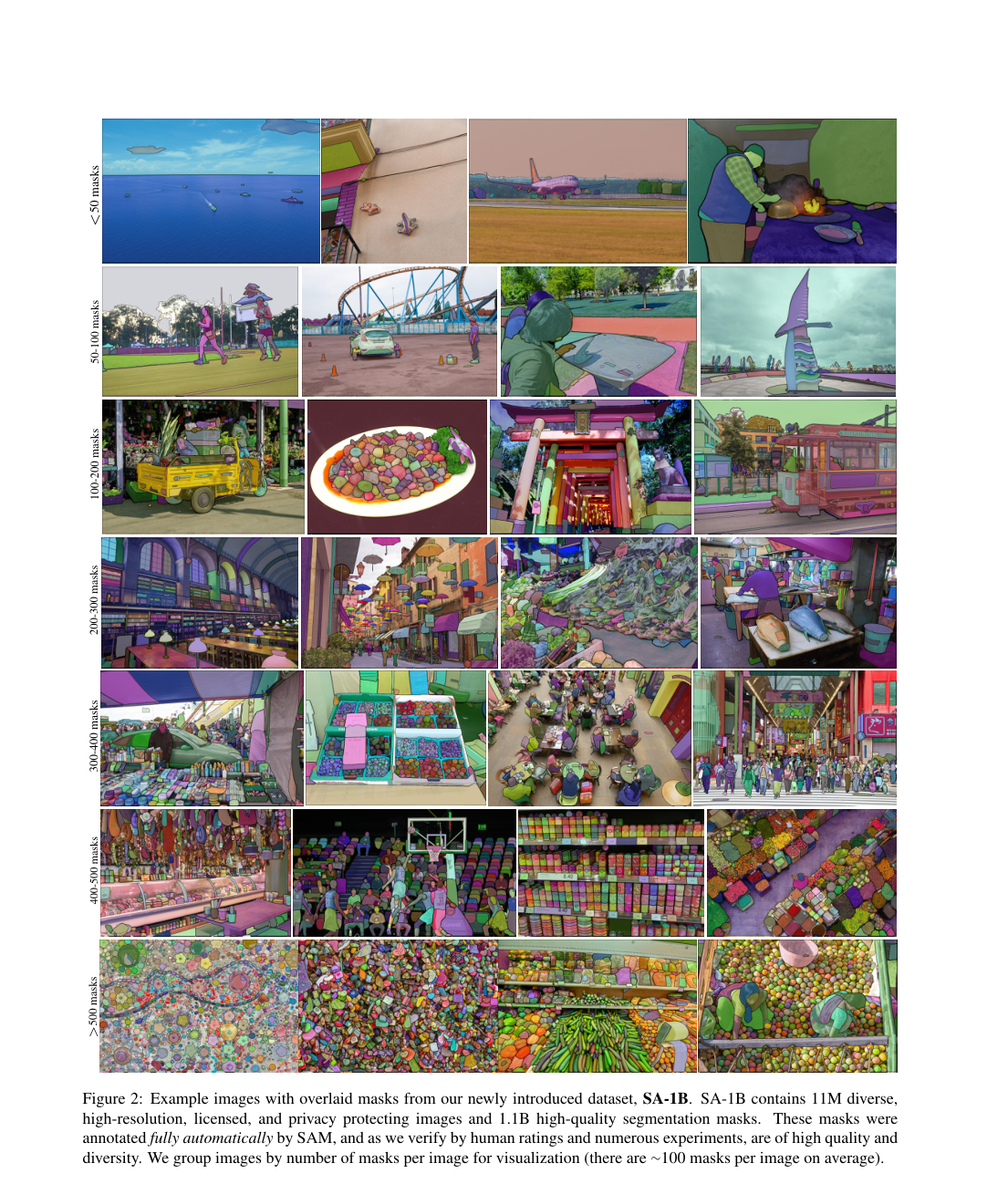
Open-vocabulary segmentation lacked a promptable model that transfers without task-specific fine-tuning and has data at foundation-model scale. SAM closes this with a prompt encoder plus lightweight mask decoder trained on SA-1B, a dataset of 11M images and 1.1B masks.
Currently Used Methods
Foundational
- @caronDINO2021 — self-distilled ViT pretraining yields strong transferable visual features.
- Limitation in context: features alone do not produce promptable masks.
- @heMaskRCNN2017 — two-stage detection-segmentation for instance masks from box proposals.
- Limitation in context: requires fixed label space and supervised downstream training.
- @dosovitskiyViT2020 — pure transformer image encoder scales representation learning.
- Limitation in context: encoder alone lacks prompt-conditioned mask prediction.
- @heMAE2021 — masked image pretraining improves dense-transfer backbones.
- Limitation in context: pretraining objective is not segmentation-aligned.
- @radfordCLIP2021 — language-supervised vision model enables strong zero-shot transfer.
- Limitation in context: outputs image-text alignment, not precise masks.
Proposed Method
Architecture
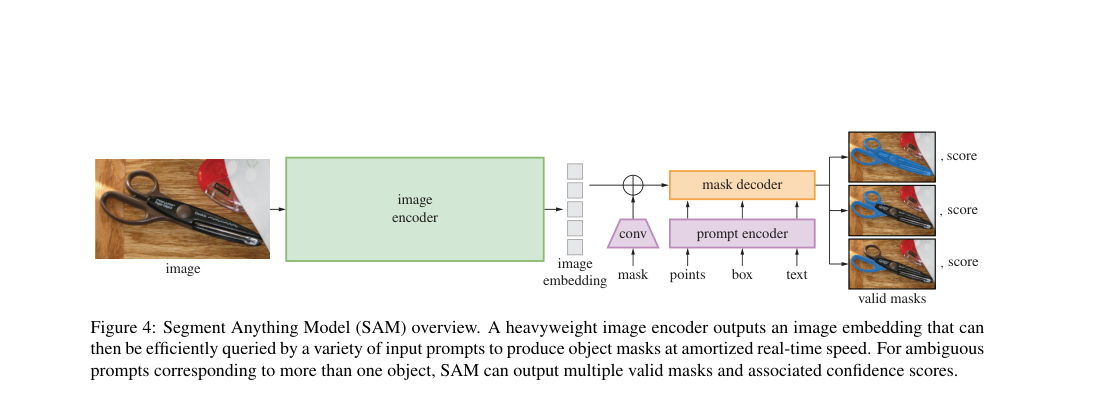
SAM uses a heavyweight ViT image encoder, a prompt encoder for points, boxes, text, and masks, and a lightweight mask decoder. The image embedding is computed once, then queried by prompts to emit multiple valid masks and an IoU confidence score.
Loss / Objective
The decoder optimizes mask quality and mask ranking jointly.
Algorithm
For ambiguous prompts, SAM predicts several candidate masks and selects by predicted IoU.
Training Procedure
- Dataset: SA-1B, 11M images, 1.1B masks.
- Image encoder: scaled from ViT-B to ViT-H.
- Masks per GPU: up to 64 randomly sampled masks.
- Data mix: default training uses automatic masks only.
- Filtering: discard masks covering more than 90% of an image.
Evaluation
Datasets
- 23-dataset zero-shot segmentation suite.
- COCO.
- LVIS v1.
- BSDS500.
- ADE20K.
- Cityscapes.
- Open Images.
Metrics
- mIoU for point-prompted segmentation.
- AP for instance segmentation.
- AR@1000 for proposal quality.
- Human mask-quality rating, 1 to 10.
Headline results
- COCO zero-shot instance segmentation: AP 46.5.
- LVIS v1 zero-shot instance segmentation: AP 44.7.
- COCO ViTDet-H supervised baseline: AP 51.0.
- LVIS v1 ViTDet-H supervised baseline: AP 46.6.
- Human rating on text-to-mask: SAM 8.1, ViTDet-H 7.9.
Ablations
- Data-engine stages: each stage improves mean mIoU on the 23-dataset suite.
- Training-data scale: roughly 10% of SA-1B is close to full SA-1B.
- Image-encoder scale: ViT-H clearly beats ViT-B, but only slightly beats ViT-L.
- Automatic-only training: similar to using masks from all data-engine stages.
Method Strengths and Weaknesses
Strengths
- Unifies points, boxes, text, and masks in one promptable interface.
- Image embedding is amortized, enabling real-time prompt queries.
- Zero-shot transfer reaches 46.5 AP on COCO instance segmentation.
- SA-1B gives segmentation pretraining unprecedented mask scale.
Weaknesses
- Still trails supervised ViTDet-H on COCO and LVIS AP.
- Misses fine structures and can hallucinate small regions.
- Ambiguous prompts require multiple-mask output and reranking.
- Strong performance depends on a massive bespoke data engine.
Suggestions from the authors
- Improve fine-structure segmentation and reduce small-region hallucinations.
- Extend promptable segmentation toward richer text-conditioned outputs.
- Study representation quality from SAM for broader downstream tasks.
- Expand automatic data collection for even larger segmentation corpora.
Links
Prior Papers
- @caronDINO2021 — SAM inherits the foundation-model recipe of large-scale pretraining for transferable visual features.
- @dosovitskiyViT2020 — SAM uses a ViT family image encoder as its heavyweight visual backbone.
- @heMaskRCNN2017 — SAM targets mask prediction at object level but removes fixed-category supervision at inference.
- @radfordCLIP2021 — SAM mirrors CLIP-style zero-shot transfer goals, but for segmentation masks.
Further Papers
- @luUnifiedIO2_2024 — extends promptable perception across tasks, including segmentation-like outputs, beyond SAM's interface.
- @wuNExTGPT2023 — multimodal systems can use SAM-style segmentation as a visual grounding primitive.
- @chameleonTeam2024 — general multimodal foundation models overlap with SAM's foundation-model framing for vision.