Emerging Properties in Self-Supervised Vision Transformers
Emerging Properties in Self-Supervised Vision Transformers
Problem
Framing
Self-supervised vision transformers had unclear behavior and weaker evidence than convnet pipelines on dense visual structure. DINO closes this with a teacher–student self-distillation objective that makes ViTs learn object-aware attention maps and strong frozen features, reaching 78.3% k-NN top-1 on ImageNet.
Currently Used Methods
Foundational
- @chenSimCLR2020 — contrastive augmentation-heavy pretraining for strong image representations.
- Limitation in context: depends on negatives; no object-centric ViT attention behavior.
- @grillBYOL2020 — bootstrap self-distillation without negatives via online and target networks.
- Limitation in context: established convnet success, but ViT behavior remained unclear.
- @dosovitskiyViT2020 — pure transformer image encoder with patch tokens and global self-attention.
- Limitation in context: supervised pretraining misses DINO's unsupervised segmentation-like attention.
- @radfordCLIP2021 — large-scale vision pretraining with language supervision.
- Limitation in context: needs text supervision, unlike DINO's image-only objective.
Proposed Method
Architecture
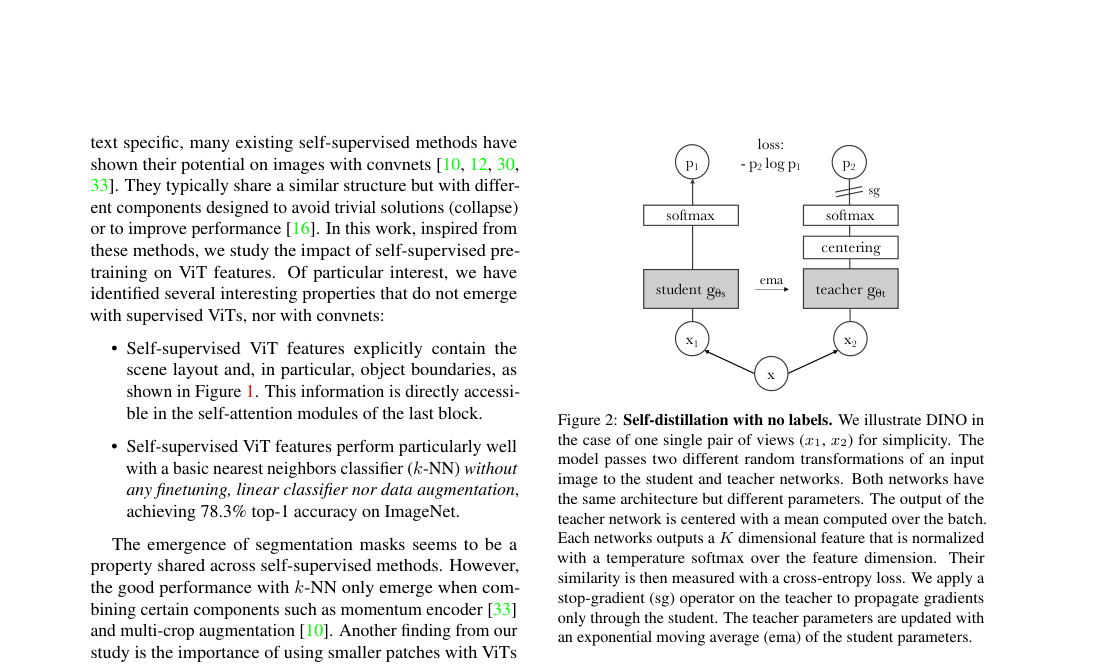
DINO uses identical student and teacher backbones, usually ViT-S or ViT-B, with separate parameters and projection heads. Both networks process multiple augmented views; the student sees all crops, the teacher only global crops. The teacher weights follow an EMA of the student.
Loss / Objective
The objective matches student predictions to sharpened, centered teacher targets across views.
Algorithm
The teacher and center follow moving-average updates.
Training Procedure
- Epochs: 300.
- Optimizer: AdamW.
- Batch size: 1024.
- Crops: global, local.
- Student temperature: .
- Teacher temperature: warmup to .
- Teacher momentum: .
Evaluation
Datasets
- ImageNet.
- Oxford Paris.
- Copydays.
- DAVIS-2017.
- VTAB.
- ImageNet low-shot.
Metrics
- ImageNet top-1 accuracy.
- k-NN top-1 accuracy.
- Retrieval mAP.
- Copy detection mAP.
- DAVIS , , and .
- VTAB task accuracy.
Headline results
- ImageNet ViT-S/8: 78.3% k-NN top-1.
- ImageNet ViT-S/16: 74.5% linear, 74.5% k-NN top-1.
- Image retrieval, RN50: 75.3 mAP on ROxf, 67.5 mAP on RPar.
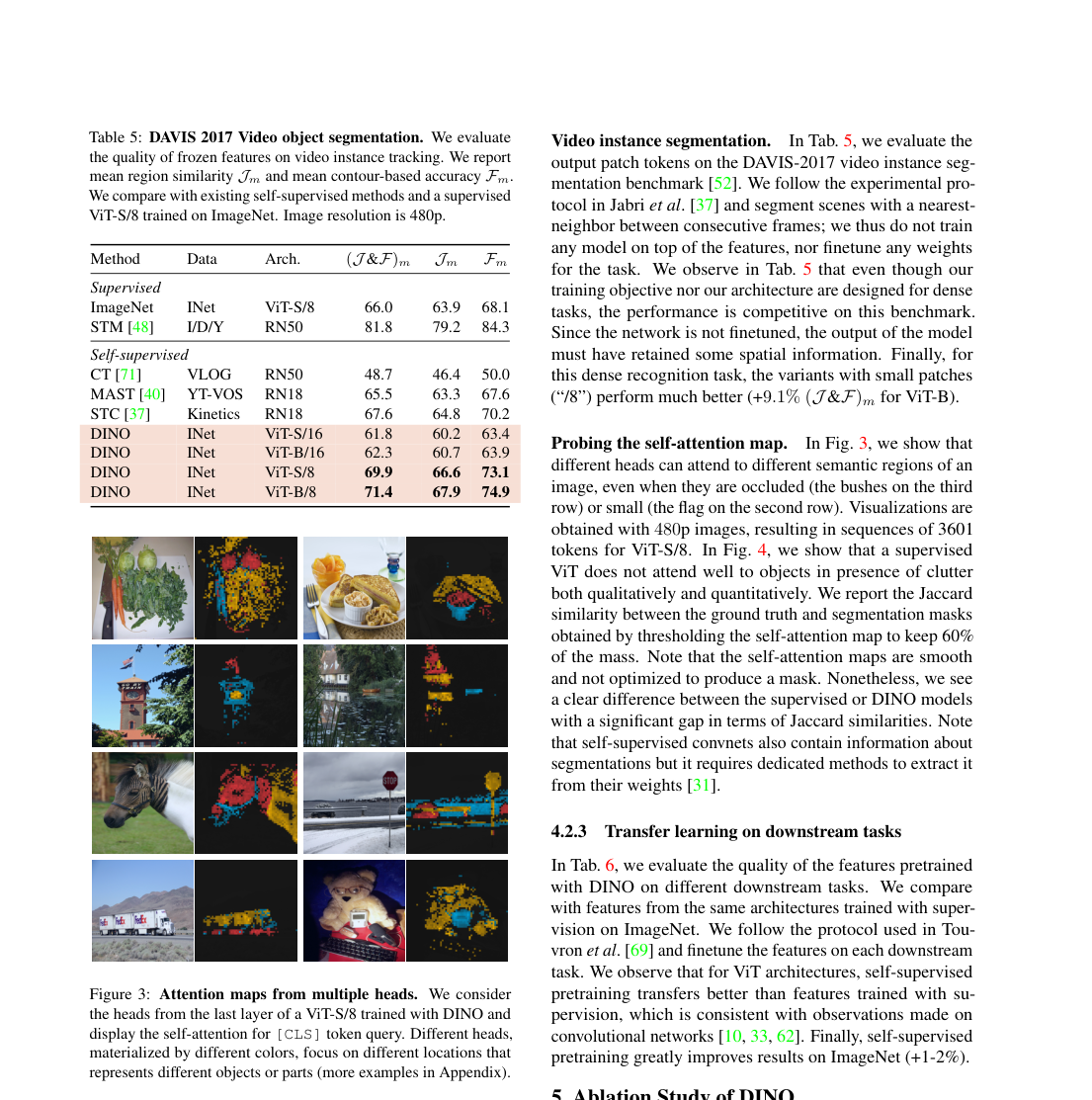
- DAVIS-2017 ViT-B/8: 71.4, 67.9, 74.9.
- Multi-crop training: 74.6% vs 72.5% k-NN, in 24h vs 46h.
Results table
Table 3: Image retrieval excerpt for DINO with ResNet-50 features
| Method | Arch. | Param. | ROxf | RPar |
|---|---|---|---|---|
| DINO | RN50 | 23 | 75.3 | 67.5 |
Qualitative dense behavior
Page 7 shows two evaluation artifacts: a DAVIS-2017 video-object-segmentation table and qualitative attention maps from different ViT heads. The maps localize distinct objects or parts without mask supervision.
Ablations
- Momentum removal collapses performance to 0.1% k-NN and linear accuracy.
- Multi-crop raises k-NN by about 2 points while reducing training time.
- Smaller ViT patches improve dense recognition and k-NN accuracy.
- Projection heads and centering are critical for stable training.
Method Strengths and Weaknesses
Strengths
- Frozen ViT features reach 78.3% ImageNet k-NN without finetuning.
- Last-layer attention maps recover object boundaries without mask supervision.
- One objective transfers across retrieval, segmentation, and classification.
- Multi-crop improves accuracy and halves training time in the reported comparison.
Weaknesses
- Performance depends critically on momentum, centering, and projection-head design.
- Training still uses many crops and large batches.
- Dense behavior is strongest with small patches, which increase token count.
- The method is evaluated mainly on ImageNet-scale visual pretraining.
Suggestions from the authors
- Pretrain larger ViT models with DINO on random uncurated images.
- Study why self-supervised ViTs expose segmentation information in attention.
- Push image-only pretraining toward stronger dense prediction transfer.
- Clarify which teacher construction choices best stabilize self-distillation.
Links
Prior Papers
- @chenSimCLR2020 — contrastive image pretraining baseline that DINO matches or surpasses without negatives.
- @grillBYOL2020 — direct teacher–student antecedent for DINO's self-distillation design.
- @dosovitskiyViT2020 — Vision Transformer backbone whose self-supervised behavior DINO probes in depth.
- @radfordCLIP2021 — adjacent vision pretraining baseline with stronger supervision through image–text pairs.
Further Papers
- @heMAE2021 — later self-supervised ViT pretraining method with a different masked reconstruction objective.
- @kirillovSAM2023 — segmentation-oriented foundation model that also relies on strong ViT representations.
- @liuSwinTransformer2021 — transformer vision backbone relevant to extending DINO-style self-supervision beyond plain ViTs.