A Simple Framework for Contrastive Learning of Visual Representations
A Simple Framework for Contrastive Learning of Visual Representations
Problem
Framing
Contrastive image pretraining lagged supervised ImageNet features because objective choice, augmentation design, and architecture coupling were entangled. SimCLR closes this gap with a minimal recipe: two stochastic views, a projection head, and temperature-scaled contrastive loss, reaching 76.5% top-1 linear evaluation on ImageNet with ResNet-50.
Currently Used Methods
Foundational
- Contrastive Predictive Coding — context prediction over image patches with a PixelCNN aggregator.
- Limitation in context: encoder sees patches, not full-image crops, and needs extra context machinery.
- Momentum Contrast — memory-bank contrastive learning with a momentum encoder.
- Limitation in context: relies on external negatives instead of pure in-batch sampling.
- PIRL — pretext-invariant representation learning with contrastive objectives.
- Limitation in context: weaker recipe than symmetric two-view augmentation plus projection head.
- AMDIM — mutual-information learning across local and global views.
- Limitation in context: constrains the backbone instead of using standard stronger ResNets.
- Contrastive Multiview Coding — separate networks for different views.
- Limitation in context: duplicates encoders where one shared encoder suffices.
Proposed Method
Architecture
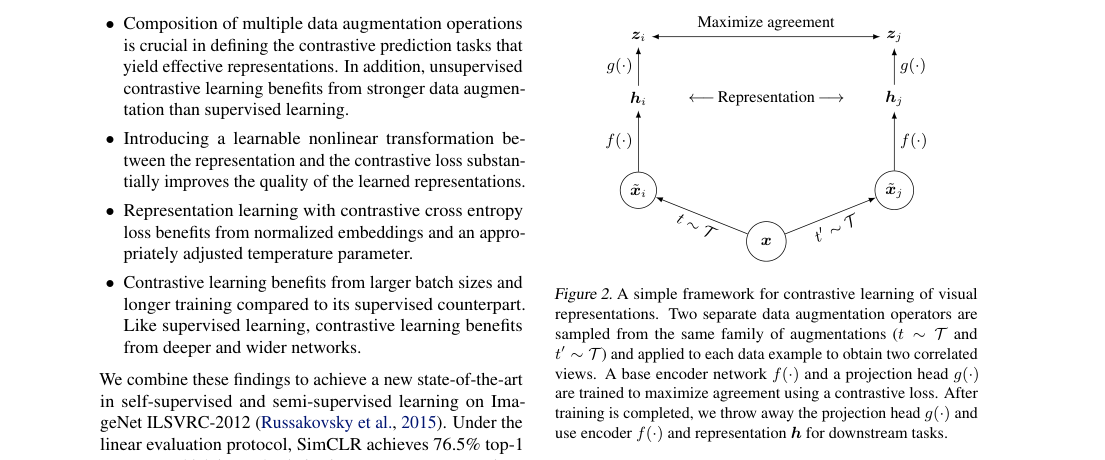
SimCLR applies two random augmentations to each image , encodes both views with a shared base network , then maps features to contrastive embeddings with a projection head . The downstream representation is the pre-projection vector ; the paper reports a nonlinear 2-layer MLP head improves it.
Loss / Objective
The paper trains on ordered positive pairs within a -view minibatch using NT-Xent.
Algorithm
Each minibatch draws two stochastic views per image, computes embeddings, and optimizes the symmetric contrastive loss over all positive pairs.
Training Procedure
- Dataset: ImageNet ILSVRC-2012 pretraining.
- Backbone: ResNet-50, plus wider and deeper variants.
- Projection head: 2-layer nonlinear MLP.
- Loss temperature: .
- Batch size: up to 4096 in main runs.
- Train epochs: 100 for base comparisons; up to 1000 for best results.
- Optimizer: LARS for pretraining.
- Learning-rate schedule: warmup then cosine decay.
- Data augmentation: random crop-resize with flip, color distortion, Gaussian blur.
- Batch norm: global BN across devices.
Evaluation
Datasets
- ImageNet ILSVRC-2012: linear evaluation and semi-supervised fine-tuning.
- 12 transfer datasets: standard downstream transfer benchmark.
- CIFAR-10: auxiliary confirmation experiments.
Metrics
- ImageNet linear evaluation: top-1, top-5 accuracy.
- Semi-supervised ImageNet: top-5 accuracy at 1% and 10% labels.
- Transfer learning: top-1 accuracy after fine-tuning.
Headline results
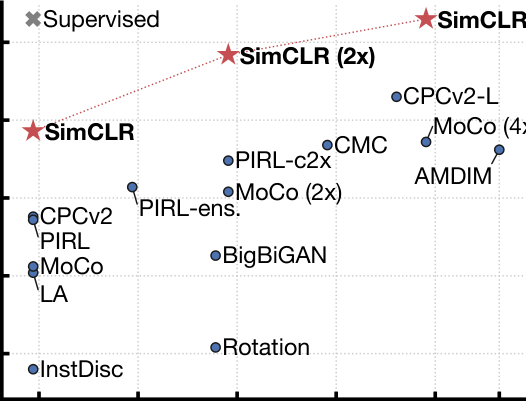
- ImageNet, ResNet-50 linear eval: 76.5% top-1.
- ImageNet, ResNet-50 linear eval: 91.0% top-5.
- ImageNet, ResNet-50 (2x) linear eval: 79.8% top-1.
- ImageNet, ResNet-50 (4x) linear eval: 85.8% top-5 with 1% labels.
- ImageNet, ResNet-50 (4x) linear eval: 92.6% top-5 with 10% labels.
Ablations
- Augmentation composition: crop plus color distortion is decisive; blur adds further gains.
- Projection head: nonlinear head clearly beats linear head.
- Loss design: NT-Xent outperforms alternative contrastive losses.
- Scale: larger batch sizes, longer training, and bigger backbones all improve accuracy.
Table 1: Effect of color distortion strength and blur on ImageNet top-1 accuracy
| Methods | 1/8 | 1/4 | 1/2 | 1 | 1 (+Blur) | AutoAug |
|---|---|---|---|---|---|---|
| SimCLR | 59.6 | 61.0 | 62.6 | 63.2 | 64.5 | 61.1 |
| Supervised | 77.0 | 76.7 | 76.5 | 75.7 | 75.4 | 77.1 |
Method Strengths and Weaknesses
Strengths
- Minimal recipe removes memory banks and separate view encoders.
- Standard ResNets suffice; no architecture-specific contrastive machinery.
- Nonlinear projection head improves learned representation quality.
- Scaling laws are clean: more batch, time, width, and depth help.
Weaknesses
- Large-batch training is central to the strongest results.
- Performance is highly sensitive to augmentation composition.
- Best numbers require long pretraining schedules.
- Learned embedding is not the best downstream representation; the objective and representation diverge.
Suggestions from the authors
- Study broader augmentation families beyond crop, color distortion, and blur.
- Understand why projection heads help while downstream tasks prefer pre-projection features.
- Reduce dependence on very large batch sizes.
- Extend contrastive pretraining analysis across more architectures and tasks.
Links
Prior Papers
- @goodfellowGAN2014 — early strong visual representation baseline that sharpened the need for label-free feature learning.
- @heDeepResidualLearning2016 — SimCLR builds directly on ResNet backbones and tests width and depth scaling.
- @kingmaAdam2014 — part of the broader optimizer background, though SimCLR's main pretraining uses LARS.
- @radfordCLIP2021 — later contrastive vision-language work inherits the two-view contrastive template at larger scope.
Further Papers
- @grillBYOL2020 — removes negatives but keeps the two-view self-supervised image-pretraining setup.
- @caronDINO2021 — extends self-distillation for visual representation learning beyond SimCLR's contrastive loss.
- @heMAE2021 — offers a masking-based alternative to contrastive image pretraining on similar backbones.
- @radfordCLIP2021 — scales contrastive pretraining from image-instance discrimination to image-text alignment.