Mamba: Linear-Time Sequence Modeling with Selective State Spaces
Mamba: Linear-Time Sequence Modeling with Selective State Spaces
Problem
Framing
Linear-time sequence models had not matched Transformer quality on discrete, information-dense modalities like language. Mamba closes this gap by making SSM dynamics input-selective and pairing them with a hardware-aware recurrent scan, yielding linear scaling, 5\times inference throughput gains, and strong language results up to 3B parameters.
Currently Used Methods
Foundational
- @vaswaniAttentionAllNeed2017 — dense self-attention enables strong content-based token interactions.
- Limitation in context: quadratic context cost and KV-cache-heavy autoregressive inference.
- @hochreiterLSTM1997 — gated recurrence with input-dependent memory updates.
- Limitation in context: sequential execution limits throughput and long-context scaling.
- "Efficiently Modeling Long Sequences with Structured State Spaces" — structured SSMs give long-range linear recurrences.
- Limitation in context: time-invariant dynamics weaken content-based reasoning on text.
- @pengRWKV2023 — recurrent language model with attention-like decay and token mixing.
- Limitation in context: limited state expansion and less expressive selective SSM parameterization.
- "Hyena Hierarchy: Towards Larger Convolutional Language Models" — long convolutions offer subquadratic sequence mixing.
- Limitation in context: convolutional kernels do not support selective token-dependent state updates.
Proposed Method
Architecture
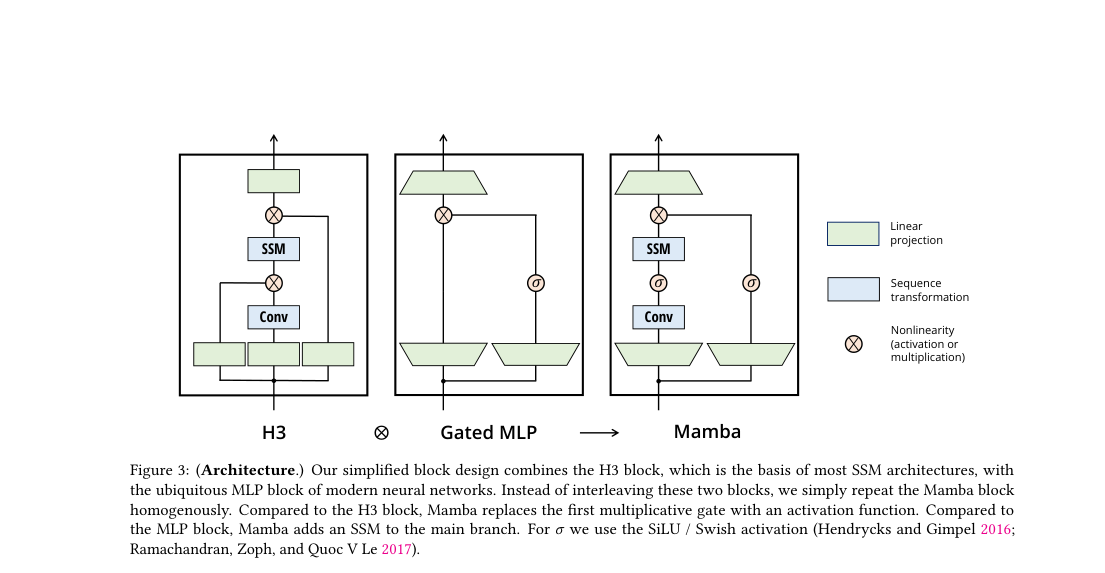
Mamba repeats a single homogeneous block. Each block uses an input projection, a short convolution, a selective SSM branch, and a multiplicative gate from the parallel branch; it removes attention and standalone MLP blocks by folding the SSM path into a gated MLP-style design.
Loss / Objective
The paper trains Mamba with the standard next-token autoregressive objective.
Sampling Rule / Algorithm
The selective SSM updates the hidden state with input-dependent discretized parameters.
Training Procedure
- Language pretraining data: The Pile.
- Language training length for zero-shot comparison: 300B tokens.
- Context lengths in scaling experiments: up to .
- Total batch size in scaling experiments: about tokens/step.
- Optimizer: AdamW.
- Weight decay: 0.1.
- Warmup: 10% of total steps.
- AdamW : in speech experiments.
- Mamba learning-rate sweep reported up to .
Evaluation
Datasets
- The Pile language modeling.
- HG38 human genome pretraining.
- Great Apes genomic classification.
- SC09 speech generation.
- Synthetic selective copying.
- Synthetic induction heads.
Metrics
- Perplexity.
- Zero-shot accuracy.
- FID.
- sFID.
- FAD.
- Induction/selective-copy accuracy.
- Throughput.
Headline results
- Language modeling: Mamba-3B outperforms same-size Transformers and matches Transformers about 2\times larger.
- Language zero-shot: Mamba is reported best-in-class at each size in Table 3.
- Inference: about 5\times higher throughput than comparable Transformers.
- Induction heads: perfect generalization to sequences beyond tokens, about 4000\times train length.
- Speech generation (SC09): FID drops by more than half versus prior state of the art.
Ablations
- Selective parameters: is the dominant selective parameter; adding selective helps further.
- SSM parameterization: real-valued S4 variants match complex variants inside the block.
- Architecture: the simpler Mamba block matches H3 while using a more uniform design.
- State size: larger recurrent state dimension improves performance.
Method Strengths and Weaknesses
Strengths
- Restores content-dependent reasoning to SSMs with input-selective dynamics.
- Linear-time recurrent inference avoids Transformer KV-cache growth.
- Strong cross-domain results span language, genomics, audio, and synthetic recall.
- Hardware-aware scan makes selective recurrence practical on modern GPUs.
Weaknesses
- Core scan algorithm is substantially more specialized than standard attention kernels.
- Evaluation emphasizes autoregressive benchmarks, not bidirectional or encoder-decoder settings.
- Reported gains rely on careful systems design, not only the mathematical model.
- Method adds custom discretization and scan machinery that complicates implementation.
Suggestions from the authors
- Apply selective SSMs to more modalities and foundation-model settings.
- Study whether models learn automatic state resets across episode boundaries.
- Explore other forms of selection beyond , , and .
- Extend selective mechanisms to broader RNN and CNN families.
Links
Prior Papers
- @vaswaniAttentionAllNeed2017 — Transformer attention is the main baseline Mamba targets on quality and efficiency.
- @hochreiterLSTM1997 — Mamba connects selective SSM updates to classical gated recurrence.
- @pengRWKV2023 — RWKV is a recurrent language-model baseline with overlapping efficiency goals.
Further Papers
No vault papers identified as further work yet.