RWKV: Reinventing RNNs for the Transformer Era
RWKV: Reinventing RNNs for the Transformer Era
Problem
Framing
Transformers train well but pay memory and compute during inference over long contexts. RWKV closes this gap with a recurrent reformulation of attention-like mixing that stays parallel during training and linear at inference, while remaining competitive with similarly sized LMs on Pile-trained zero-shot benchmarks.
Currently Used Methods
Foundational
- @vaswaniAttentionAllNeed2017 — full self-attention gives strong sequence modeling with global token interactions.
- Limitation in context: quadratic inference cost blocks long-context efficiency.
- @hochreiterLSTM1997 — recurrent state gives linear-time autoregressive inference.
- Limitation in context: training is sequential and scales poorly.
- "An Attention Free Transformer" — replaces pairwise attention with kernelized content-position mixing.
- Limitation in context: not cast as an efficient recurrent cell.
- "Reformer: The Efficient Transformer" — reduces attention cost with sparse and hashed approximations.
- Limitation in context: still keeps transformer-style sequence memory overhead.
- "Linear Transformers Are Secretly Fast Weight Memory Systems" — linearizes attention with kernel feature maps.
- Limitation in context: does not recover RWKV's simple recurrent update.
Proposed Method
Architecture
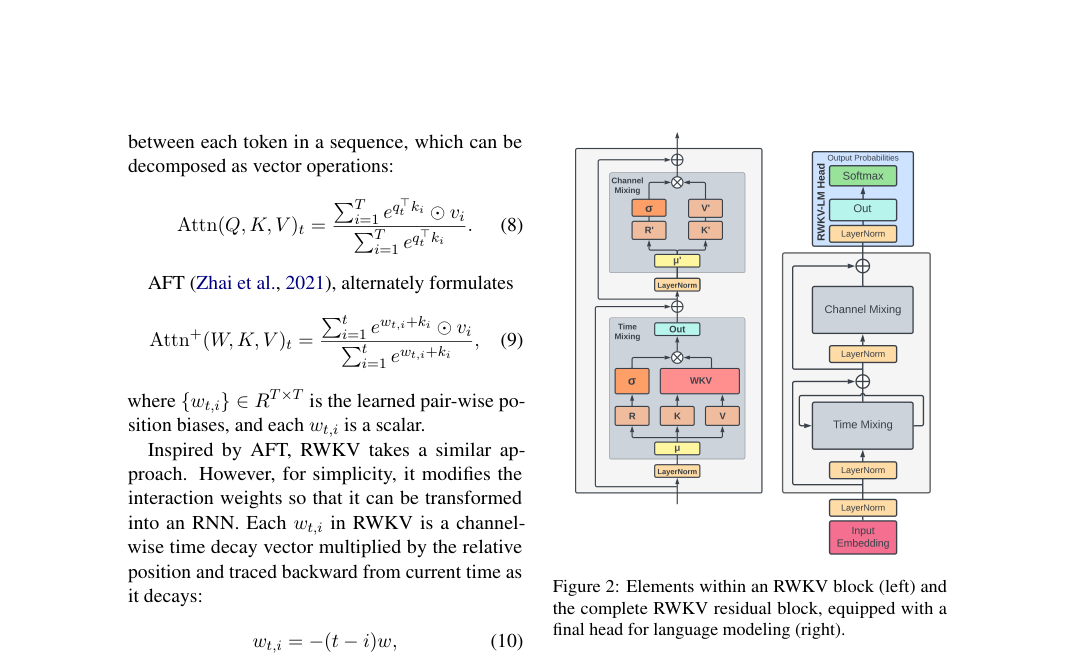
RWKV stacks pre-norm residual blocks with two sublayers: Time Mixing and Channel Mixing. Time Mixing computes receptance, key, value, and a decayed weighted key-value aggregation; Channel Mixing is a gated feed-forward block with token shift.
Loss / Objective
The model trains with standard next-token cross-entropy.
Sampling Rule / Algorithm
Autoregressive inference updates a recurrent WKV state and emits the next-token distribution from the LM head.
Training Procedure
- Optimizer: Adam,
- Weight decay:
- Precision: bfloat16
- Context length:
- Batch size: 128 or 256 sequences
- Training data: one epoch on the Pile, 330B tokens
- Initial learning rate: to by model size
- End learning rate: about
Evaluation
Datasets
- The Pile pretraining corpus
- ARC-Easy, ARC-Challenge
- BoolQ, COPA, HeadQA
- HellaSwag, LAMBADA, OpenBookQA
- PiQA, ReCoRD, SciQ, Winogrande
- Enwik8
- Long Range Arena
Metrics
- Zero-shot accuracy
- Validation loss
- Bits per character
- Inference time
- RAM / VRAM usage
Headline results
- Scaling-law fit: Pareto linear fit reaches .
- Scaling-law extrapolation: one-order extrapolation still reaches .
- Pile-trained zero-shot NLP: RWKV tracks OPT, BLOOM, and Pythia at matched scale.
- Inference complexity: linear scaling in generation time and memory, unlike transformer baselines.
- Enwik8: competitive test bpc against efficient-transformer baselines.
Ablations
- Model size sweep: larger RWKV improves zero-shot accuracy across common NLP tasks.
- Compute scaling: loss follows transformer-style log-log scaling trends.
- Context-length training: longer contexts improve long-context language modeling.
- Inference benchmark: advantage widens as prompt length and model size grow.
Method Strengths and Weaknesses
Strengths
- Parallel training with recurrent inference targets the main transformer efficiency bottleneck.
- Scaling-law fit with suggests predictable large-model behavior.
- Zero-shot accuracy stays competitive with OPT, BLOOM, and Pythia at similar scales.
- Linear-time inference and lower memory directly matter for long-context deployment.
Weaknesses
- Core WKV mechanism is more specialized than standard attention and less widely validated.
- Reported competitiveness is mostly against open-source baselines, not strongest closed models.
- Training still uses fixed 1024-token chunks for pretraining.
- Evidence for long-context gains is narrower than the broad zero-shot suite.
Suggestions from the authors
- Extend RWKV to more modalities, including vision and audio.
- Study stronger long-context training and evaluation regimes.
- Improve kernels and systems support for faster large-scale training.
- Analyze theoretical properties of recurrent state and gradient flow.
Links
Prior Papers
- @vaswaniAttentionAllNeed2017 — RWKV keeps transformer-style parallel training while removing quadratic inference.
- @hochreiterLSTM1997 — RWKV inherits recurrent hidden-state efficiency without classic sequential training constraints.
Further Papers
- @guMamba2023 — another sequence model that replaces full attention with linear-time state-space style recurrence.