Long Short-Term Memory
Long Short-Term Memory
Problem
Framing
Standard RNN training could not bridge long delays because backpropagated error decays or explodes exponentially with time. LSTM closes this gap with a self-connected memory cell and gates that preserve constant error flow, and it reports learning across delays above 1000 steps.
Currently Used Methods
Foundational
- @rumelhartLearningRepresentationsBackpropagating1986 — backpropagation establishes gradient learning for neural networks.
- Limitation in context: no mechanism preserves gradients across long recurrent delays.
- "Backpropagation Through Time" — unfolds recurrent nets across time for gradient descent.
- Limitation in context: long-range error signals vanish or explode.
- "Real-Time Recurrent Learning" — online gradient updates for recurrent networks.
- Limitation in context: suffers the same long-time-lag instability.
- "Time-Delay Neural Networks" — fixed temporal windows model short local dependencies.
- Limitation in context: cannot span arbitrarily long unknown lags.
- @choGRU2014 — later gated recurrence simplifies memory control after LSTM.
- Limitation in context: it is a descendant, not a pre-LSTM solution.
Proposed Method
Architecture
LSTM introduces a memory cell with a unit self-connection of weight , an input gate, and an output gate. The self-loop forms the constant error carousel; the gates decide when to write to memory and when to expose memory to the rest of the network.
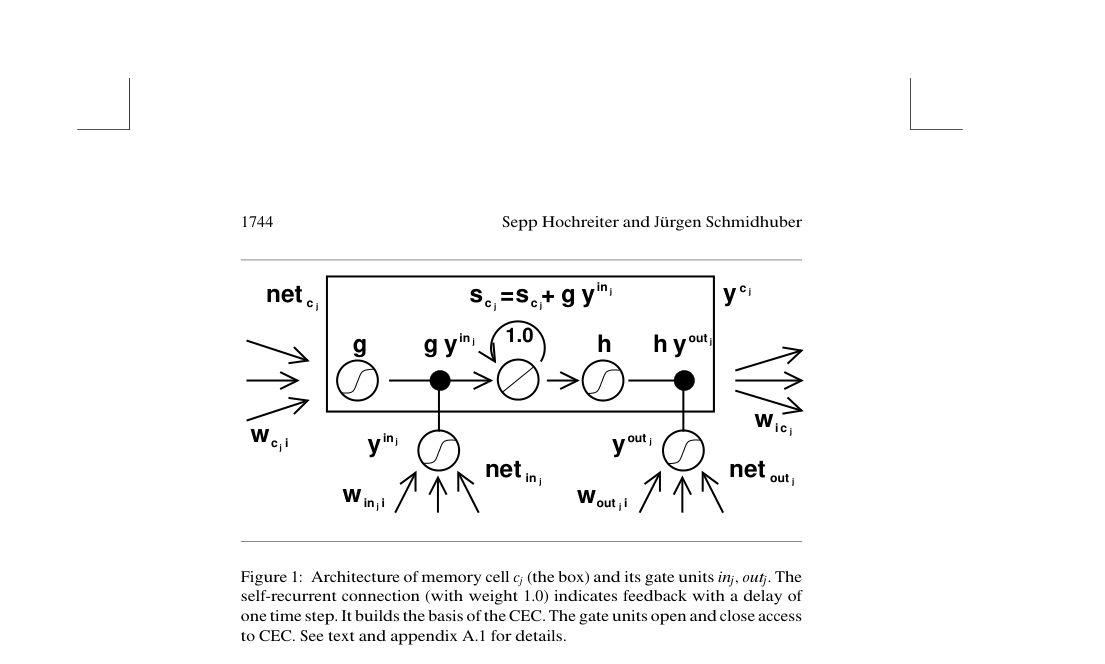
Loss / Objective
The paper trains by gradient descent on sequence prediction errors with truncated backpropagation through the gated cell dynamics.
Sampling Rule / Algorithm
The core recurrence is additive state accumulation through the gated self-loop.
Training Procedure
- Online learning.
- Logistic sigmoid activations.
- Initial weights in for experiments 1–2.
- Initial weights in for experiments 3–6.
- Activations reset after each input sequence.
- Error signals at every step only for experiment 1; otherwise mostly at sequence end.
Evaluation
Datasets
- Embedded Reber grammar.
- Noisy and noise-free long-lag synthetic sequences.
- Two-sequence tasks.
- Adding problem.
- Temporal order tasks.
Metrics
- Success rate across trials.
- Training sequences until success.
- Wrong predictions on held-out sequences.
- Mean squared error for regression-style tasks.
Headline results
- Embedded Reber grammar: LSTM reaches 100% success; older recurrent baselines do not.
- Task 2c, lag : success after 1,170,000 sequences.
- Adding problem, : 1 wrong prediction out of 2560; success after 74,000 sequences.
- Adding problem, : 0 wrong predictions out of 2560; success after 209,000 sequences.
- Adding problem, : 1 wrong prediction out of 2560; success after 853,000 sequences.
Ablations
- Output gates matter on embedded Reber grammar; the paper includes it mainly to show this.
- Delay length increase from 50 to 1000 remains solvable for LSTM on task 2c.
- Continuous-valued storage remains stable across hundreds of steps in the adding task.
- Baseline RTRL and BPTT fail once minimal lags become nontrivial.
Method Strengths and Weaknesses
Strengths
- Solves delays above 1000 steps with gradient training.
- Preserves error flow through an explicit additive memory path.
- Handles discrete and continuous long-lag tasks.
- Uses operations per time step, not second-order .
Weaknesses
- Evidence comes from synthetic tasks, not large real applications.
- Original cell uses only input and output gates; forgetting is unmanaged.
- Training still needs many sequence presentations on hard tasks.
- Truncated gradients restrict exact credit assignment outside the cell.
Suggestions from the authors
- Test LSTM on more realistic long-lag tasks beyond artificial benchmarks.
- Explore systematic network construction instead of arbitrary architecture choices.
- Study variants with different connectivity and cell-block sizes.
- Analyze and reduce internal-state drift over very long storage intervals.
Links
Prior Papers
- @rumelhartLearningRepresentationsBackpropagating1986 — provides the gradient-learning foundation that recurrent training extends across time.
Further Papers
- @choGRU2014 — simplifies gated recurrence with a lighter alternative to LSTM.
- @sutskeverSeq2Seq2014 — uses LSTM to make sequence-to-sequence learning practical.
- @petersELMo2018 — builds contextual language representations from stacked bidirectional LSTMs.
- @haWorldModels2018 — uses recurrent memory for latent dynamics modeling.
- @pengRWKV2023 — revisits recurrent sequence modeling with modern large-scale training.
- @guMamba2023 — advances long-range sequence modeling with selective state-space recurrence.