Recurrent World Models Facilitate Policy Evolution
Recurrent World Models Facilitate Policy Evolution
Problem
Framing
Model-based RL usually learns dynamics but still trains policies in the real environment, because learned simulators are exploitable. This paper closes that gap with a compact controller over a learned latent world model: a VAE for spatial compression, an MDN-RNN for stochastic dynamics, and CMA-ES for policy search. It solves CarRacing-v0 with and trains a VizDoom policy entirely inside the learned simulator, then transfers it to in the real game.
Currently Used Methods
Foundational
- @kingmaVAE2013 — variational autoencoders learn compact latent codes from pixels.
- Limitation in context: framewise compression alone misses temporal prediction needed for control.
- @hochreiterLSTM1997 — LSTM provides recurrent memory for sequential prediction.
- Limitation in context: plain recurrence lacks stochastic output modeling for multimodal futures.
- @choGRU2014 — gated recurrent units popularize compact recurrent dynamics models.
- Limitation in context: still not a probabilistic latent simulator for policy training.
- @mnihA3C_2016 — model-free deep RL learns control directly from observations.
- Limitation in context: weaker sample efficiency and lower CarRacing scores from raw pixels.
- @goodfellowGAN2014 — adversarial training sharpens generative realism.
- Limitation in context: no recurrent latent dynamics model for interactive control.
Proposed Method
Architecture
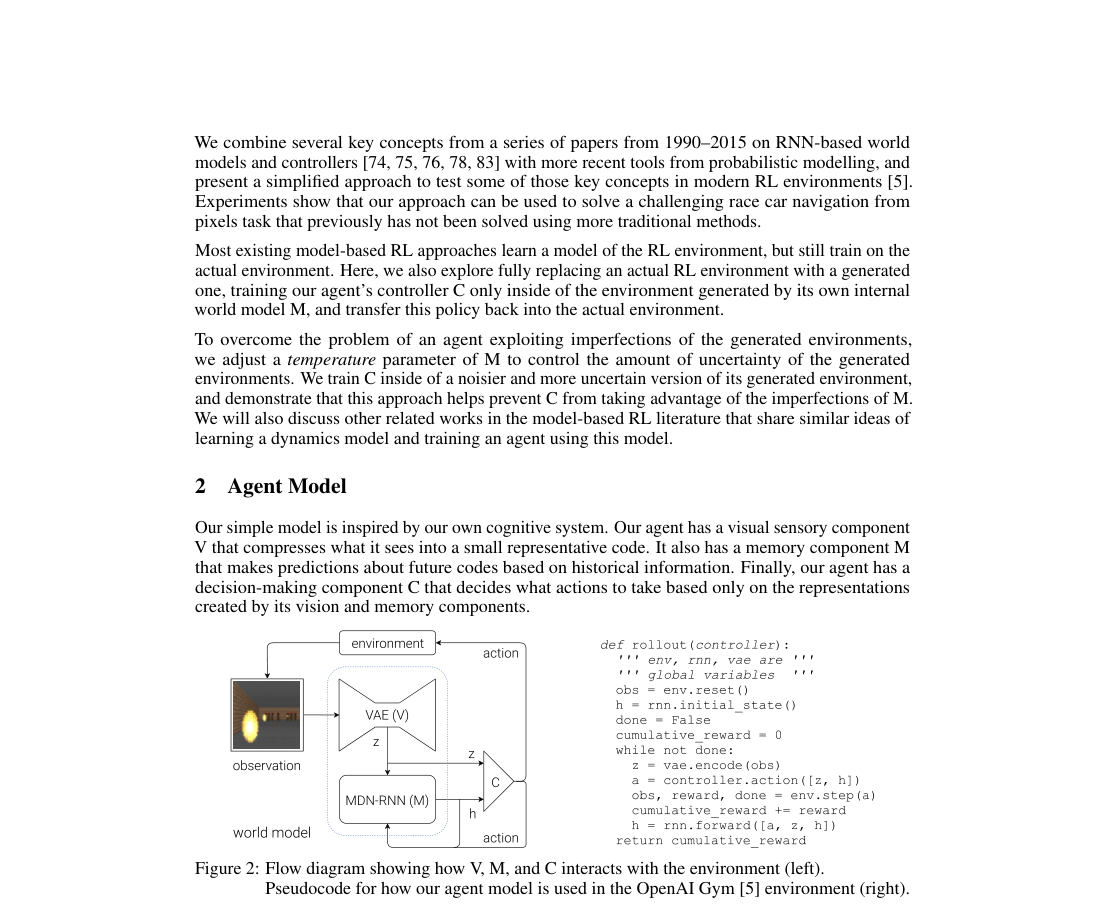
The agent factorizes into vision , memory , and controller . is a ConvVAE that maps each frame to latent ; is an LSTM-MDN that models the next-latent distribution; is a linear policy over . CarRacing uses 256 LSTM units, Doom uses 512, and both use 5 Gaussian mixtures.
Loss / Objective
The method trains reconstruction, latent regularization, and next-state density modeling in separate stages.
Sampling Rule / Algorithm
Rollouts sample the next latent from the MDN-RNN, with temperature controlling simulator stochasticity.
Training Procedure
- Collect 10,000 random rollouts.
- Train ConvVAE on frames.
- Train MDN-RNN for 20 epochs with teacher forcing.
- CarRacing MDN-RNN: 256 LSTM units.
- Doom MDN-RNN: 512 LSTM units.
- Both tasks: 5 Gaussian mixtures.
- Controller optimization: CMA-ES.
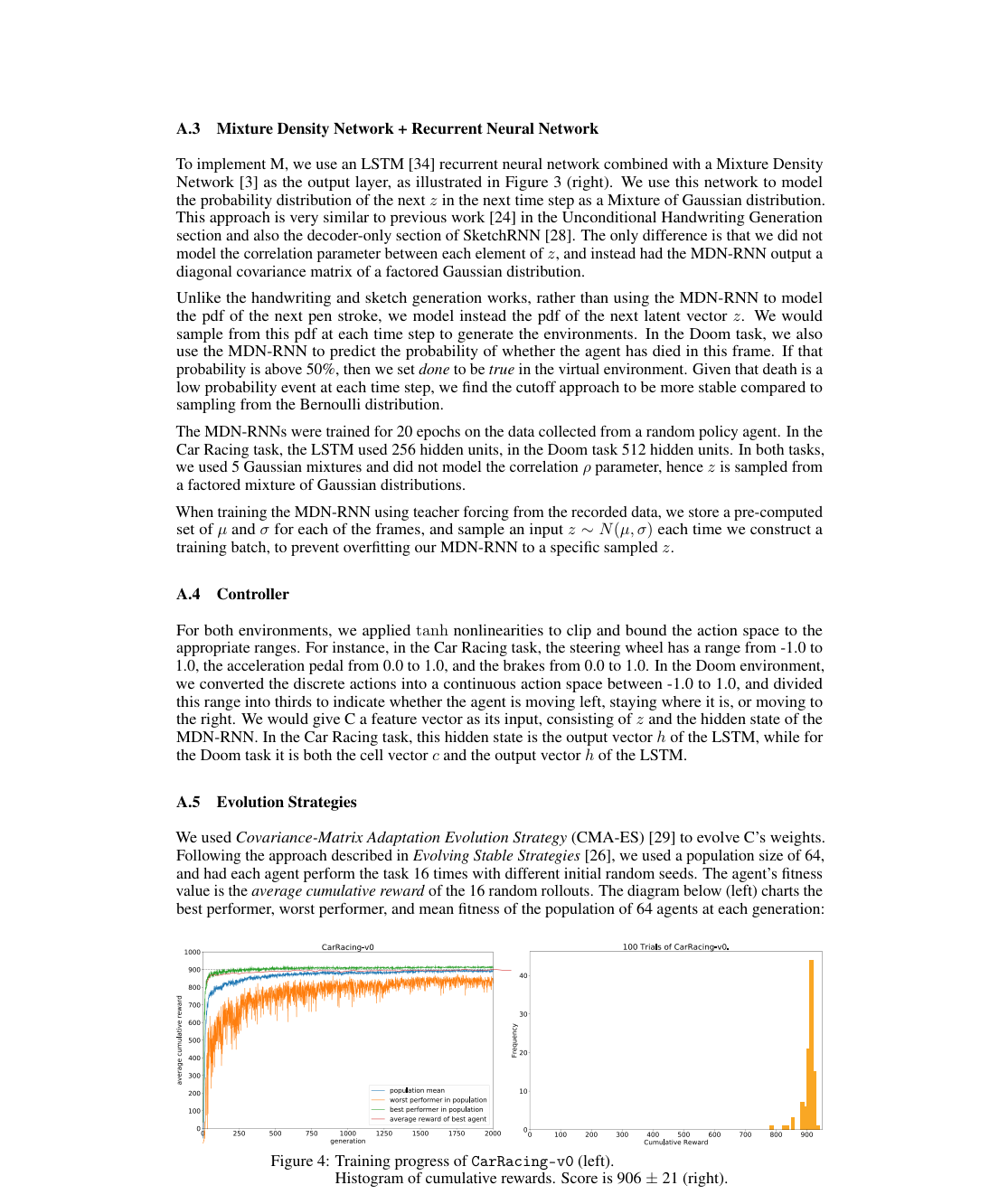
- CMA-ES population size: 64.
- Fitness evaluation: 16 rollouts per agent.
- Doom transfer setting: .
Evaluation
Datasets
- CarRacing-v0, pixel-based continuous control.
- DoomTakeCover-v0, pixel-based survival task.
- 10,000 random-policy rollouts for model learning.
Metrics
- Average return over 100 trials.
- Survival time over 100 VizDoom rollouts.
- Transfer score from virtual to actual environment.
Headline results
- CarRacing-v0, V-only controller: .
- CarRacing-v0, V-only with hidden layer: .
- CarRacing-v0, full world model: .
- DoomTakeCover-v0, virtual training at : virtual , actual .
- DoomTakeCover-v0, previous gym leader: actual .
Ablations
- Remove memory : CarRacing drops from to mean return.
- Add one hidden layer to V-only controller: improves to but still fails the solve threshold.
- Sweep simulator temperature : low induces exploitative policies that fail transfer.
- Raise to : harder virtual training yields the best real-environment Doom score.
Method Strengths and Weaknesses
Strengths
- Solves CarRacing-v0 with , exceeding the 900 solve threshold.
- Transfers a policy trained only in latent simulation to on real VizDoom.
- Keeps control simple: only 867 controller parameters in CarRacing.
- Uses stochastic dynamics and temperature to reduce simulator exploitation.
Weaknesses
- Learned simulators remain exploitable; low policies collapse at transfer time.
- World model misses scene details, including exact monster counts in Doom.
- Policy receives simulator hidden state, richer than standard agent observations.
- Training is stage-wise, not end-to-end, which may limit task-specific representation learning.
Suggestions from the authors
- Train policies in generated environments with tuned uncertainty to improve transfer.
- Explore better defenses against controllers exploiting model imperfections.
- Study richer world models that capture game logic and rare events more faithfully.
- Extend latent-space training to more realistic, computationally expensive environments.
Links
Prior Papers
- @kingmaVAE2013 — provides the latent-variable encoder-decoder used as the vision module .
- @hochreiterLSTM1997 — supplies the recurrent memory backbone used inside the MDN-RNN world model.
- @choGRU2014 — relevant recurrent-sequence precursor for learned latent dynamics over action-conditioned trajectories.
- @mnihA3C_2016 — serves as a model-free RL baseline family that underperforms the full world model on CarRacing.
Further Papers
- @hafnerDreamerV1_2019 — advances latent world models by optimizing behavior through imagined rollouts.
- @hafnerDreamerV2_2021 — extends the world-model paradigm to stronger visual control with improved latent planning.
- @hafnerDreamerV3_2023 — scales latent world models into a more general, robust control recipe.
- @schrittwieserMuZero2020 — builds a stronger model-based RL line around learned dynamics and policy/value optimization.