Mastering Diverse Domains through World Models
Mastering Diverse Domains through World Models
Problem
Framing
Deep RL still needs domain-specific tuning when tasks shift across action spaces, observation types, and reward scales. DreamerV3 argues that a single world-model agent can remove most retuning by making optimization scale-robust through symlog transforms, twohot value heads, KL balancing, and return-range normalization. It then outperforms specialized baselines across 150+ tasks and solves Minecraft diamond from scratch.
Currently Used Methods
Foundational
- @haWorldModels2018 — latent dynamics model for control from compact imagined rollouts.
- Limitation in context: lacked DreamerV3's actor-critic training and cross-domain robustness.
- @hafnerDreamerV1_2019 — latent imagination with actor-critic for continuous control.
- Limitation in context: restricted to continuous control and less robust objectives.
- @hafnerDreamerV2_2021 — discrete latents and Atari-level world-model control.
- Limitation in context: still needed more tuning across diverse domains and scales.
- @schulmanPPO2017 — strong on-policy baseline with broad adoption.
- Limitation in context: fixed hyperparameters trail Dreamer across diverse visual domains.
- @schrittwieserMuZero2020 — model-based value learning with strong game performance.
- Limitation in context: more specialized and less plug-and-play across domains.
Proposed Method
Architecture
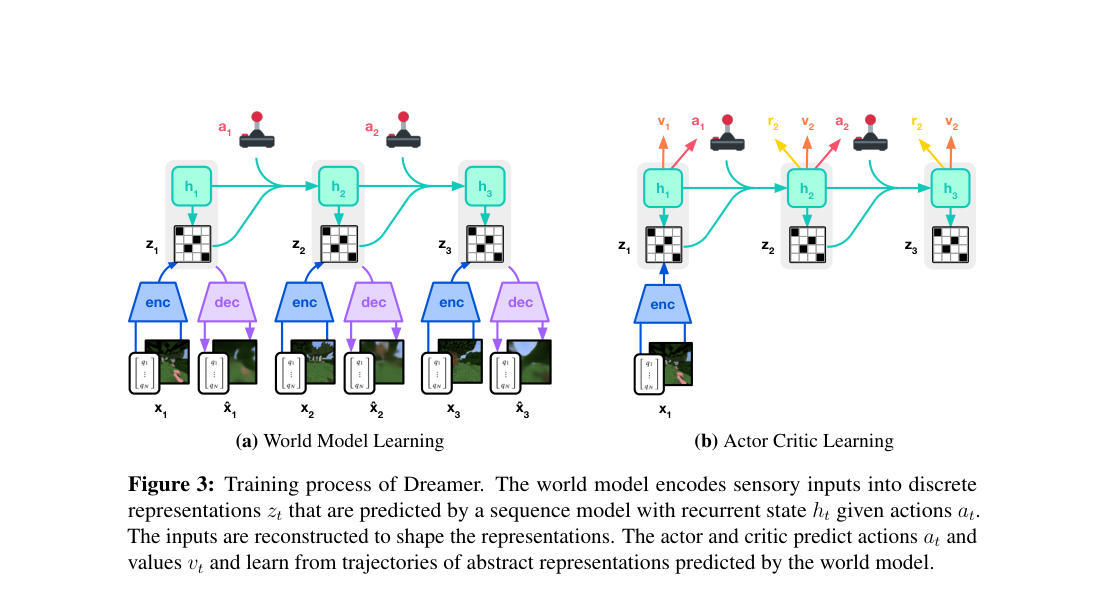
DreamerV3 keeps the Dreamer template: an RSSM world model, a critic over imagined returns, and an actor trained only in latent space. The encoder maps to discrete ; a recurrent model updates ; predictions for observation, reward, and continuation are decoded from .
Loss / Objective
The world model minimizes reconstruction, reward, continuation, dynamics, and representation losses with KL free bits and asymmetric stop-gradient placement:
Sampling Rule / Algorithm
Actor learning uses imagined trajectories and return-range normalization with a floor at :
Training Procedure
- Replay capacity:
- Batch size:
- Batch length:
- Imagination horizon:
- Discount:
- Return trace parameter:
- Entropy scale:
- Loss scales: , ,
- Critic loss scales: ,
- Free bits threshold: nat
- Replay ratio:
- EMA regularization rate for return scale:
Evaluation
Datasets
- Atari: 57 tasks, 200M steps
- ProcGen: 16 tasks, 50M steps
- DMLab: 30 tasks, 100M steps
- Minecraft Diamond: 1 task, 100M steps
- Also evaluates Control Suite, Crafter, Atari 100k, and BSuite
Metrics
- Human-normalized score on Atari
- Episode return on ProcGen, DMLab, Crafter, Control Suite, BSuite
- Item-discovery rate on Minecraft Diamond
- Data-efficiency curves over environment steps
Headline results
- Atari (57-task, 200M): exceeds tuned PPO and competes with specialized expert methods.
- ProcGen (16-task, 50M): beats PPO under one fixed configuration.
- DMLab (30-task, 100M): beats prior published baselines even against some 10\times-data references.
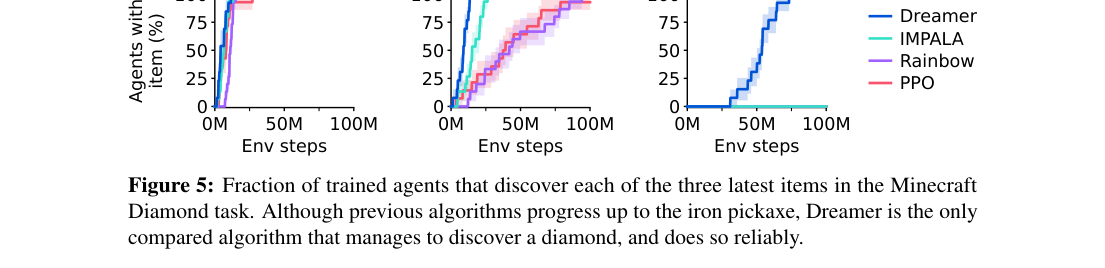
- Minecraft Diamond (100M): first method here to collect diamonds from scratch without human data.
- Cross-domain: one hyperparameter setting works across 150+ tasks.
Ablations
- Observation symlog: removing it lowers the 14-task mean return.
- Return normalization: replacing it with advantage normalization hurts robustness.
- Symexp twohot critic/reward heads: swapping to Huber loss degrades performance.
- KL balance plus free bits: removing them destabilizes learning and lowers return.
Method Strengths and Weaknesses
Strengths
- One configuration spans discrete, continuous, visual, and vector domains.
- Latent imagination avoids expensive online planning at action time.
- Return-range normalization stabilizes exploration under sparse rewards.
- Minecraft diamond result shows unusually long-horizon capability from pixels.
Weaknesses
- Strong robustness comes from many coupled tricks, not one simple principle.
- Evaluation emphasizes aggregate breadth more than controlled per-domain analysis.
- World-model quality still bottlenecks performance on hard stochastic environments.
- Large models and long training budgets remain expensive despite single-GPU runs.
Suggestions from the authors
- Study larger world models to extend the observed scaling trends.
- Improve sparse-reward exploration beyond current entropy-based behavior learning.
- Push model-based RL to harder open-world and long-horizon domains.
- Refine robust optimization tools for broader classes of prediction targets.
Links
Prior Papers
- @haWorldModels2018 — early latent world-model control that motivates learning in imagination.
- @hafnerDreamerV1_2019 — introduces Dreamer-style latent actor-critic training.
- @hafnerDreamerV2_2021 — direct predecessor adding discrete latents and strong Atari performance.
- @schulmanPPO2017 — central fixed-hyperparameter baseline throughout the paper.
- @schrittwieserMuZero2020 — specialized model-based benchmark for comparison on hard domains.
Further Papers
No vault papers identified as further work yet.