Dream to Control: Learning Behaviors by Latent Imagination
Dream to Control: Learning Behaviors by Latent Imagination
Problem
Framing
World-model agents from pixels were still short-horizon: they either planned over shallow rollouts or used derivative-free policy search. Dreamer closes this gap by learning an actor-critic entirely inside latent imagination and backpropagating value gradients through the learned dynamics. On 20 visual control tasks, it reaches an average score of 823 after steps.
Currently Used Methods
Foundational
- @haWorldModels2018 — latent dynamics with compact rollouts for visual control.
- Limitation in context: derivative-free controller training and weaker long-horizon credit assignment.
- @lillicrapDDPG2015 — deterministic actor-critic for continuous control.
- Limitation in context: learns from replay, not imagined latent trajectories.
- @mnihA3C_2016 — asynchronous policy gradients for scalable online RL.
- Limitation in context: needs far more environment interaction than model-based imagination.
- @haarnojaSAC2018 — entropy-regularized off-policy actor-critic.
- Limitation in context: no learned world model, so sample efficiency lags.
- @schulmanPPO2017 — stable clipped policy optimization.
- Limitation in context: optimizes on real trajectories, not differentiable latent rollouts.
Proposed Method
Architecture
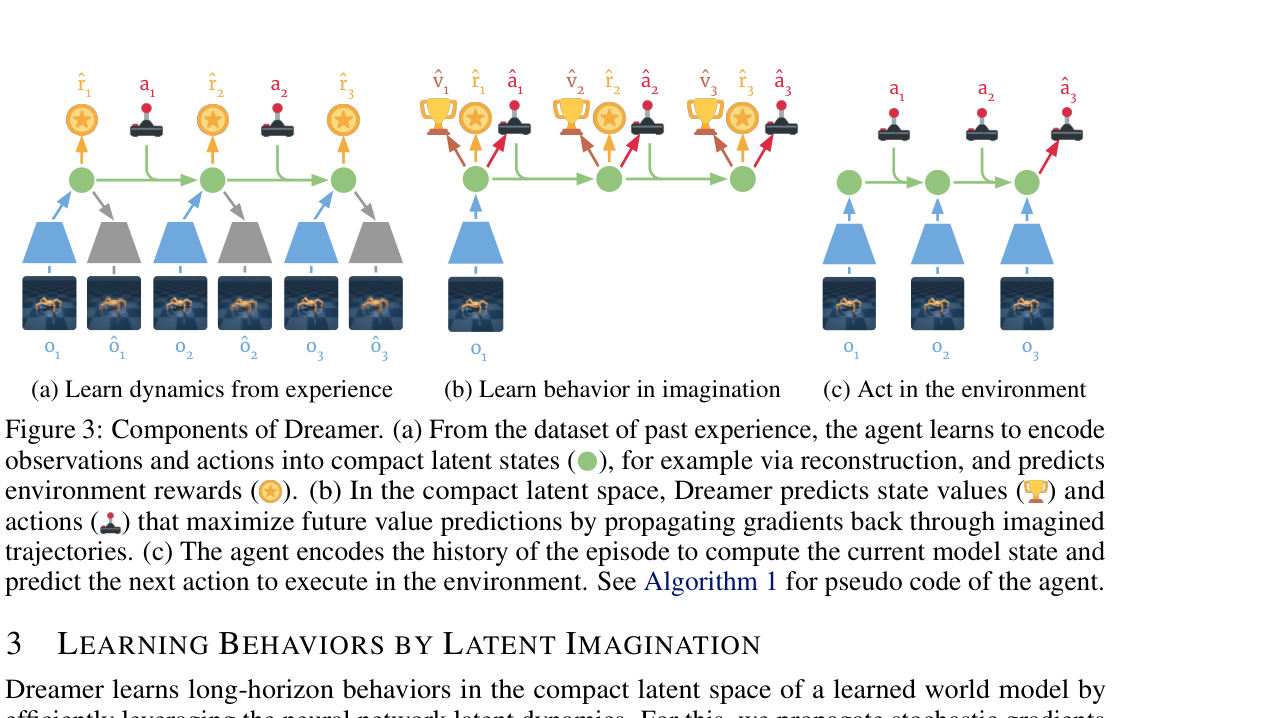
Dreamer combines an RSSM world model with dense actor and value heads in latent space. The world model uses an image encoder, latent transition and representation models, an image decoder, and a reward predictor; latent stochastic states are 30-dimensional diagonal Gaussians, and actor/value networks use 3 layers of 300 ELU units.
Loss / Objective
Behavior learning uses imagined -returns and regresses the value head to them.
Algorithm
The actor samples actions from the imagined latent state, and the value target bootstraps beyond the finite rollout horizon.
Training Procedure
- Seed episodes .
- Action repeat .
- Imagination horizon .
- Discount .
- Return parameter .
- Adam learning rate .
- Batch size sequences.
- Sequence length .
- Gradient clipping .
- Actor entropy scale .
Evaluation
Datasets
- DeepMind Control Suite from image observations.
- 20 continuous-control visual tasks.
- Comparisons include PlaNet, D4PG, A3C, and SLAC.
Metrics
- Episode return.
- Average score across tasks.
- Environment steps.
- Computation time.
Headline results
- DeepMind Control Suite average at steps: 823.
- D4PG average at steps: 786.
- Tasks solved with same hyperparameters: 20 visual control tasks.
- Dreamer exceeds prior methods in data-efficiency, computation time, and final performance.
Ablations
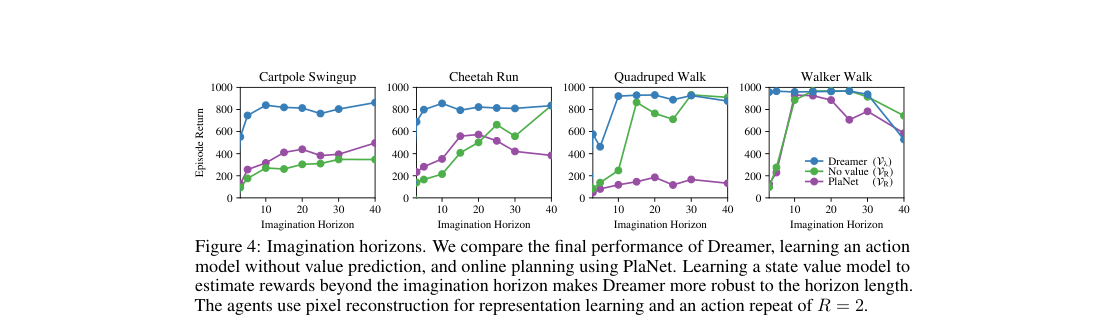
- Imagination horizon: Dreamer stays strong across , while no-value training degrades more sharply.
- Value learning: adding the value head reduces shortsightedness beyond finite rollouts.
- Action selection scheme: latent actor learning beats online planning on the visual control suite.
- World-model objective: reconstruction-based representation learning is sufficient for strong control.
Method Strengths and Weaknesses
Strengths
- Learns policy updates through analytic gradients in latent space.
- Same hyperparameters work across 20 visual control tasks.
- Beats D4PG average score with far fewer environment steps.
- Value head makes performance less sensitive to imagination horizon.
Weaknesses
- Depends on world-model accuracy for policy optimization.
- Finite imagination horizon still requires bootstrap targets.
- Evaluation centers on continuous control, not harder discrete domains.
- Uses image reconstruction, which may spend capacity on irrelevant detail.
Suggestions from the authors
- Extend latent-imagination learning to discrete-action domains like Atari and DeepMind Lab.
- Improve representation objectives beyond plain reconstruction for control.
- Study robustness of analytic gradient learning under model errors.
- Scale world models to harder long-horizon visual tasks.
Links
Prior Papers
- @haWorldModels2018 — supplies the latent world-model template that Dreamer upgrades with actor-critic behavior learning.
- @lillicrapDDPG2015 — provides the continuous-control actor-critic baseline that Dreamer replaces with imagined latent updates.
- @mnihA3C_2016 — represents strong model-free policy-gradient control used for efficiency and performance comparison.
- @haarnojaSAC2018 — anchors the comparison to modern off-policy actor-critic methods for continuous control.
Further Papers
- @hafnerDreamerV2_2021 — extends Dreamer to stronger world-model RL with broader empirical coverage.
- @hafnerDreamerV3_2023 — scales the Dreamer line into a more general and robust world-model agent.
- @schrittwieserMuZero2020 — shares the theme of learning behavior from compact learned dynamics, though with planning instead of latent actor-critic updates.