Asynchronous Methods for Deep Reinforcement Learning
Asynchronous Methods for Deep Reinforcement Learning
Problem
Framing
Deep RL in 2016 still depended on replay buffers or large distributed systems to stabilize correlated updates. This paper shows that parallel actor-learners alone can decorrelate training enough to make on-policy and value-based deep RL fast, stable, and CPU-only. On 57 Atari games, A3C reaches 496.8% mean and 116.6% median human-normalized score.
Currently Used Methods
Foundational
- @mnihDQN2015 — deep Q-learning from pixels with replay and target networks.
- Limitation in context: replay raises memory cost and ties training to off-policy updates.
- @schulmanTRPO2015 — stable policy-gradient updates with constrained optimization.
- Limitation in context: no scalable asynchronous deep visual control recipe.
- @lillicrapDDPG2015 — replay-based actor-critic for continuous control.
- Limitation in context: still depends on replay, so parallel on-policy learning remains open.
- "Massively Parallel Methods for Deep Reinforcement Learning" — distributed value learning at large scale.
- Limitation in context: requires many machines rather than one multicore CPU.
- "Playing Atari with Deep Reinforcement Learning" extensions such as Double and prioritized replay — stronger value estimation.
- Limitation in context: they still inherit replay-centric training and GPU-heavy pipelines.
Proposed Method
Architecture
A3C uses a shared convolutional encoder with separate policy and value heads. Atari uses a feedforward convnet or an LSTM variant; each thread keeps local parameters, rolls out for up to steps, then applies asynchronous gradients to shared global weights.
Loss / Objective
The actor maximizes -step advantage estimates with entropy regularization, while the critic regresses the bootstrapped return.
Sampling Rule / Algorithm
Each worker forms a truncated -step return and backs gradients through the rollout.
Training Procedure
- 16 actor-learners on one machine
- update every 5 actions
- shared RMSProp
- learning rate sampled from for Atari subset
- no GPUs for asynchronous methods
Evaluation
Datasets
- Atari 2600, 57 games, human-start evaluation
- TORCS car racing
- MuJoCo continuous control
- Labyrinth 3D maze tasks
Metrics
- Human-normalized score: mean, median
- Raw game score
- Training time in hours
- Data efficiency in training epochs
Headline results
- Atari-57 human starts: A3C FF 344.1% mean, 68.2% median.
- Atari-57 human starts: A3C LSTM 496.8% mean, 116.6% median.
- Atari-57 human starts: A3C FF, 1 day 263.9% mean, 61.3% median.
- DQN baseline: 121.9% mean, 47.5% median.
- A3C also solves Labyrinth random mazes and several MuJoCo continuous-control tasks.
Ablations
- Parallelism: more actor-learners improves wall-clock speedup; 1-step Q reaches at 16 threads.
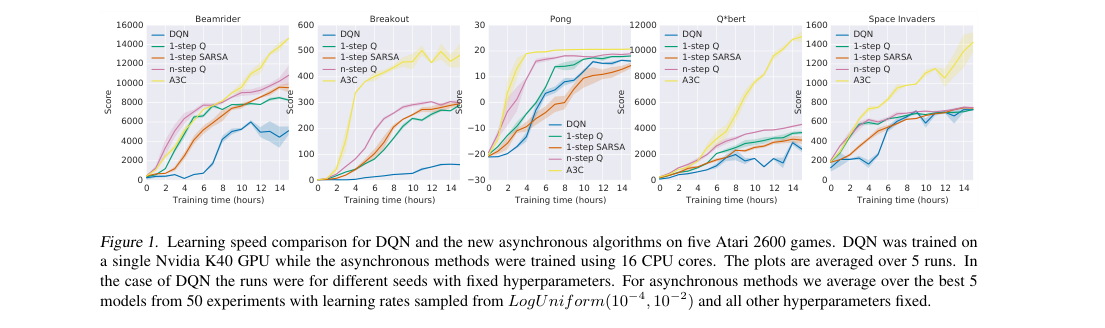
- Algorithm choice: A3C learns faster than DQN and asynchronous Q/SARSA variants on five Atari games.
- Initialization and learning rate: A3C stays robust across a wide range of rates.
- Optimizer: shared RMSProp is the most robust asynchronous optimizer reported.
Table 1: Mean and median human-normalized scores on 57 Atari games using the human starts evaluation metric
| Method | Training Time | Mean | Median |
|---|---|---|---|
| DQN | 8 days on GPU | 121.9% | 47.5% |
| Gorila | 4 days on 130 machines | 215.2% | 71.3% |
| Double | 8 days on GPU | 332.9% | 110.9% |
| Dueling | 8 days on GPU | 343.8% | 117.1% |
| Prioritized | 8 days on GPU | 463.6% | 127.6% |
| A3C FF, 1 day | 1 day on 16 CPU cores | 344.1% | 68.2% |
| A3C FF | 4 days on 16 CPU cores | 496.8% | 116.6% |
| A3C LSTM | 4 days on 16 CPU cores | 623.0% | 112.6% |
Method Strengths and Weaknesses
Strengths
- Removes replay memory and target-network dependence for the best-performing method.
- Delivers competitive Atari results with 16 CPU cores, not GPU clusters.
- One-day A3C already exceeds DQN mean human-normalized score.
- Extends one recipe across discrete control, 3D navigation, and MuJoCo.
Weaknesses
- A3C is not best on every Atari game in the raw-score table.
- Asynchrony adds gradient staleness and weakens theoretical convergence guarantees.
- Hyperparameter sweeps remain large: 50 learning rates in several plots.
- Reported gains emphasize wall-clock speed, not sample efficiency against replay methods.
Suggestions from the authors
- Combine asynchronous training with experience replay for better data efficiency.
- Study other parallel optimization algorithms for lock-free deep RL.
- Scale the framework to broader task families and larger models.
- Tighten understanding of why asynchronous updates stabilize nonlinear function approximation.
Links
Prior Papers
- @mnihDQN2015 — establishes deep Q-learning from pixels, the main Atari baseline A3C is measured against.
- @schulmanTRPO2015 — provides a contemporary policy-gradient baseline for stable optimization without replay.
- @lillicrapDDPG2015 — connects A3C to actor-critic deep control in continuous action settings.
Further Papers
- @haWorldModels2018 — learns compact latent dynamics and controllers, extending lightweight RL beyond reactive A3C agents.
- @hafnerDreamerV1_2019 — replaces asynchronous model-free updates with latent world-model learning and imagination rollouts.
- @schulmanTRPO2015 — complementary policy-optimization direction that frames later comparisons for actor-critic methods.