Human-Level Control through Deep Reinforcement Learning
Human-Level Control through Deep Reinforcement Learning
Problem
Framing
Deep RL had not shown stable, end-to-end control from raw pixels across many Atari games. DQN closes this with a convolutional -network plus experience replay and a lagged target network, reaching above human score on 29 of 49 games.
Currently Used Methods
Foundational
- @krizhevskyAlexNet2012 — deep convolutional networks for visual representation learning.
- Limitation in context: no control objective or temporal-difference bootstrapping.
- Playing Atari with Deep Reinforcement Learning — early single-paper DQN preprint on Atari from pixels.
- Limitation in context: smaller evaluation scope than the Nature version.
- Reinforcement Learning with Linear Function Approximation — hand-crafted Atari features with linear value prediction.
- Limitation in context: weak visual abstraction from raw pixels.
- Contingency Awareness in Reinforcement Learning — SARSA-style Atari agent with game-specific structure.
- Limitation in context: needs stronger prior knowledge than DQN.
- Reinforcement Learning for Robots using Neural Networks — experience replay for stabilizing neural RL.
- Limitation in context: no large-scale deep visual control demonstration.
Proposed Method
Architecture
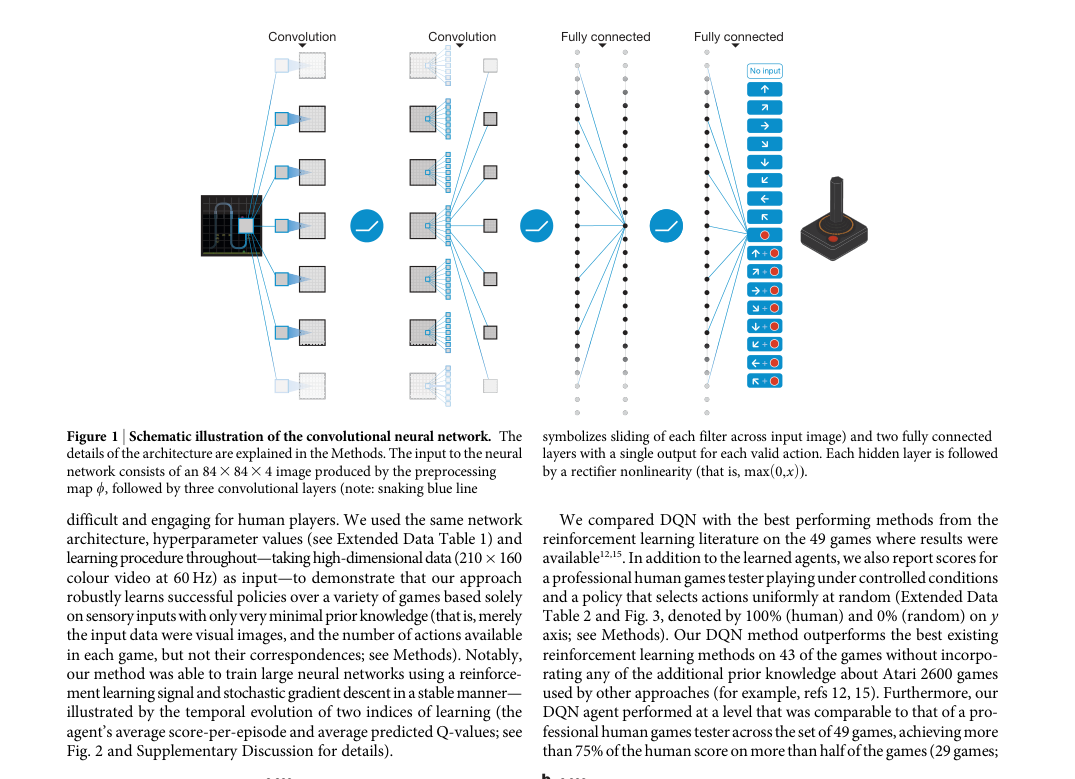
The agent maps a preprocessed state stack to one output per legal action. It uses three convolution layers, then two fully connected layers, with rectifiers after each hidden layer.
Loss / Objective
DQN minimizes one-step temporal-difference error against a frozen target network.
Sampling Rule / Algorithm
Action selection uses an -greedy policy over the learned action values.
Training Procedure
- Replay memory: transitions.
- Discount: .
- Minibatch size: .
- Target network update: every parameter updates.
- Replay start size: frames.
- Frame skip: .
- Exploration: annealed from to over frames.
- Training horizon: million frames.
- Optimizer: RMSProp.
- Learning rate: .
Evaluation
Datasets
- Atari 2600 Arcade Learning Environment.
- 49 games from raw pixels.
- Two evaluation protocols: no-op starts and human starts.
Metrics
- Raw game score.
- Human-normalized score, with random policy as and human as .
- Learning curves over training frames.
Headline results
- Atari-49, no prior game features: beats prior RL methods on 43 games.
- Atari-49, professional-human reference: exceeds of human score on 29 games.
- Atari-49, aggregate comparison: competitive with or above human on more than half the suite.
- Five validation games: convolutional DQN beats a linear approximator under matched training setup.
Ablations
- Replay removal: training degrades and becomes less stable.
- Separate target network removal: value learning destabilizes.
- Linear model replacement: scores drop on validation games.
- Representation analysis: final-layer features cluster semantically similar game states.
Method Strengths and Weaknesses
Strengths
- End-to-end control from pixels, rewards, and actions only.
- Replay plus target network directly attack divergence in nonlinear -learning.
- One architecture and hyperparameter set spans 49 games.
- Human-level or better play appears on a large fraction of the suite.
Weaknesses
- Sample inefficient: training uses million frames per game.
- Discrete-action formulation does not cover continuous control.
- One-step bootstrap target still inherits overestimation bias.
- Partial observability is handled only by stacking four frames.
Suggestions from the authors
- Extend value learning to harder planning and delayed-credit tasks.
- Reduce data requirements for real-world control domains.
- Learn stronger state representations under partial observability.
- Transfer knowledge across games instead of training from scratch.
Links
Prior Papers
- @krizhevskyAlexNet2012 — DQN imports deep convolutional visual feature learning into value-based control.
Further Papers
- @lillicrapDDPG2015 — extends deep value learning ideas to continuous-action actor-critic control.
- @mnihA3C_2016 — replaces replay-based stabilization with asynchronous parallel actor-learners.
- @schulmanTRPO2015 — offers a policy-optimization alternative to value-based deep RL.
- @schulmanPPO2017 — simplifies stable policy-gradient training for broad control tasks.
- @silverAlphaGo2016 — combines deep RL with search for superhuman game playing.
- @christianoRLHF2017 — reuses deep RL machinery in preference-based reward learning.
- @chenDecisionTransformer2021 — reframes sequential decision making with learned return-conditioned models.