Decision Transformer: Reinforcement Learning via Sequence Modeling
Decision Transformer: Reinforcement Learning via Sequence Modeling
Problem
Framing
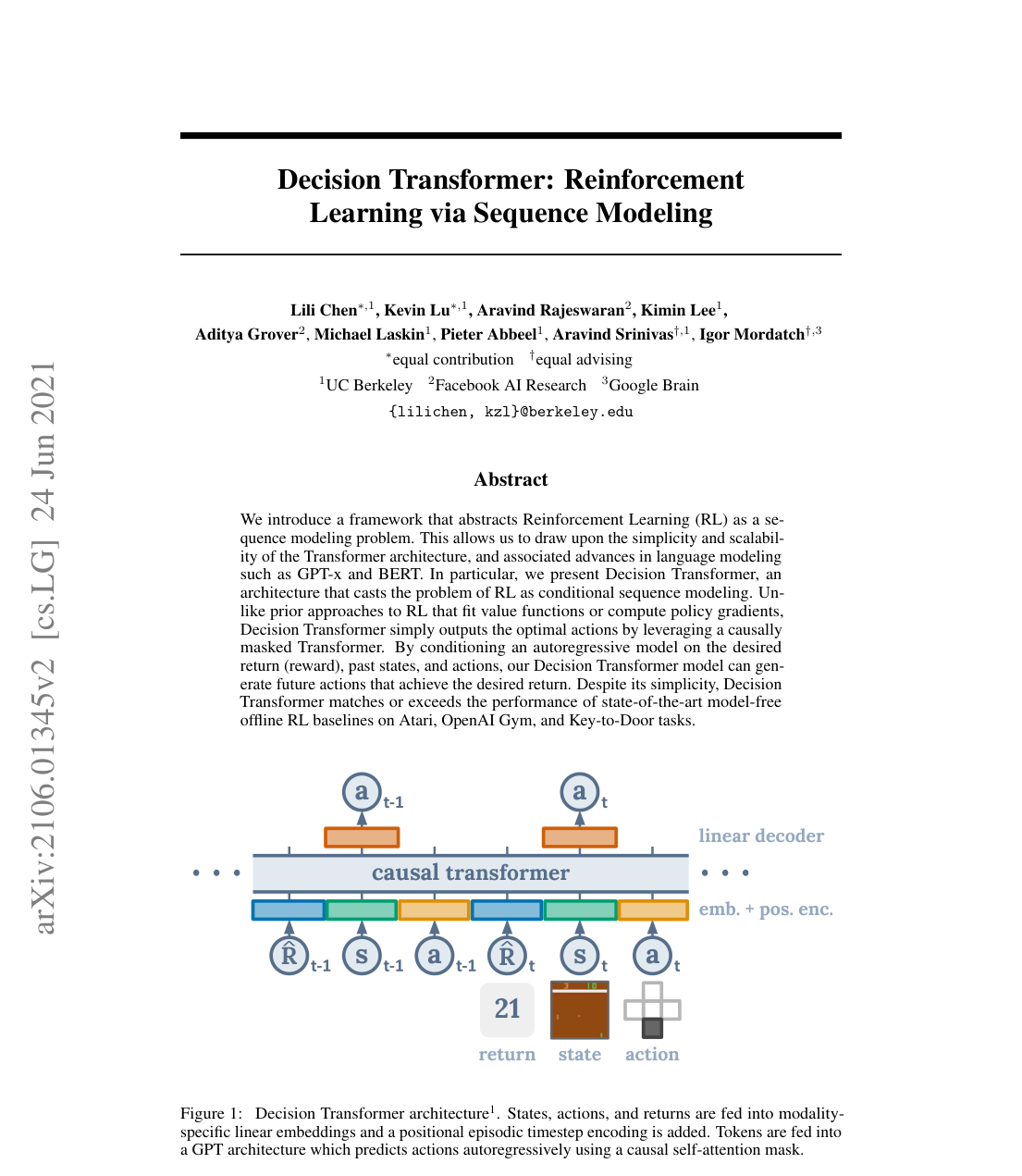
Offline RL still relies on value estimation, bootstrapping, and pessimism to recover good policies from fixed data. This paper replaces that stack with conditional sequence modeling: a causal Transformer predicts actions from desired return-to-go, past states, and past actions, matching or exceeding strong offline RL baselines on Atari and D4RL.
Currently Used Methods
Foundational
- @mnihDQN2015 — value-based deep RL for Atari from replayed transitions.
- Limitation in context: needs bootstrapped value learning, which is unstable offline.
- @schulmanPPO2017 — policy-gradient optimization with clipped surrogate objectives.
- Limitation in context: assumes online interaction, not fixed suboptimal datasets.
- @vaswaniAttentionAllNeed2017 — self-attention sequence model for long-range dependencies.
- Limitation in context: not formulated as a return-conditioned control policy.
- @brownGPT3_2020 — causal autoregressive Transformer scaled for sequence prediction.
- Limitation in context: does not model trajectories or optimize control returns.
- @haarnojaSAC2018 — actor-critic RL with entropy regularization for continuous control.
- Limitation in context: still depends on critic estimation and online updates.
Proposed Method
Architecture
Decision Transformer packs each timestep as return-to-go, state, and action tokens, then feeds the last steps as tokens to a causally masked GPT. Each modality has its own embedding layer, timestep embeddings are shared across the three tokens of a step, and the hidden state at each state token predicts the next action.
Loss / Objective
Training reduces to next-action prediction on offline trajectories.
Sampling Rule / Algorithm
At test time, the model conditions on a target return and rolls it forward autoregressively.
Training Procedure
- Atari: 6 layers, 8 heads, embedding size 128.
- Atari batch size: 512 for Pong; 128 for Breakout, Qbert, Seaquest.
- Atari context length : 50 for Pong; 30 for Breakout, Qbert, Seaquest.
- OpenAI Gym: 3 layers, 1 head, embedding size 128.
- OpenAI Gym batch size: 64.
- OpenAI Gym context length : 20 for HalfCheetah, Hopper, Walker; 5 for Reacher.
- OpenAI Gym nonlinearity: ReLU.
Evaluation
Datasets
- Atari 1% DQN-replay: Breakout, Qbert, Pong, Seaquest.
- D4RL continuous control: HalfCheetah, Hopper, Walker.
- Sparse-goal control: Reacher.
- Key-to-Door sparse-reward benchmark.
Metrics
- Gamer-normalized score for Atari.
- D4RL normalized score for Gym tasks.
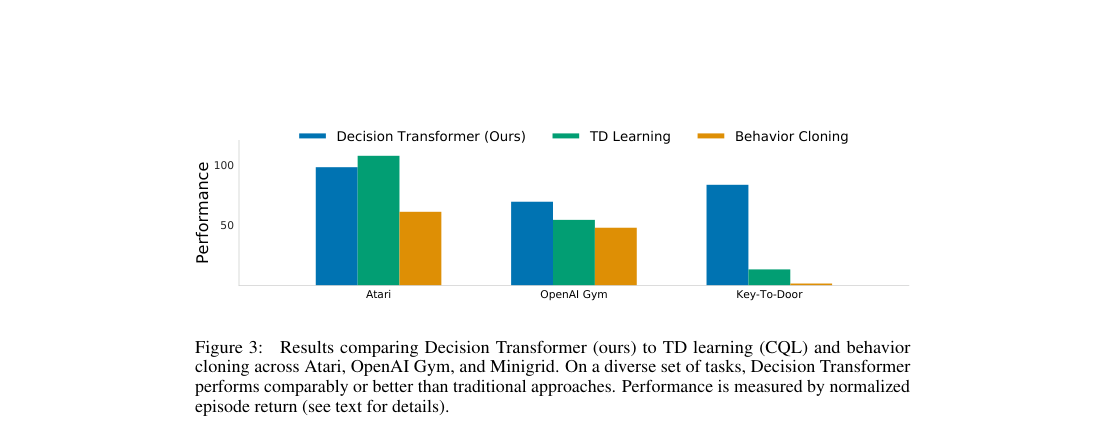
- Normalized episode return in cross-domain summary.
- Success rate for Key-to-Door.
Headline results
- Atari Breakout (1% replay): 267.5 97.5, above CQL 211.1.
- Atari Pong (1% replay): 106.1 8.1, near CQL 111.9.
- D4RL HalfCheetah medium-expert: 86.8 1.3, above CQL 62.4.
- D4RL Walker medium-expert: 108.1 0.2, above CQL 98.7.
- D4RL Hopper medium-replay: 82.7 7.0, above CQL 48.6.
Ablations
- Context length: is much worse than longer contexts; the model uses history.
- Behavior cloning subset: Decision Transformer beats percentile-filtered BC on most Atari games.
- Return modeling: larger models improve return-distribution modeling in Gym.
- Sparse rewards: hindsight-conditioned methods succeed where TD learning struggles in Key-to-Door.
Method Strengths and Weaknesses
Strengths
- Removes Bellman backups and explicit value functions entirely.
- Matches or beats CQL on most D4RL settings.
- Strong on sparse-reward credit assignment in Key-to-Door.
- Longer-context gains show self-attention uses trajectory history.
Weaknesses
- Qbert underperforms CQL: 15.4 versus 104.2.
- Requires selecting a target return at inference.
- Pure offline training does not address exploration.
- Reported gains are uneven across Atari tasks.
Suggestions from the authors
- Study joint prediction of actions, states, and returns.
- Extend the method from offline to online RL regimes.
- Test larger transformers for broader behavior modeling.
- Analyze sequence modeling for harder long-horizon credit assignment.
Links
Prior Papers
- @vaswaniAttentionAllNeed2017 — supplies the self-attention backbone that Decision Transformer recasts for control.
- @brownGPT3_2020 — motivates the causal autoregressive GPT-style modeling used for trajectory prediction.
- @mnihDQN2015 — defines the Atari setting and replay-based regime that the offline benchmark derives from.
- @haarnojaSAC2018 — represents the critic-based continuous-control tradition that this paper sidesteps.
Further Papers
- @hafnerDreamerV2_2021 — another sequence-oriented RL direction, useful for contrasting latent world modeling with return-conditioned transformers.
- @hafnerDreamerV3_2023 — extends scalable sequence-style decision making, relevant as a later descendant in RL modeling.
- @schrittwieserMuZero2020 — a strong planning-based alternative for long-horizon control, useful as a contrasting follow-on paradigm.