Trust Region Policy Optimization
Trust Region Policy Optimization
Problem
Framing
Policy-gradient updates were brittle: large steps collapsed performance, small steps wasted samples. TRPO closes this gap by maximizing a local surrogate under an explicit KL trust-region constraint, giving monotonic-improvement style guarantees and strong results on MuJoCo locomotion and Atari.
Currently Used Methods
Foundational
- @mnihDQN2015 — deep Q-learning for Atari from pixels.
- Limitation in context: value-based and discrete-action; not a stable stochastic-policy update rule.
- @mnihA3C_2016 — asynchronous actor-critic with parallel on-policy learning.
- Limitation in context: no explicit trust region, so update size remains hard to control.
- @lillicrapDDPG2015 — deterministic actor-critic for continuous control.
- Limitation in context: off-policy instability and no monotonic improvement constraint.
- @schulmanPPO2017 — clipped surrogate that approximates trust-region updates.
- Limitation in context: relaxes the hard KL constraint that TRPO enforces.
- @haarnojaSAC2018 — entropy-regularized off-policy actor-critic.
- Limitation in context: trades guarantees for efficiency; not the trust-region formulation.
Proposed Method
Architecture
TRPO is an update rule, not a new policy network. The paper instantiates it with small MLP policies for locomotion and a convolutional network for Atari.
Loss / Objective
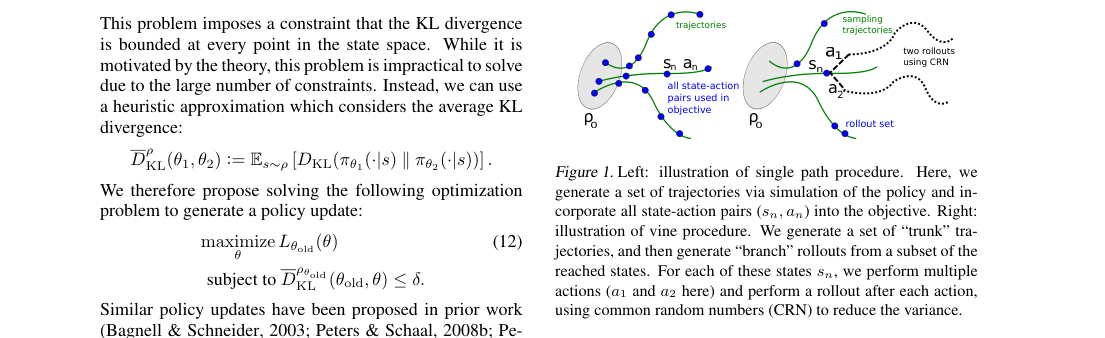
The update maximizes a first-order surrogate while constraining average policy drift.
Algorithm
TRPO solves the constrained step with a quadratic KL model, conjugate gradient, then backtracking line search.
Training Procedure
- MuJoCo policy parameters: 364 / 4806 / 8206 for Swimmer / Hopper / Walker.
- MuJoCo simulator steps per iteration: 5{,}000 / 25{,}000 / 50{,}000.
- Conjugate gradient iterations: .
- Atari policy parameters: .
- Atari vine simulator steps per iteration: .
- Atari single-path simulator steps per iteration: .
Evaluation
Datasets
- MuJoCo locomotion: Swimmer, Hopper, Walker.
- Atari from pixels: Beam Rider, Breakout, Enduro, Pong, Q*bert, Seaquest, Space Invaders.
Metrics
- Episodic return for locomotion.
- Game score for Atari.
- Learning curves over policy iterations.
- Average KL-constrained policy improvement.
Headline results
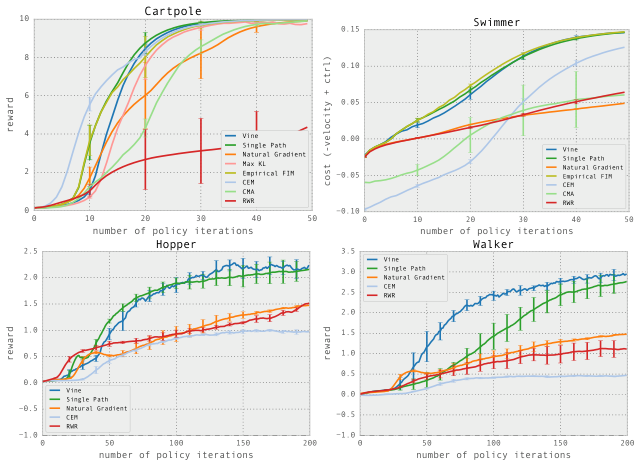
- Swimmer: vine and single-path reach about reward, above natural gradient and CEM.
- Hopper: vine reaches about reward, above single-path near .
- Walker: vine reaches about reward, above single-path near .
- Cartpole: trust-region variants reach near-optimal reward in about -- iterations.
- Atari: TRPO variants are competitive with prior deep RL baselines across seven games.
Ablations
- Sampling procedure: vine reduces variance and improves learning on harder control tasks.
- Trust-region choice: fixed KL works better than penalty-based natural gradient tuning.
- Domain: gains persist from low-dimensional states to pixel-based Atari control.
- Baseline class: TRPO beats derivative-free methods on sample efficiency.
Method Strengths and Weaknesses
Strengths
- Hard KL constraint directly controls destructive policy jumps.
- Monotonic-improvement analysis motivates the surrogate objective.
- Works for both continuous control and pixel-based Atari.
- Conjugate-gradient solver avoids explicit Fisher matrix inversion.
Weaknesses
- Second-order step requires repeated Fisher-vector products.
- Line search and conjugate gradient add implementation complexity.
- Vine sampling needs state reset access; many environments cannot provide it.
- Atari error bars are absent because each task is run once.
Suggestions from the authors
- Extend the monotonic-improvement analysis to broader policy classes.
- Reduce computation in Fisher-vector products and conjugate-gradient solves.
- Study lower-variance sampling without simulator state resets.
- Improve scalability on high-dimensional vision-based control.
Links
Prior Papers
- @mnihDQN2015 — establishes the Atari deep RL benchmark that TRPO later tests against.
- @lillicrapDDPG2015 — provides a contemporary continuous-control actor baseline for comparison.
- @mnihA3C_2016 — represents early scalable policy-gradient actor-critic methods without trust-region constraints.
Further Papers
- @schulmanPPO2017 — simplifies TRPO's constrained update into a clipped first-order objective.
- @haarnojaSAC2018 — advances policy optimization in continuous control with off-policy entropy regularization.
- @hafnerDreamerV1_2019 — applies policy optimization inside a learned world model for sample-efficient control.
- @hafnerDreamerV2_2021 — extends model-based actor learning to Atari-scale pixel control.
- @hafnerDreamerV3_2023 — modern descendant on large-scale general-control benchmarks with learned dynamics.