Retrieval-Augmented Generation for Knowledge-Intensive NLP Tasks
Retrieval-Augmented Generation for Knowledge-Intensive NLP Tasks
Problem
Framing
Large parametric seq2seq models store facts, but they cannot update knowledge, expose provenance, or reliably ground generation on knowledge-intensive tasks. RAG closes this gap by treating retrieved Wikipedia passages as latent variables inside generation, then marginalizing over them end-to-end. It sets new open-domain QA results, including 44.5 EM on Natural Questions.
Currently Used Methods
Direct antecedents
- "Retrieval-Augmented Language Model Pre-Training" — differentiable dense retrieval for open-domain extractive QA.
- Limitation in context: tied to extractive QA, not general seq2seq generation.
- "Open Retrieval Question Answering" — retrieve-then-read pipeline for open-domain QA.
- Limitation in context: retrieval and reader are not jointly optimized.
- @raffelT5_2020 — large parametric text-to-text model with strong closed-book QA.
- Limitation in context: facts stay in weights, so updates and provenance are hard.
- "BART: Denoising Sequence-to-Sequence Pre-training for Natural Language Generation" — strong pre-trained seq2seq generator.
- Limitation in context: no explicit external memory during inference.
- "Dense Passage Retrieval for Open-Domain Question Answering" — bi-encoder neural retriever over Wikipedia passages.
- Limitation in context: retrieves evidence, but does not generate answers jointly.
Proposed Method
Architecture
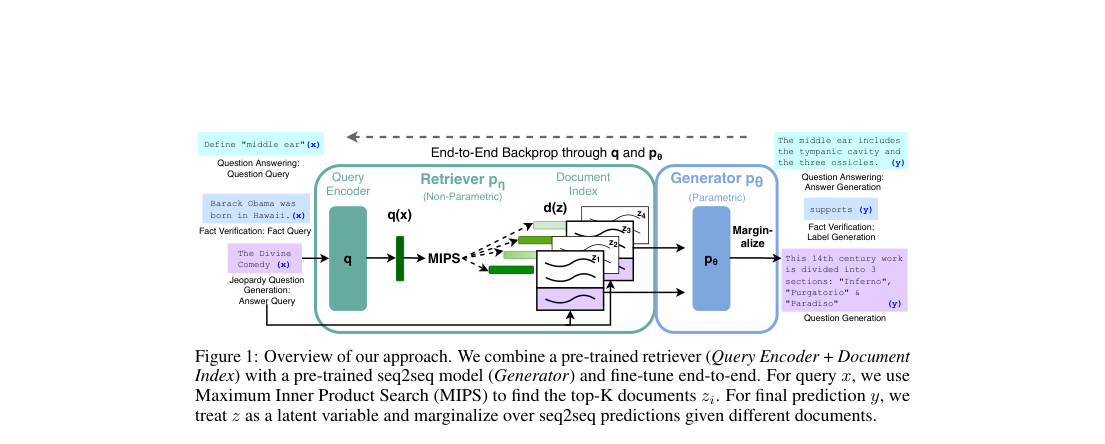
RAG combines a DPR-style retriever with a BART generator . The retriever scores 21M Wikipedia 100-word passages with a BERT-base query encoder against a fixed document index, then the generator conditions on the input and top- passages.
Loss / Objective
The model treats retrieved documents as latent variables and optimizes negative log-likelihood after top- marginalization.
Sampling Rule / Algorithm
Decoding differs by marginalization level: sequence-level for RAG-Sequence, token-level for RAG-Token.
Training Procedure
- Non-parametric memory: December 2018 Wikipedia dump.
- Passage granularity: disjoint 100-word chunks.
- Index size: 21M documents.
- Training retrieval depth: .
- QA test retrieval depth: 15 for RAG-Token, 50 for RAG-Sequence.
- Optimizer: Adam.
- Hardware: 8 \times 32GB NVIDIA V100.
- Precision: mixed precision.
- Document encoder and index: fixed during training.
Evaluation
Datasets
- Open-domain QA: Natural Questions, TriviaQA, WebQuestions, CuratedTrec.
- Abstractive QA: MS-MARCO NLG.
- Question generation: Jeopardy from SearchQA splits.
- Fact verification: FEVER 3-way and 2-way.
Metrics
- Open-domain QA: Exact Match.
- MS-MARCO: Bleu-1, Rouge-L.
- Jeopardy generation: Q-BLEU-1, human factuality, human specificity.
- FEVER: label accuracy.
- Diversity: distinct tri-gram ratio.
Headline results
- Natural Questions, open-domain QA: 44.5 EM with RAG-Sequence.
- TriviaQA unfiltered / Wiki: 56.1 / 72.7 EM with RAG-Sequence.
- WebQuestions: 45.2 EM with RAG-Sequence.
- CuratedTrec: 50.0 EM with RAG-Sequence.
- MS-MARCO: 44.1 Bleu-1, 45.5 Rouge-L with RAG-Sequence.
- Jeopardy question generation: 17.43 Q-BLEU-1 with RAG-Token.
- FEVER 3-way / 2-way: 86.3 / 89.0 accuracy with RAG.
Ablations
- Learned retrieval vs frozen retriever: learned retrieval improves every task.
- Dense retriever vs BM25: dense retrieval wins on most tasks.
- Train-time vs : little difference.
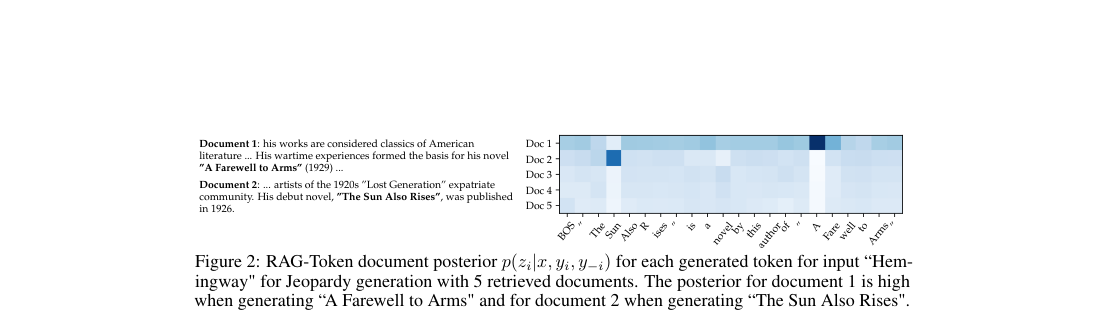
- Test-time retrieved documents: more documents improve QA, with smaller gains for generation.
Method Strengths and Weaknesses
Strengths
- Unifies retrieval and generation in one probabilistic model.
- Sets SOTA on NQ, WQ, and CuratedTrec.
- Improves MS-MARCO over BART by 2.6 Bleu-1 and 2.6 Rouge-L.
- Retrieved passages provide inspectable provenance and hot-swappable knowledge.
Weaknesses
- Document encoder stays fixed, limiting retrieval adaptation.
- QA gains require more retrieved documents at test time.
- FEVER trails specialized supervised pipelines by 4.3% on 3-way accuracy.
- Wikipedia-only memory leaves some MS-MARCO questions unanswerable.
Suggestions from the authors
- Scale non-parametric memory beyond Wikipedia and beyond text-only sources.
- Improve retrieval and generation jointly with stronger end-to-end learning.
- Study faster decoding and retrieval for lower-latency generation.
- Explore richer memory updating as world knowledge changes.
Links
Prior Papers
- @raffelT5_2020 — strong parametric text-to-text baseline that RAG surpasses on knowledge-intensive tasks.
Further Papers
- @schickToolformer2023 — extends the idea of augmenting language models with external tools and retrieval-like actions.
- @chameleonTeam2024 — builds multimodal generative systems that also rely on externalized knowledge and retrieval-style grounding.