Toolformer: Language Models Can Teach Themselves to Use Tools
Toolformer: Language Models Can Teach Themselves to Use Tools
Problem
Framing
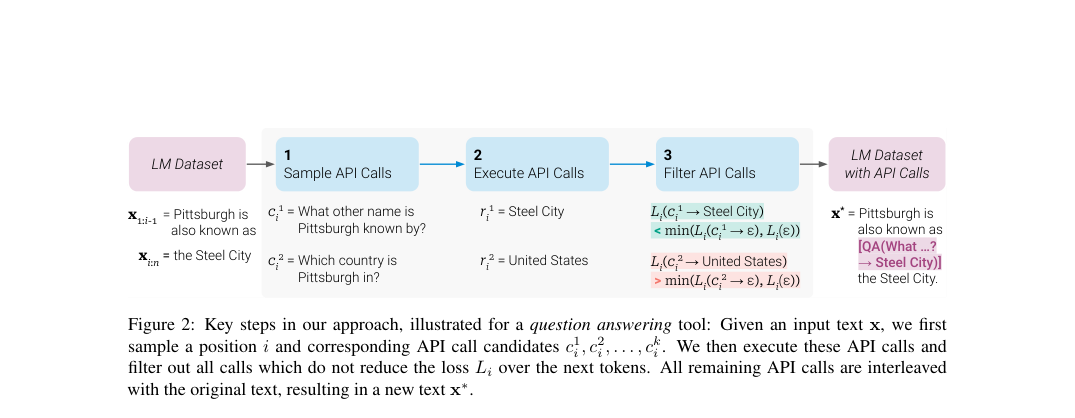
Large LMs still hallucinate facts, miss recent information, and fail at arithmetic or time-sensitive queries. The paper closes this gap by teaching the LM to insert API calls into its own text stream, then keeping only calls that lower next-token loss. A 6.7B GPT-J variant then beats larger models on several zero-shot tasks, including 40.4 on ASDiv.
Currently Used Methods
Direct antecedents
- @chenCodex2021 — code-specialized LM with in-context execution and synthesis abilities.
- Limitation in context: no self-supervised policy for deciding when external tools help.
- @lewisRAG2020 — retrieval-augmented generation injects documents into generation.
- Limitation in context: retrieval is fixed, not model-chosen API use during free-form decoding.
- @yaoReAct2022 — interleaves reasoning traces with actions over external environments.
- Limitation in context: relies on prompting trajectories, not self-labeled training data.
- "GPT-3: Language Models are Few-Shot Learners" — large in-context learner with strong zero-shot transfer.
- Limitation in context: scale alone does not fix arithmetic, recency, or temporal grounding.
- "LaMDA: Language Models for Dialog Applications" — tool-augmented dialogue via human-designed demonstrations.
- Limitation in context: needs substantial annotation and task-specific tool supervision.
Proposed Method
Architecture
Toolformer keeps the base LM architecture fixed and augments training text with inline tool calls of the form or . The tool set spans question answering, Wikipedia search, calculator, machine translation, and calendar APIs. Inference runs normal decoding until the model emits , then executes the chosen API and resumes generation.
Loss / Objective
Candidate calls survive only if their returned result improves prediction of future tokens.
Sampling Rule / Algorithm
The LM first proposes where a tool call should start, then samples call strings at those positions.
For each , it samples up to calls and keeps at most top- positions.
Training Procedure
- Base LM: GPT-J, 6.7B parameters.
- Data: subset of CCNet, then augmented to .
- Tools: QA, WikiSearch, Calculator, Calendar, MT.
- Weighting: , normalized to .
- Finetuning examples: up to 25k per API.
- Max sequence length: 1,024.
- Effective batch size: 128.
- Learning rate: .
- Warmup: first 10% of training.
- Decoding for tool use: top- trigger for .
- Inference restriction: at most one API call per input.
Evaluation
Datasets
- LAMA: SQuAD, Google-RE, T-REx.
- Math: ASDiv, SVAMP, MAWPS.
- QA: WebQS, Natural Questions, TriviaQA.
- Multilingual QA: MLQA.
- Temporal: T EMP LAMA, DATESET.
- LM retention: WikiText, held-out CCNet.
Metrics
- LAMA: correct answer appears in first 5 generated words.
- Math: first predicted number matches target.
- QA: correct answer appears in first 20 generated words.
- MLQA: answer appears in first 10 generated words.
- Language modeling: perplexity.
Headline results
- LAMA SQuAD: 33.8 for Toolformer vs 26.8 for GPT-3 and 21.6 for OPT-66B.
- LAMA T-REx: 53.5 vs 39.8 for GPT-3.
- ASDiv: 40.4 vs 14.0 for GPT-3.
- SVAMP: 29.4 vs 10.0 for GPT-3.
- DATESET: 27.3 vs 0.8 for GPT-3.
Results table
Table 2: Number of examples with API calls in for different filtering thresholds
| API | |||
|---|---|---|---|
| Question Answering | 51,987 | 18,526 | 5,135 |
| Wikipedia Search | 207,241 | 60,974 | 13,944 |
| Calculator | 3,680 | 994 | 138 |
| Calendar | 61,811 | 20,587 | 3,007 |
| Machine Translation | 3,156 | 1,034 | 229 |
Ablations
- API-disabled decoding still improves math, showing tool-augmented finetuning teaches latent skills.
- Calendar helps DATESET, but barely triggers on T EMP LAMA; one-call inference is too restrictive.
- Tool use emerges near 775M parameters; smaller GPT-2 variants gain little.
- Finetuning on API-augmented text preserves perplexity: 10.5 on CCNet with or without disabled tool calls.
Method Strengths and Weaknesses
Strengths
- Self-supervised filtering turns tool use into a measurable likelihood gain.
- Beats GPT-3 on LAMA T-REx: 53.5 vs 39.8.
- Beats GPT-3 on arithmetic tasks by large margins.
- Preserves language-model perplexity after API-call finetuning.
Weaknesses
- One API call per example blocks multi-step tool compositions.
- Search tool is shallow; no iterative reformulation or browsing.
- Benefits emerge late; sub-775M models barely exploit tools.
- CCNet finetuning hurts some multilingual settings, limiting MLQA gains.
Suggestions from the authors
- Add interactive search with query reformulation and multi-result browsing.
- Learn multi-step tool chains instead of independent single calls.
- Study stronger tool use in smaller models.
- Improve multilingual finetuning to avoid distribution-shift regressions.
Links
Prior Papers
- @chenCodex2021 — relevant as a strong code-capable LM baseline for external execution and prompting.
- @lewisRAG2020 — relevant as the canonical retrieval-augmented LM that injects external knowledge.
- @yaoReAct2022 — relevant as an action-and-reasoning framework for tool-interacting language agents.
Further Papers
- @kwonvLLM2023 — extends the systems question of how LLMs use external memory and serving-time resources.
- @luUnifiedIO2_2024 — pushes toward a broader multi-tool, multimodal model interface beyond text-only APIs.