Evaluating Large Language Models Trained on Code
Evaluating Large Language Models Trained on Code
Problem
Framing
Code LMs were scored with token overlap, not executable correctness, so benchmark gains did not imply working programs. The paper closes this with HumanEval and a pass@ estimator, then shows code-specialized GPT reaches 28.8% pass@1 and 77.5% pass@100 with reranking on HumanEval.
Currently Used Methods
Foundational
- @brownGPT3_2020 — large autoregressive language modeling at scale.
- Limitation in context: near-zero HumanEval pass@1 at 12B after text-only pretraining.
- @kaplanScalingLaws2020 — power-law scaling laws for language-model loss.
- Limitation in context: loss scaling alone does not measure executable program correctness.
- "Measuring Coding Challenge Competence With APPS" — benchmarked program synthesis with hidden tests.
- Limitation in context: contest-style tasks mix specification parsing with coding ability.
- "GPT-Neo" — open GPT-style models used for code generation comparison.
- Limitation in context: lower HumanEval pass rates than similarly sized Codex models.
- "GPT-J-6B" — larger open autoregressive baseline for code completion.
- Limitation in context: still trails code-finetuned Codex on functional correctness.
Proposed Method
Architecture
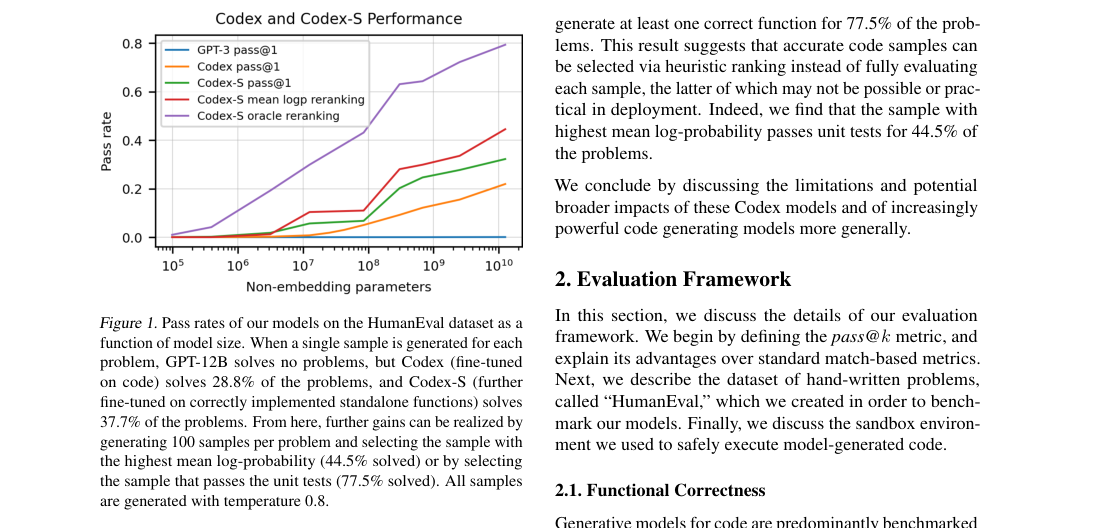
Codex keeps the GPT-3 decoder-only Transformer and changes the data mix: large-scale Python pretraining plus code-focused fine-tuning. The main variants span roughly 85M to 12B non-embedding parameters, with an extra Codex-S stage tuned on correctly implemented standalone functions.
Loss / Objective
Training remains next-token maximum likelihood on code sequences.
Held-out code loss after fine-tuning follows an empirical scaling law:
Sampling Rule
The evaluation target is functional success under samples, estimated from draws with correct programs.
Training Procedure
- Base model family: 85M to 12B non-embedding parameters.
- Domain adaptation: large-scale Python GitHub corpus.
- Codex-S: further supervised fine-tuning on standalone Python functions.
- Sampling temperatures are tuned per pass@ evaluation.
- APPS results use temperature to cover multiple values.
Evaluation
Datasets
- HumanEval: 164 hand-written Python programming problems with unit tests.
- APPS: coding-challenge benchmark with hidden tests.
- Docstring generation set: human-graded generation tasks.
Metrics
- pass@1, pass@10, pass@100.
- BLEU for reference-similarity analysis.
- Held-out code cross-entropy loss.
Headline results
- HumanEval, Codex-12B: pass@1 28.8%.
- HumanEval, Codex-S: pass@1 37.7%.
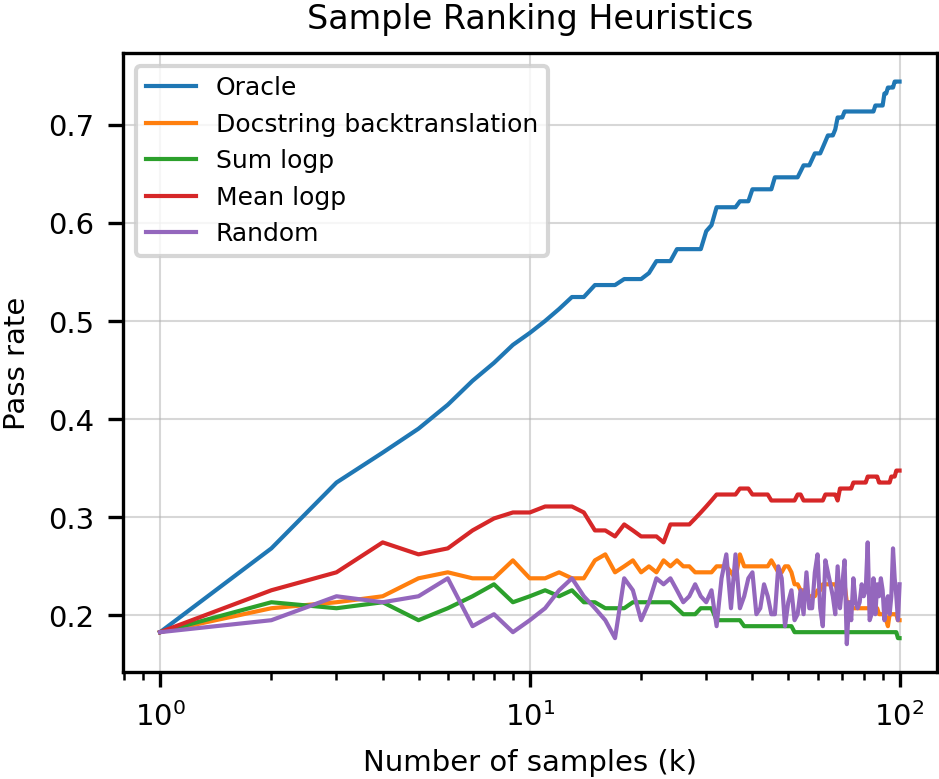
- HumanEval, Codex-S mean-logp reranking: 44.5% solved.
- HumanEval, Codex-S oracle over 100 samples: 77.5% solved.
- APPS: Codex improves over GPT-Neo and GPT-J baselines across pass@.
Ablations
- Model size: pass rate rises smoothly with non-embedding parameters.
- Additional standalone-function tuning: Codex-S beats plain Codex at fixed size.
- Sample count: more draws sharply raise solvable-problem coverage.
- Reranking heuristic: mean log-probability beats random and back-translation; BLEU separates correct from wrong solutions poorly.
Method Strengths and Weaknesses
Strengths
- Replaces proxy string metrics with executable pass@ on hidden tests.
- HumanEval is hand-written to reduce simple memorization of benchmark items.
- Code fine-tuning yields a large jump over GPT-3 at equal scale.
- Multi-sample decoding exposes much higher latent competence than pass@1 alone.
Weaknesses
- Training objective stays token-level likelihood, not direct program correctness.
- Reported gains depend strongly on sampling budget and reranking.
- BLEU fails to track correctness, so common text metrics remain misleading.
- Sandbox execution and hidden tests cover only observable behavior, not full software quality.
Suggestions from the authors
- Improve automatic evaluation beyond hidden tests and overlap-based metrics.
- Study alignment for code models under more capable real-world deployment.
- Reduce harmful memorization, insecure suggestions, and adversarially triggered code.
- Develop better ways to select correct samples without executing every candidate.
Links
Prior Papers
- @brownGPT3_2020 — Codex is a code-specialized descendant of GPT-3 scaling and autoregressive pretraining.
- @kaplanScalingLaws2020 — the paper reuses scaling-law analysis and shows similar power-law behavior after code fine-tuning.
Further Papers
- @ouyangInstructGPT2022 — extends large autoregressive models with preference-aligned fine-tuning, a direct follow-on concern for Codex deployment.
- @schickToolformer2023 — overlaps on using language models as tool-using systems, with code generation as a natural tool interface.
- @leviathanSpeculativeDecoding2023 — overlaps on accelerating autoregressive sampling, relevant when pass@ depends on many code samples.