ReAct: Synergizing Reasoning and Acting in Language Models
ReAct: Synergizing Reasoning and Acting in Language Models
Problem
Framing
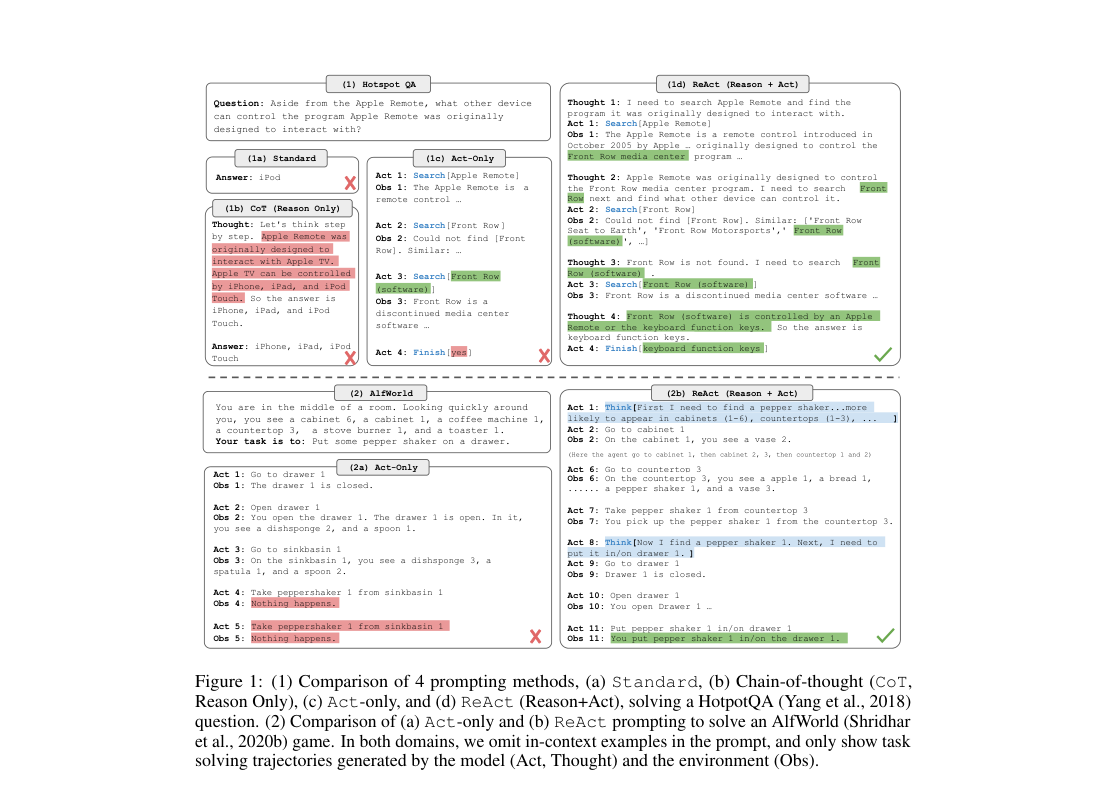
Chain-of-thought improves reasoning, but it cannot query the world, and action-only prompting lacks explicit planning. ReAct closes this gap by interleaving free-form thoughts with text actions and observations, improving grounded multi-hop QA, fact verification, and interactive decision making.
Currently Used Methods
Foundational
- @weiCoT2022 — chain-of-thought prompting elicits explicit intermediate reasoning.
- Limitation in context: no external actions, so factual errors can persist uncorrected.
- @kojimaZeroShotCoT2022 — zero-shot reasoning via simple prompting cues.
- Limitation in context: reasoning remains detached from environment feedback.
- @schickToolformer2023 — language models learn tool use through API-call supervision.
- Limitation in context: tool use is not framed as interleaved reasoning trajectories.
- @brownGPT3_2020 — large language models support few-shot in-context task adaptation.
- Limitation in context: prompting alone does not coordinate planning with action execution.
- @yaoToT2023 — tree search expands multiple reasoning paths before committing.
- Limitation in context: search over thoughts still omits external environment interaction.
Proposed Method
Architecture
ReAct uses a single LM as a policy over an alternating trajectory of thought, action, and observation tokens. Thoughts decompose goals and plan retrieval; actions query an external environment; observations feed back into the next reasoning step.
Algorithm
At step , the model conditions on the full interaction history and emits either a reasoning trace or an action:
The environment then returns a new observation after each action:
Training Procedure
- Prompting: PaLM-540B for main results.
- CoT-SC baseline: 21 samples, decoding temperature .
- ReAct CoT-SC fallback: 7 steps on HotpotQA, 5 on FEVER.
- Finetuning data: 3,000 correct ReAct-generated trajectories.
- Finetuning models: PaLM-8B and PaLM-62B.
- Batch size: 64.
- Finetuning steps: 4,000 for ReAct/Act; 2,000 or 1,000 for Standard/CoT.
Evaluation
Datasets
- HotpotQA: multi-hop question answering over Wikipedia.
- FEVER: fact verification with Wikipedia evidence.
- ALFWorld: text-based household decision making.
- WebShop: online shopping in a noisy web environment.
Metrics
- HotpotQA: exact match.
- FEVER: accuracy.
- ALFWorld: task success rate.
- WebShop: score and success rate.
Headline results
- HotpotQA (PaLM-540B, prompting): ReAct EM; CoT ; Act .
- FEVER (PaLM-540B, prompting): ReAct Acc; CoT ; Act .
- HotpotQA (best hybrid): ReAct CoT-SC EM.
- FEVER (best hybrid): CoT-SC ReAct Acc.
- ALFWorld: best ReAct success; best Act ; BUTLER .
- WebShop: ReAct score, SR; Act , SR.
Ablations
- Reasoning + acting vs acting only: ReAct beats Act on all four tasks.
- ReAct vs CoT: ReAct is more grounded, but slightly worse on HotpotQA EM.
- Hybrid fallback with CoT-SC: both switch rules beat plain CoT-SC with fewer samples.
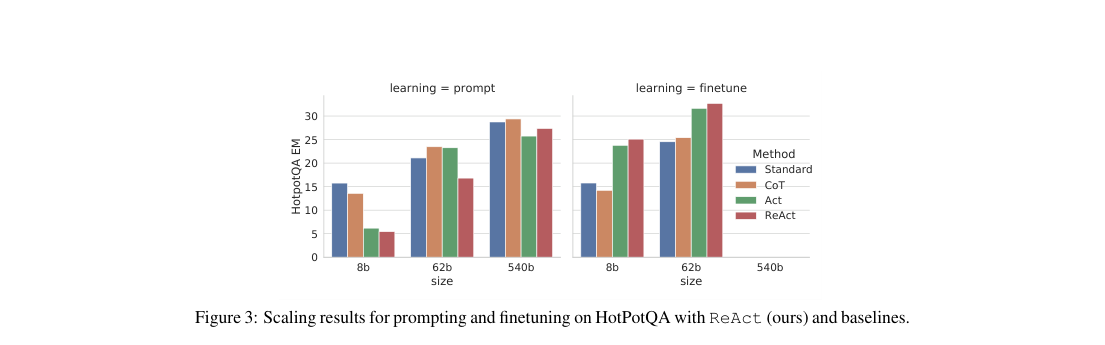
- Finetuning vs prompting: ReAct is weakest in small-model prompting, strongest after 3k-example finetuning.
Method Strengths and Weaknesses
Strengths
- Grounds reasoning in retrieved observations, reducing HotpotQA hallucination failures versus CoT.
- Improves FEVER accuracy over CoT: vs .
- Large gains in decision making: ALFWorld vs Act .
- Finetunes well: 3k trajectories make ReAct strongest on PaLM-8B and 62B.
Weaknesses
- Slightly trails CoT on HotpotQA prompting: vs EM.
- Interleaving constraints raise reasoning-error rate on HotpotQA failure analysis.
- Search failures derail performance; non-informative retrieval forms of ReAct errors.
- Long-horizon prompting needs many demonstrations and hits context-length limits.
Suggestions from the authors
- Collect more high-quality human-written reasoning and action annotations.
- Improve long-context learning for tasks needing many demonstrations.
- Scale ReAct with multi-task training across domains.
- Combine ReAct with reinforcement learning and human feedback.
Links
Prior Papers
- @weiCoT2022 — ReAct extends chain-of-thought by inserting environment actions and observations into the reasoning loop.
- @kojimaZeroShotCoT2022 — zero-shot CoT is a direct reasoning-only baseline that clarifies what acting adds.
- @brownGPT3_2020 — the paper relies on large few-shot language models as the substrate for prompted trajectories.
Further Papers
- @yaoToT2023 — extends LM reasoning beyond single trajectories by searching over multiple thought branches.
- @schickToolformer2023 — studies explicit tool-use training, a close descendant of LM acting with external interfaces.