Tree of Thoughts: Deliberate Problem Solving with Large Language Models
Tree of Thoughts: Deliberate Problem Solving with Large Language Models
Problem
Framing
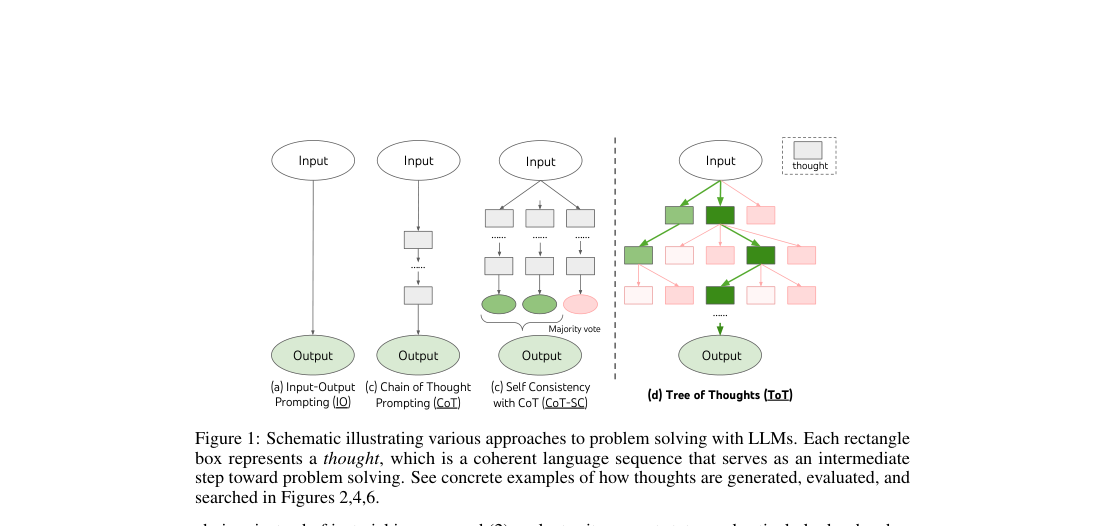
LLM inference stayed token-local and greedy at test time, which breaks on tasks that need lookahead, branching, and backtracking. The paper replaces single-chain decoding with search over semantically coherent thoughts plus LM-based self-evaluation. On Game of 24, GPT-4 rises from 4% with CoT to 74% with ToT.
Currently Used Methods
Direct antecedents
- @yaoReAct2022 — interleaves reasoning traces with actions in external environments.
- Limitation in context: no explicit tree search over alternative thoughts.
- @weiCoT2022 — elicits intermediate reasoning with chain-of-thought prompting.
- Limitation in context: commits to one left-to-right reasoning path.
- @kojimaZeroShotCoT2022 — triggers reasoning by prompting “let’s think step by step”.
- Limitation in context: improves decomposition, not exploration or backtracking.
- @schrittwieserMuZero2020 — plans by tree search with learned value and policy models.
- Limitation in context: needs trained search heuristics, not language-native evaluation.
Proposed Method
Architecture
ToT represents inference as a tree whose nodes are partial thoughts and whose edges are LM-generated continuations. The LM alternates between generating candidate thoughts, scoring states, and applying a search policy such as BFS or DFS. The thought granularity is task-specific: 3 arithmetic steps, a writing plan, or crossword fills.
Loss / Objective
The framework changes inference, not model training.It still queries the base LM autoregressively:
Algorithm
At each step, ToT expands candidate thoughts and keeps or explores states using LM-scored heuristics.
For Game of 24, BFS keeps the best states per depth. For Mini Crosswords, DFS explores one clue fill at a time and backtracks after low-value states.
Training Procedure
- Base model: GPT-4 chat completion.
- Sampling temperature: .
- Game of 24: BFS, depth , beam width .
- Creative Writing: sample plans, vote times.
- Mini Crosswords: DFS with LM state evaluation and pruning.
Evaluation
Datasets
- Game of 24: 100 hard instances from 4nums.com, indexed 901–1000.
- Creative Writing: 100 prompts built from 4 random sentences.
- Mini Crosswords: 5×5 crossword puzzles with 10 clues.
Metrics
- Game of 24: success rate over valid equations.
- Creative Writing: GPT-4 coherency score; human pairwise preference.
- Mini Crosswords: crossword solve quality from exact fills / clue consistency.
Headline results
- Game of 24, GPT-4 CoT: 4.0% success.
- Game of 24, GPT-4 ToT : 74% success.
- Game of 24, best-of-100 CoT: 49% success.
- Creative Writing, GPT-4 IO: coherency 6.19.
- Creative Writing, GPT-4 ToT: coherency 7.56.
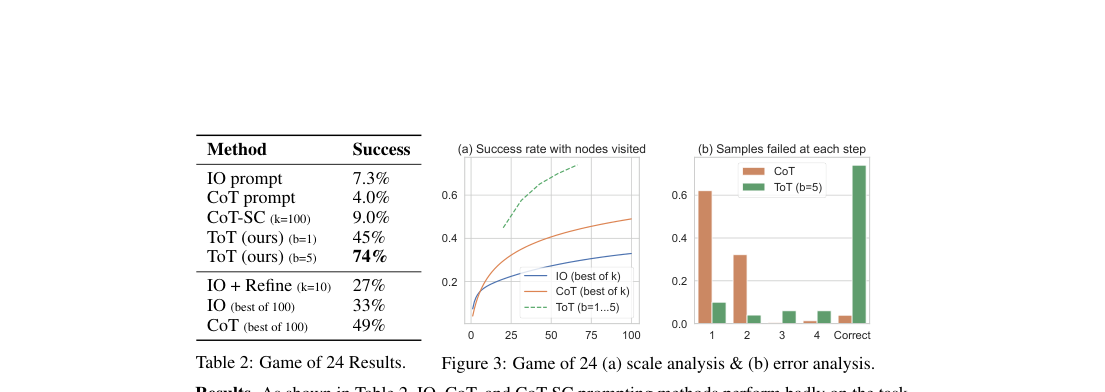
Table 2: Game of 24 Results.
| Method | Success |
|---|---|
| IO prompt | 7.3% |
| CoT prompt | 4.0% |
| CoT-SC | 9.0% |
| ToT (ours) | 45% |
| ToT (ours) | 74% |
| IO + Refine | 27% |
| IO (best of 100) | 33% |
| CoT (best of 100) | 49% |
Ablations
- Beam width on Game of 24: far exceeds ; search breadth matters.
- Best-of- sampling: independent CoT samples trail deliberate search at similar token budgets.
- Creative Writing voting: plan-level voting raises coherency from 6.19 to 7.67.
- Passage refinement atop ToT raises coherency from 7.56 to 7.91.
Method Strengths and Weaknesses
Strengths
- Large gain on Game of 24: 74% versus 4% for GPT-4 CoT.
- Modular across tasks: same framework supports arithmetic, writing, and crosswords.
- Search is interpretable through explicit thought states and LM valuations.
- Beats best-of-100 CoT on Game of 24 with structured exploration.
Weaknesses
- Adds substantial inference cost; ToT uses far more tokens than IO or CoT.
- Requires task-specific thought granularity and search design.
- Evaluation is narrow: three bespoke tasks, all relatively small.
- Relies on LM self-evaluation, which can be noisy or miscalibrated.
Suggestions from the authors
- Apply ToT to harder tasks with deeper search trees.
- Learn or improve search heuristics beyond prompt-based self-evaluation.
- Study interaction with external environments and humans.
- Reduce token cost with better prompts and search algorithms.
Links
Prior Papers
- @yaoReAct2022 — ReAct is the clearest direct precursor: LM reasoning traces coupled to sequential decisions.
- @weiCoT2022 — ToT generalizes chain-of-thought from one trajectory to a searched set of trajectories.
- @kojimaZeroShotCoT2022 — Zero-shot CoT is a core inference baseline that ToT extends with branching and evaluation.
- @schrittwieserMuZero2020 — MuZero is a planning analogue: tree search with state evaluation, but outside language prompting.
Further Papers
- @kwonvLLM2023 — Extends LLM inference with explicit search or verification, in the same planning-for-reasoning vein.
- @lightmanProcessSupervision2023 — Focuses on supervising intermediate reasoning steps, complementary to ToT’s thought-level search.
- @shaoGRPO2024 — Later reasoning work can use structured rollouts and selection, echoing ToT’s multi-path exploration.