Let's Verify Step by Step
Let's Verify Step by Step
Problem
Framing
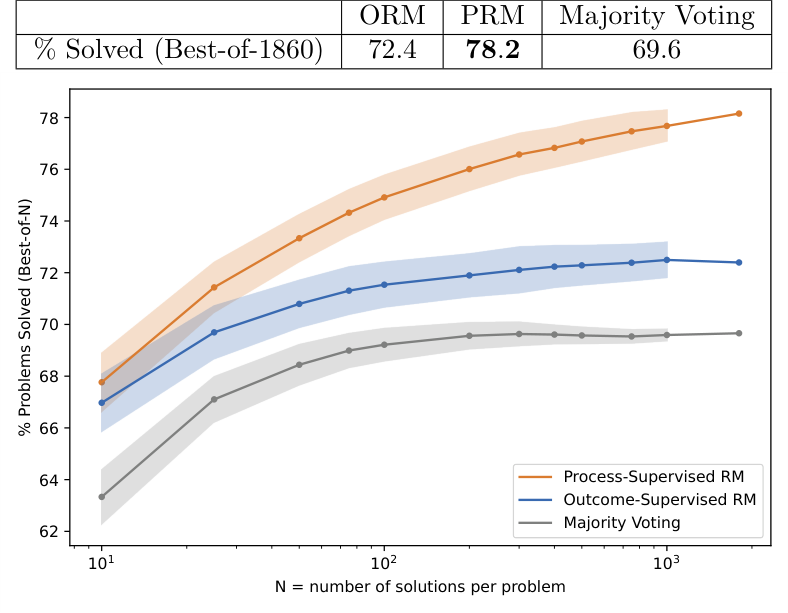
Outcome-only reward models cannot localize where chain-of-thought reasoning fails, so they mis-rank solutions that reach the right answer for the wrong reasons. The paper argues that step-level process supervision fixes this credit-assignment problem and lifts best-of- math search from 72.4% to 78.2% on MATH.
Currently Used Methods
Direct antecedents
- @christianoRLHF2017 — reward modeling from human preferences for downstream policy optimization.
- Limitation in context: feedback targets whole outputs, not individual reasoning errors.
- @ouyangInstructGPT2022 — instruction-following via RM training and RLHF.
- Limitation in context: supervision stays outcome-level, so false-positive reasoning survives.
- @weiCoT2022 — chain-of-thought prompting improves multi-step reasoning.
- Limitation in context: prompting exposes reasoning traces but does not verify them.
- @kojimaZeroShotCoT2022 — zero-shot step-by-step elicitation without demonstrations.
- Limitation in context: generated steps remain unchecked and can drift logically.
- @yaoToT2023 — search over intermediate thoughts for deliberate reasoning.
- Limitation in context: search still depends on a reliable step evaluator.
Proposed Method
Architecture
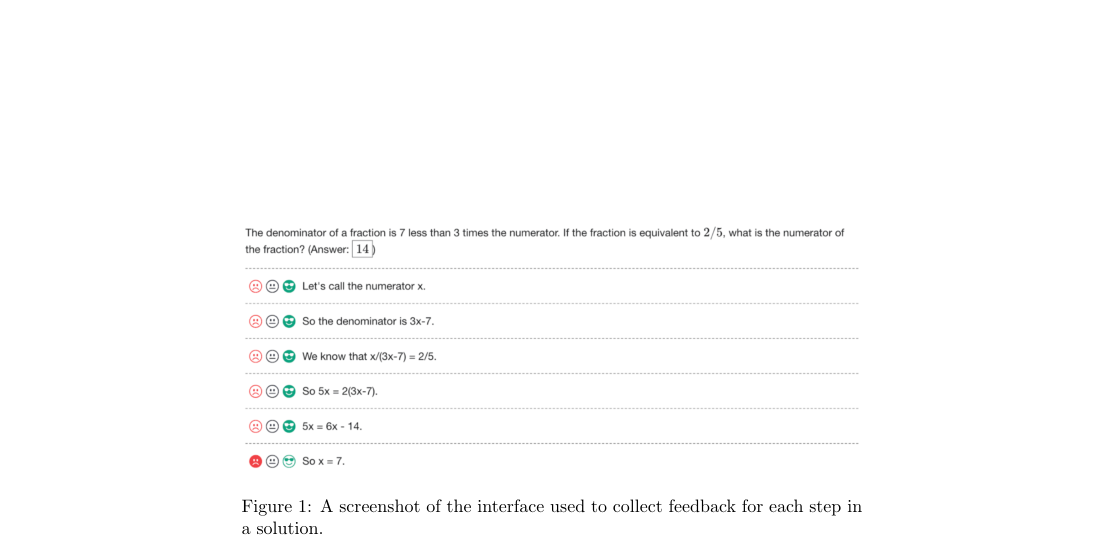
The system has two parts: a generator that emits newline-delimited solution steps, and a reward model that scores either the final answer token (ORM) or every step terminus (PRM). Large-scale models are GPT-4-derived; small-scale models use the same design with roughly less pretraining compute.
Loss / Objective
PRM training is next-token classification over step labels.
Here is the label for step .
Sampling Rule / Algorithm
At test time, the PRM ranks complete solutions by multiplying stepwise correctness probabilities.
Training Procedure
- PRM800K filtered training set: about step labels.
- Solutions in PRM800K: about .
- Problems in PRM800K: about .
- ORM training: 100 uniform samples per problem.
- Reward models: single epoch.
- ORM: no dropout.
- Small-scale active learning pool: 1000 samples per problem.
- Active-learning mix: 80% convincing wrong-answer, 20% remaining convincing.
Evaluation
Datasets
- MATH, evaluated on a held-out 500-problem subset.
- PRM800K for step-level supervision.
- OOD STEM set: AP Calculus, AP Chemistry, AP Physics, AMC10/12.
Metrics
- % problems solved under best-of- search.
- Best-of-1860 for the main large-scale comparison.
- Best-of-100 for OOD evaluation.
- Data efficiency under varying labeled solutions per problem.
Headline results
- MATH large-scale (best-of-1860): PRM 78.2%, ORM 72.4%, majority voting 69.6%.
- MATH large-scale (all tested ): PRM beats ORM and majority voting.
- Small-scale synthetic supervision: process supervision beats both ORM baselines at every data scale.
- Active learning: better data efficiency than uniform labeling.
- OOD STEM aggregate (best-of-100): PRM 72.9%, ORM 63.8%, majority voting 61.3%.
Table 1: OOD generalization on recent STEM tests
| ORM | PRM | Majority Vote | # Problems | |
|---|---|---|---|---|
| AP Calculus | 68.9% | 86.7% | 80.0% | 45 |
| AP Chemistry | 68.9% | 80.0% | 71.7% | 60 |
| AP Physics | 77.8% | 86.7% | 82.2% | 45 |
| AMC10/12 | 49.1% | 53.2% | 32.8% | 84 |
| Aggregate | 63.8% | 72.9% | 61.3% | 234 |
Ablations
- Supervision type: process labels beat outcome labels on identical small-scale datasets.
- Outcome target source: PRM-based outcome labels beat final-answer checking.
- Data collection strategy: active learning improves sample efficiency by .
- RM-weighted voting: no noticeable gain over plain PRM ranking.
Method Strengths and Weaknesses
Strengths
- Closes the main gap with a direct metric gain: 78.2% vs 72.4% best-of-1860.
- Uses dense step labels, so the reward signal localizes the first reasoning error.
- Shows robustness beyond MATH: 72.9% aggregate on fresh STEM exams.
- Releases PRM800K, a large supervised dataset for verifier research.
Weaknesses
- Main large-scale ORM and PRM training sets are not directly comparable.
- Evaluation only measures reranking, not generator improvement through RL.
- PRM score uses a simple product reduction that may over-penalize long solutions.
- Test set shrinks to 500 MATH problems because PRM800K uses many test items.
Suggestions from the authors
- Finetune the generator with RL using the reward model.
- Study process supervision in domains without easy final-answer checking.
- Improve iterative retraining for active learning without instability.
- Explore alternative reductions from step scores to solution scores.
Links
Prior Papers
- @baiConstitutionalAI2022 — another alignment paper that replaces coarse preference signals with more structured supervision.
- @yaoToT2023 — search over intermediate reasoning states becomes stronger when paired with reliable step scoring.
- @christianoRLHF2017 — establishes the reward-modeling frame that this paper refines with step-level labels.
- @ouyangInstructGPT2022 — outcome-level RLHF is the direct baseline this paper argues to surpass for reasoning.
Further Papers
- @shaoGRPO2024 — later reasoning-focused RL work that benefits from stronger reward signals for multi-step tasks.
- @rafailovDPO2023 — preference-optimization methods are adjacent alternatives to RLHF-style reward modeling.
- @kwonvLLM2023 — verifier-style reasoning supervision overlaps with this paper's process-reward modeling agenda.