Constitutional AI: Harmlessness from AI Feedback
Constitutional AI: Harmlessness from AI Feedback
Problem
Framing
RLHF needs large harmfulness-label datasets and tends to buy harmlessness with evasive refusals. Constitutional AI replaces those labels with a short natural-language constitution plus AI self-critique, revision, and preference judgments, yielding a more harmless, less evasive assistant.
Currently Used Methods
Foundational
- @christianoRLHF2017 — preference-based RL from human comparisons.
- Limitation in context: harmfulness supervision remains human-label intensive.
- @ouyangInstructGPT2022 — instruction tuning plus RLHF for aligned assistants.
- Limitation in context: objective changes still require new human feedback collection.
- @weiCoT2022 — chain-of-thought prompting for explicit intermediate reasoning.
- Limitation in context: reasoning is not itself a harmlessness-training pipeline.
- @kojimaZeroShotCoT2022 — zero-shot CoT via “Let’s think step-by-step”.
- Limitation in context: improves judgments, but does not replace preference labels.
- @baiConstitutionalAI2022 — prior helpful-and-harmless RLHF assistants.
- Limitation in context: harmlessness training still trades off against non-evasiveness.
Proposed Method
Architecture
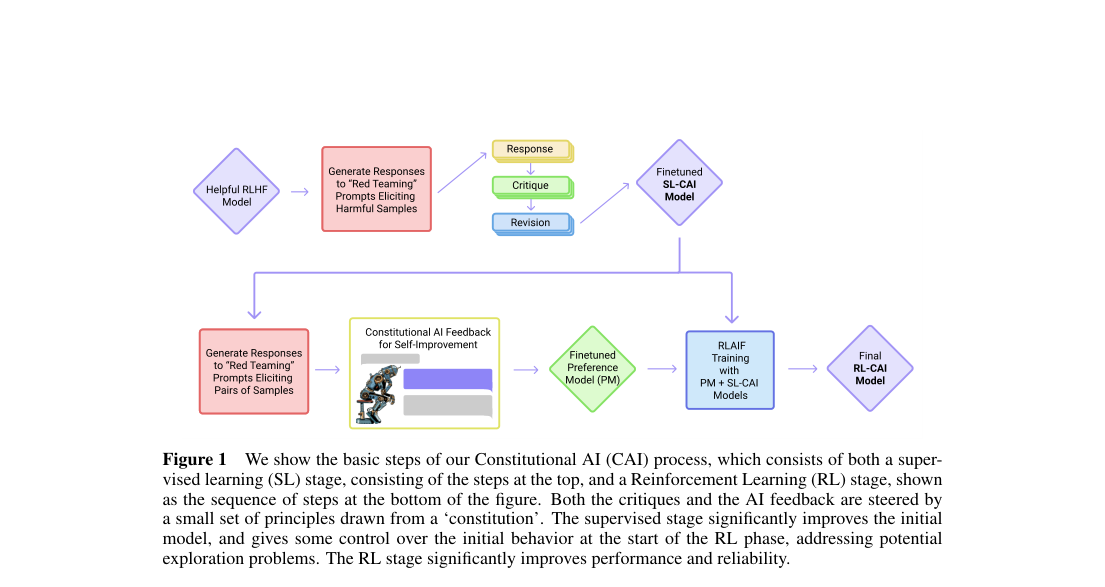
The pipeline has two stages. Supervised CAI samples harmful responses from a helpful RLHF model, then applies critique revision under one sampled constitutional principle; RL-CAI then uses AI preference judgments to train a preference model and optimize the policy.
Loss / Objective
The RL stage trains on AI preference targets for two candidate responses under a constitutional principle.
Sampling Rule / Algorithm
The supervised stage repeatedly rewrites a sampled response with critique-conditioned revision.
Training Procedure
- Constitution size: 16 principles.
- Red-team prompts: 42,496 human-written + 140,335 model-generated = 182,831.
- Critique-revision samples: 4 per red-team prompt.
- Helpfulness prompts: 135,296 human-written.
- Helpfulness samples: 2 per prompt.
- Sampling temperature: .
- SL finetuning: 1 epoch.
- SL batch size: 1024 sequences.
- SL learning rate: 0.5 relative to pretraining LR.
- PM data: 135,296 helpfulness comparisons + 182,831 AI harmlessness comparisons.
- RL training prompts: 491,142 red-team + 474,300 helpfulness.
- CoT label clamp: 40–60%.
Evaluation
Datasets
- 438 binary HHH comparison questions for evaluator accuracy.
- Red-team prompt set from prior harmfulness elicitation.
- Crowdworker open-ended conversations for Elo evaluation.
- Model sizes up to 52B parameters.
Metrics
- Crowdworker helpfulness Elo.
- Crowdworker harmlessness Elo.
- Preference-model score.
- Binary comparison accuracy.
Headline results
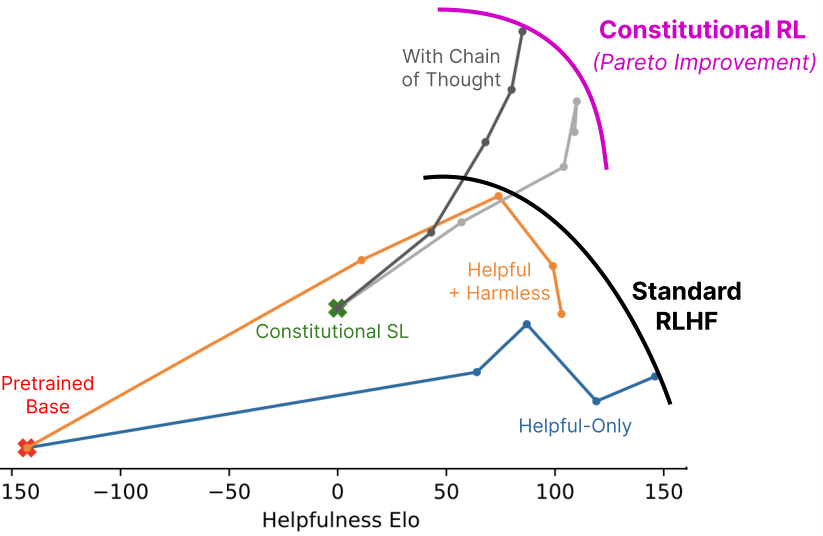
- 52B RL-CAI: preferred frontier over standard RLHF in harmlessness–helpfulness tradeoff.
- RL-CAI: significantly more harmless than RLHF and SL-CAI in crowdworker Elo tests.
- RL-CAI w/ CoT: slightly less helpful, slightly more harmless than RL-CAI without CoT.
- 52B SL-CAI: more harmless than helpful-only RLHF, less harmless than HH RLHF.
- Larger LMs with CoT: approach human-feedback PM accuracy on 438 HHH comparisons.
Ablations
- Number of revisions: harmlessness PM score improves monotonically with more revisions.
- Number of principles: little harmlessness-score gain, but more behavioral diversity.
- Critiqued vs direct revision: critiques help smaller models more.
- Soft vs hard labels: soft preference targets work better for RL-CAI.
- CoT labels: unclamped probabilities become too extreme; 40–60% clamping stabilizes training.
Method Strengths and Weaknesses
Strengths
- Replaces harmfulness labels with a short constitution and AI feedback.
- Produces less evasive refusals that explain objections.
- More revisions steadily improve harmlessness PM scores.
- RL-CAI improves the harmlessness–helpfulness frontier over standard RLHF.
Weaknesses
- SL-CAI alone remains less helpful than RL-trained models.
- Constitutional principles are ad hoc, not stakeholder-designed.
- Larger constitutions improve diversity, not measured harmlessness.
- CoT feedback needs probability clamping to avoid extreme policies.
Suggestions from the authors
- Redevelop constitutional principles with broader stakeholder input.
- Adapt constitutions to deployment context and geographic setting.
- Train models to imitate human natural-language evaluation explanations.
- Use non-evasive assistants to scale automated red teaming.
Links
Prior Papers
- @christianoRLHF2017 — establishes preference-based RL, the template CAI partially replaces with AI feedback.
- @ouyangInstructGPT2022 — shows RLHF for instruction-following assistants, the direct alignment baseline here.
- @weiCoT2022 — motivates chain-of-thought prompting, which CAI uses to improve AI preference judgments.
- @kojimaZeroShotCoT2022 — supplies the zero-shot CoT prompting pattern used for feedback models.
Further Papers
- @lightmanProcessSupervision2023 — extends the idea of supervising intermediate reasoning rather than only final outputs.
- @rafailovDPO2023 — offers a post-RL alternative for preference optimization, relevant to CAI-style preference data.
- @shaoGRPO2024 — studies newer preference-optimization objectives that could replace PPO-style RL in CAI pipelines.