Grokking: Generalization Beyond Overfitting on Small Algorithmic Datasets
Grokking: Generalization Beyond Overfitting on Small Algorithmic Datasets
Problem
Framing
Small algorithmic datasets expose a gap between interpolation and true rule learning: networks can memorize every seen equation yet fail on held-out ones for orders of magnitude more steps. The paper identifies a delayed phase transition, "grokking," where the same model later jumps from chance-level validation accuracy to near-perfect generalization.
Currently Used Methods
Foundational
- @vaswaniAttentionAllNeed2017 — decoder-only Transformers for symbolic sequence modeling.
- Limitation in context: point estimates hide late generalization dynamics after memorization.
- @frankleLotteryTicket2019 — sparse subnetworks can train as well as dense networks.
- Limitation in context: does not explain delayed transition from memorization to rule learning.
- @srivastavaDropout2014 — dropout regularizes networks with stochastic masking.
- Limitation in context: weaker than weight decay for data-efficient generalization here.
- @loshchilovAdamW2019 — decoupled weight decay for adaptive optimization.
- Limitation in context: regularization was not studied as a trigger for grokking dynamics.
Proposed Method
Architecture
The paper uses a decoder-only Transformer on equations of the form , with each symbol tokenized separately. The network has 2 layers, width 128, and 4 attention heads, for about non-embedding parameters.
Loss / Objective
Training minimizes next-token cross-entropy on the answer token only.
Algorithm
For noisy-update ablations, the paper perturbs Adam updates with Gaussian noise.
Training Procedure
- Model: decoder-only Transformer, 2 layers, width 128, 4 heads.
- Parameters: about non-embedding parameters.
- Main Section 3.1 runs: Adam, no weight decay.
- Optimization budget: steps for Section 3.1.
- Learning-time curves: budget increased to steps.
- Repeats: 3 random seeds; 7 seeds for Section 3.1.1.
Evaluation
Datasets
- Binary operation tables over discrete symbols.
- Modular arithmetic tasks, including , , and .
- Polynomial-style operations over finite fields.
- Composition and product tasks in the abstract group .
- Random train/validation splits over all equations.
Metrics
- Train accuracy.
- Validation accuracy.
- Train loss.
- Validation loss.
- Steps to first reach validation accuracy.
Headline results
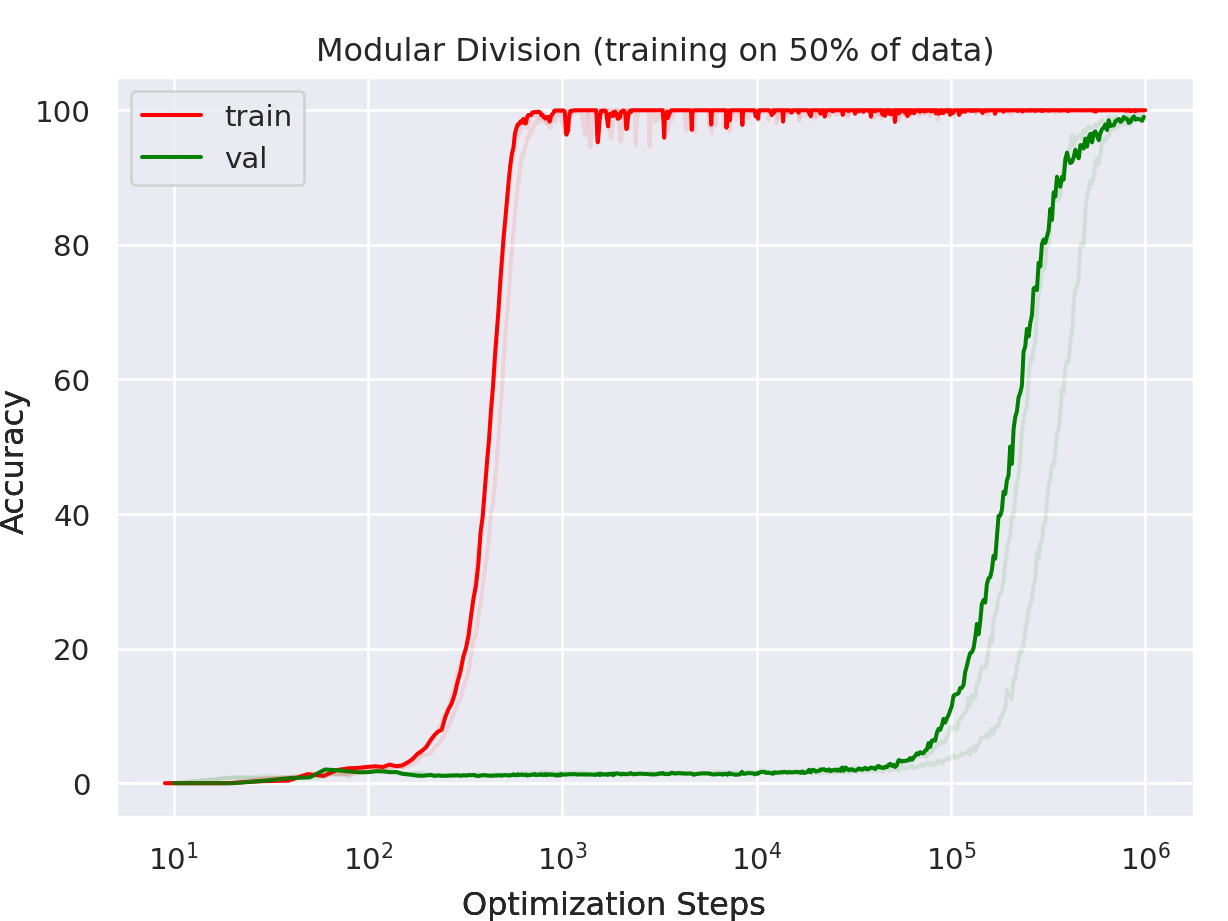
- Modular division, train data: train accuracy reaches by about steps.
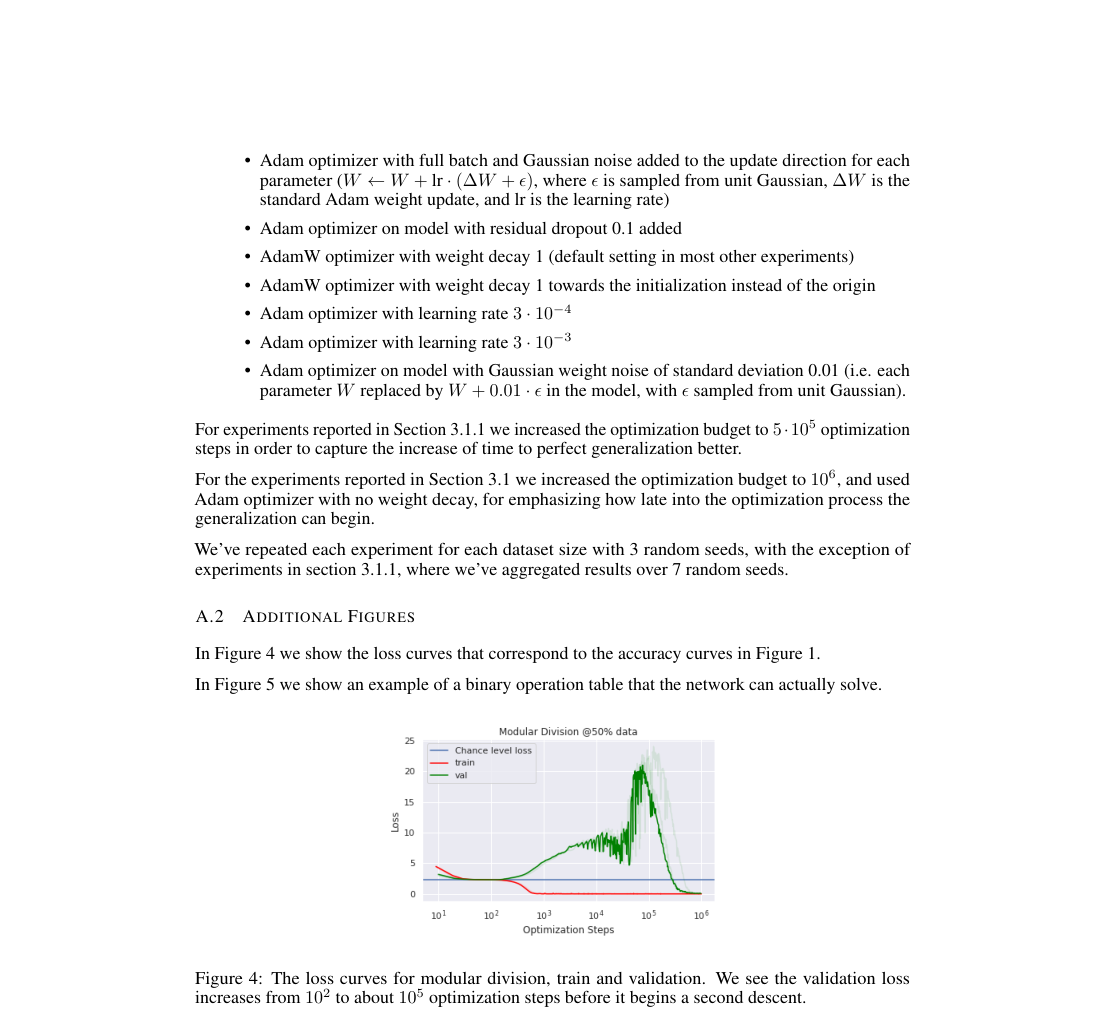
- Modular division, train data: validation stays near chance until about steps.
- Modular division, train data: validation then rises to about by about steps.
- product, - train data: a data drop increases median time-to- by -.
- product, -step budget: weight decay more than halves samples needed versus most interventions.
Ablations
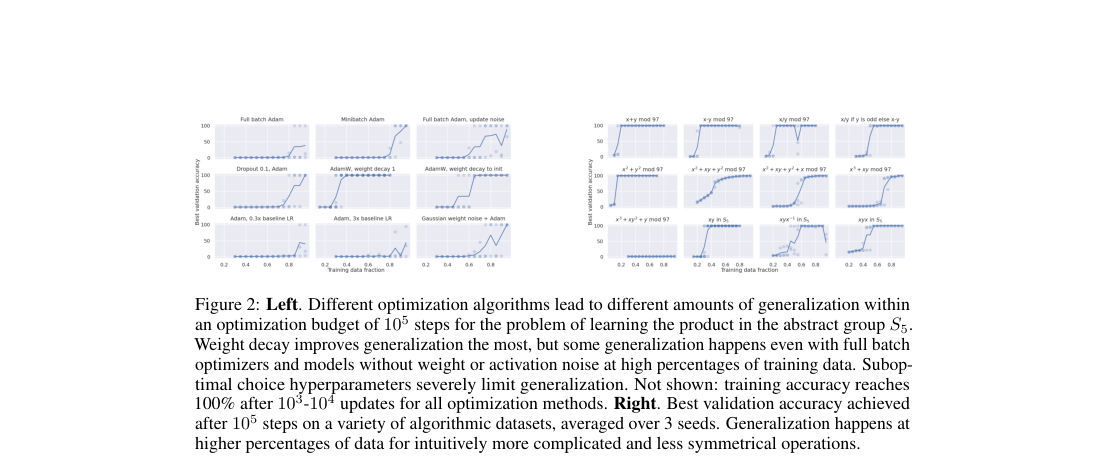
- Optimizer choice: full-batch, minibatch, and noisy variants all generalize differently under fixed compute.
- Weight decay: strongest data-efficiency gain; more than halves required samples on .
- Training-data fraction: less data preserves final accuracy, but sharply delays generalization onset.
- Task structure: less symmetric or more complex operations need higher train fractions to generalize.
Method Strengths and Weaknesses
Strengths
- Isolates memorization versus generalization with exact train/validation equation splits.
- Shows a stark temporal separation: perfect fit by , generalization near steps.
- Demonstrates strong regularization effects; weight decay sharply improves data efficiency.
- Uses multiple algebraic tasks, showing grokking is not unique to one dataset.
Weaknesses
- Evidence is centered on tiny synthetic operation tables, not naturalistic tasks.
- Main mechanism remains descriptive; no predictive theory for grokking onset.
- Results depend on very long optimization horizons, which may be impractical.
- Architecture sweep is narrow: one small Transformer family dominates experiments.
Suggestions from the authors
- Test whether grokking appears on datasets beyond small algorithmic tables.
- Evaluate whether sharpness and related minima measures predict grokking onset.
- Study compute–data tradeoffs behind rapidly increasing time to generalization.
- Investigate why SGD noise and flatter solutions correlate with better generalization.
Links
Prior Papers
- @frankleLotteryTicket2019 — adjacent perspective on implicit structure in overparameterized networks and which subnetworks support generalization.
- @vaswaniAttentionAllNeed2017 — provides the Transformer architecture used for the symbolic equation model.
- @srivastavaDropout2014 — dropout is one of the regularization baselines compared in the optimization ablations.
- @loshchilovAdamW2019 — AdamW weight decay is a central intervention in the paper's generalization experiments.
Further Papers
No vault papers identified as further work yet.