Robust Speech Recognition via Large-Scale Weak Supervision
Robust Speech Recognition via Large-Scale Weak Supervision
Problem
Framing
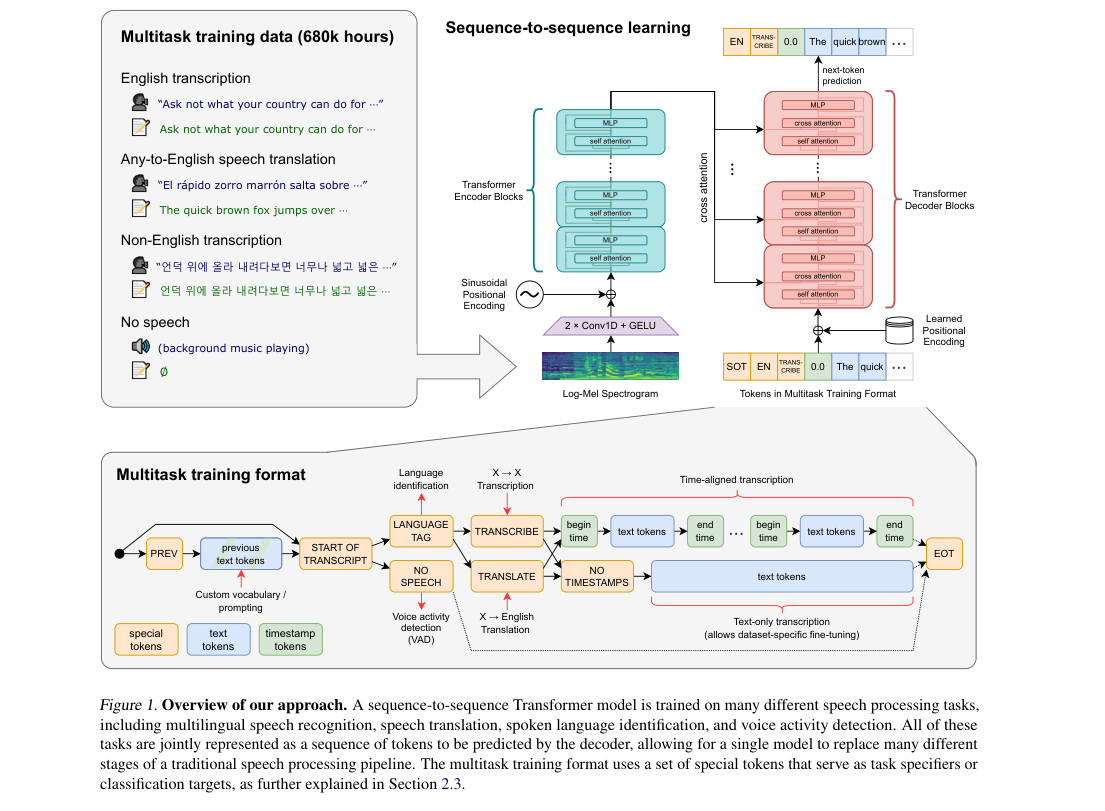
Supervised ASR had strong in-domain accuracy but weak transfer, brittle multilingual coverage, and fragmented task pipelines. Whisper closes this with a single encoder-decoder Transformer trained on 680k hours of weakly supervised web audio, using task-specifying text tokens for transcription, translation, language ID, and VAD.
Currently Used Methods
Foundational
- @oordWaveNet2016 — autoregressive raw-audio generation shows sequence modeling at waveform scale.
- Limitation in context: not an end-to-end multilingual ASR transfer recipe.
- @baevskiWav2Vec2_2020 — self-supervised speech pretraining with strong fine-tuned ASR.
- Limitation in context: still relies on supervised adaptation and task-specific pipelines.
- "Attention Is All You Need" — Transformer sequence modeling enables large-scale encoder-decoder learning.
- Limitation in context: does not specify speech multitask prompting or weak-supervision scaling.
- "Scaling Laws for Transfer" — scaling data and parameters improves weakly supervised transfer.
- Limitation in context: speech had little evidence at 680k-hour multilingual scale.
Proposed Method
Architecture
Whisper uses a sequence-to-sequence Transformer over 30-second 80-channel log-Mel spectrograms. The encoder applies two Conv1D+GELU front-end layers, sinusoidal positions, and Transformer blocks; the decoder uses learned positions, causal self-attention, and cross-attention into the encoder. Model sizes range from Tiny to Large, with 4 to 32 layers and 39M to 1550M parameters.
Loss / Objective
Training is standard next-token prediction over the multitask token stream.
Algorithm
Task control is done by prefix tokens that specify language, task, timestamp behavior, and optional prior context.
Training Procedure
- Training data: 680k hours.
- Audio context: 30 seconds.
- Batch size: 256.
- Updates: 1,048,576.
- Warmup updates: 2,048.
- Max grad norm: 1.0.
- Learning rates: Tiny 1.5 10^{-3}, Base 1 10^{-3}, Small 5 10^{-4}, Medium 2.5 10^{-4}, Large 1.75 10^{-4}.
Evaluation
Datasets
- LibriSpeech test-clean, test-other.
- TED-LIUM 3.
- Common Voice 5.1 and 9.
- CHiME-6.
- CallHome, Switchboard.
- Fleurs.
- VoxPopuli.
- CoVoST 2.
Metrics
- Word error rate (WER).
- BLEU for translation.
- Language identification accuracy.
- Robustness under additive noise and long-form transcription.
Headline results
- LibriSpeech test-clean: WER 2.7.
- LibriSpeech test-other: WER 5.9.
- CoVoST2 : beats prior zero-shot systems in overall, medium, and low-resource groups.
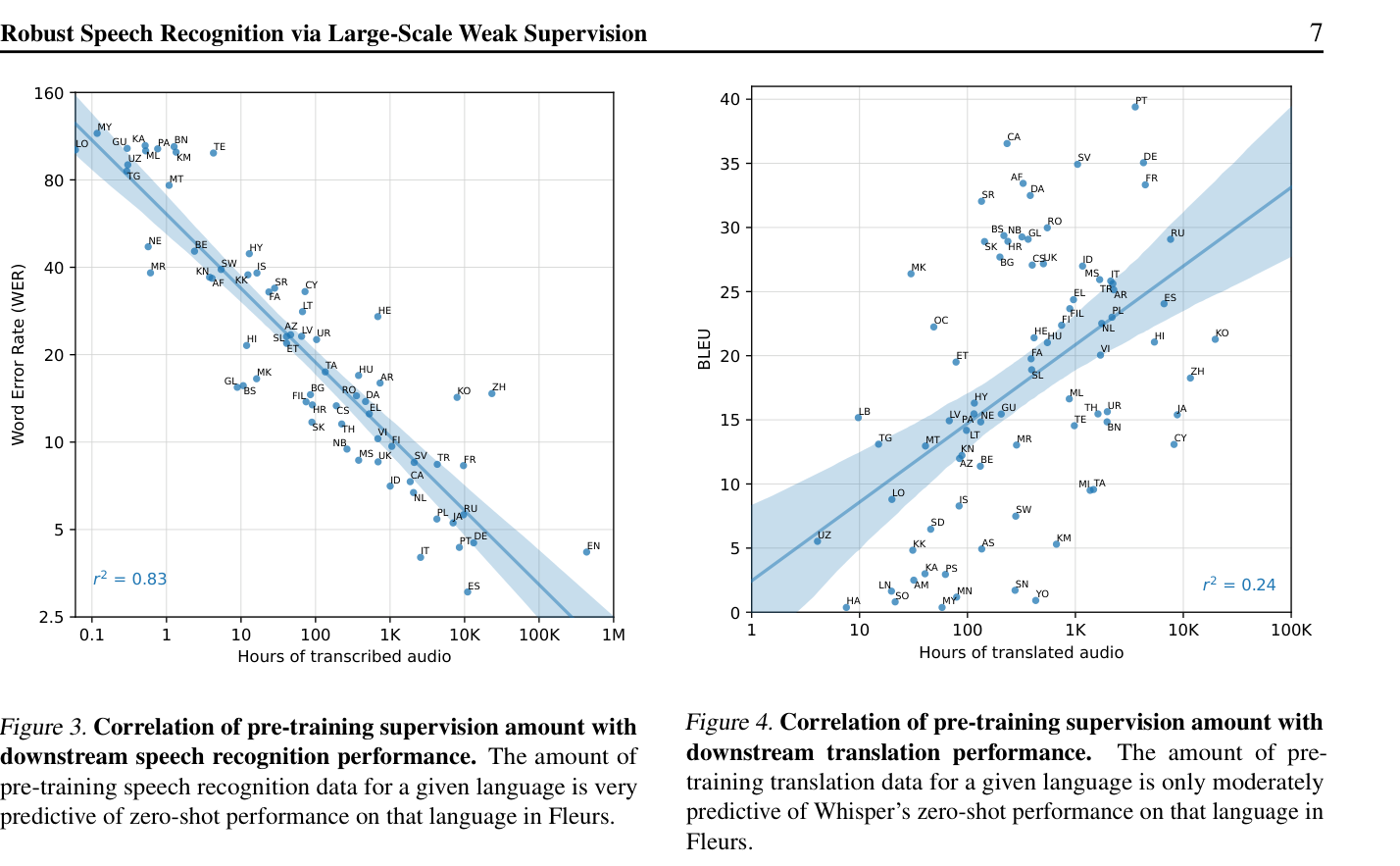
- Fleurs multilingual ASR: speech-recognition supervision strongly predicts zero-shot WER with .
- Fleurs translation: translated-audio hours predict zero-shot BLEU weakly with .
Ablations
- Model size: scaling improves English, multilingual, and translation performance smoothly.
- Dataset size: gains persist up to the full 680k-hour corpus, then diminish.
- Noise level: Whisper degrades more gracefully than competing systems under white and pub noise.
- Task mixture: multitask prompting supports one model across ASR, translation, language ID, and VAD.
Method Strengths and Weaknesses
Strengths
- One model covers ASR, translation, language ID, and VAD through prompting.
- 680k-hour weak supervision yields strong zero-shot transfer across many datasets.
- LibriSpeech reaches 2.7 WER on test-clean without a language model.
- Noise robustness exceeds competing systems across SNR conditions.
Weaknesses
- Translation transfer is weaker than ASR transfer; Fleurs BLEU correlation is only .
- Language identification is not competitive with supervised specialists.
- Decoder can emit speaker names or hallucinatory text on long-form audio.
- Many remaining errors are linguistic and world-knowledge failures, not acoustics.
Suggestions from the authors
- Improve decoding to reduce linguistic and world-knowledge errors.
- Study language-model fusion for pretrained speech encoders and Whisper-like decoders.
- Add auxiliary objectives beyond next-token prediction.
- Improve long-form transcription behavior and suppress speaker-name hallucinations.
Links
Prior Papers
- @baevskiWav2Vec2_2020 — strong speech representation pretraining baseline that Whisper challenges with weakly supervised multitask transfer.
- @oordWaveNet2016 — early large-scale sequence modeling for speech audio, useful as historical context for end-to-end speech systems.
Further Papers
- @alayracFlamingo2022 — shares the theme of large-scale weakly supervised multimodal transfer with prompted downstream behavior.
- @luUnifiedIO2_2024 — extends the single-model, many-task paradigm to broader multimodal sequence transduction.