wav2vec 2.0: A Framework for Self-Supervised Learning of Speech Representations
wav2vec 2.0: A Framework for Self-Supervised Learning of Speech Representations
Problem
Framing
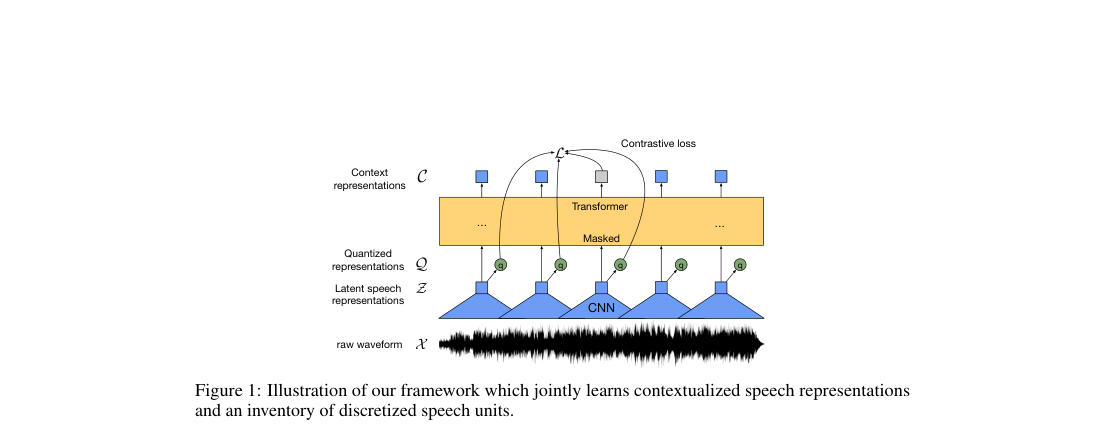
End-to-end ASR still depends on large transcribed corpora, while unlabeled speech is abundant. The paper closes this gap by masking latent audio frames and predicting quantized targets with a contrastive objective, reaching 1.8/3.3 WER on LibriSpeech test-clean/other and 4.8/8.2 WER with only 10 minutes of labels.
Currently Used Methods
Foundational
- @vaswaniAttentionAllNeed2017 — Transformer context modeling over long sequences.
- Limitation in context: needs supervised targets; no speech-only pretraining objective.
- @devlinBERT2018 — masked prediction for contextual representation learning.
- Limitation in context: discrete text tokens; raw speech lacks native tokenization.
- @bahdanauAttention2014 — neural sequence transduction for speech and translation.
- Limitation in context: still relies on paired input-output supervision.
- @radfordWhisper2022 — large-scale speech recognition from weak supervision.
- Limitation in context: uses labeled or pseudo-labeled transcripts, not pure self-supervision.
- @baevskiWav2Vec2_2020 — end-to-end masked contrastive speech pretraining with quantized targets.
- Limitation in context: this paper is the method under review.
Proposed Method
Architecture
The model maps raw waveform through a 7-layer temporal CNN to latent frames , masks sampled spans, then applies a Transformer to produce contextual states . A product quantizer converts unmasked latent frames into discrete targets for contrastive prediction. BASE uses 12 Transformer blocks with model size 768 and 8 heads; LARGE uses 24 blocks, 1024, and 16 heads.
Loss / Objective
Pretraining combines masked contrastive prediction with a codebook-usage penalty.
Algorithm
Fine-tuning adds a linear projection over contextual states and optimizes CTC on labeled speech.
Training Procedure
- Mask starts:
- Mask span length:
- Masked fraction: about 49%
- Feature encoder: 7 conv blocks, 512 channels
- Conv kernels:
- Conv strides:
- Optimizer: Adam
- LR peak: BASE, LARGE
- Warmup: first 8% of updates
- Updates: 400k BASE, 250k LARGE, 600k LARGE on LV-60k
- Diversity weight:
- Quantizer groups/codewords: ,
Evaluation
Datasets
- LibriSpeech 960h labeled ASR
- Libri-light low-resource splits: 10 min, 1h, 10h
- LibriSpeech train-clean-100
- LS-960 unlabeled pretraining audio
- LV-60k unlabeled LibriVox audio, 53.2k hours
- TIMIT phoneme recognition
Metrics
- Word error rate (WER)
- Phoneme error rate (PER)
Headline results
- LibriSpeech 960h, LARGE + LV-60k + Transformer LM: test WER 1.8 / 3.3
- LibriSpeech 960h, LARGE + LV-60k + 4-gram LM: test WER 2.0 / 3.6
- 10 min labeled, pretrain on 53k hours: test WER 4.8 / 8.2
- 1 hour labeled: improves over prior 100h semi-supervised setups with 100\times fewer labels
- TIMIT: new SOTA PER with relative 23% / 29% gains on dev / test
Table 10: WER on LibriSpeech with all 960 hours labeled
| Model | Unlabeled data | LM | dev clean | dev other | test clean | test other |
|---|---|---|---|---|---|---|
| LARGE - from scratch | - | None | 2.8 | 7.6 | 3.0 | 7.7 |
| LARGE - from scratch | - | 4-gram | 1.8 | 5.4 | 2.6 | 5.8 |
| LARGE - from scratch | - | Transf. | 1.7 | 4.3 | 2.1 | 4.6 |
| BASE | LS-960 | None | 3.2 | 8.9 | 3.4 | 8.5 |
| BASE | LS-960 | 4-gram | 2.0 | 5.9 | 2.6 | 6.1 |
| BASE | LS-960 | Transf. | 1.8 | 4.7 | 2.1 | 4.8 |
| LARGE | LS-960 | None | 2.6 | 6.5 | 2.8 | 6.3 |
| LARGE | LS-960 | 4-gram | 1.7 | 4.6 | 2.3 | 5.0 |
| LARGE | LS-960 | Transf. | 1.7 | 3.9 | 2.0 | 4.1 |
| LARGE | LV-60k | None | 2.1 | 4.5 | 2.2 | 4.5 |
| LARGE | LV-60k | 4-gram | 1.4 | 3.5 | 2.0 | 3.6 |
| LARGE | LV-60k | Transf. | 1.6 | 3.0 | 1.8 | 3.3 |
Ablations
- Quantizing only contrastive targets beats feeding quantized inputs into the Transformer.
- Larger model size lowers WER across all low-resource and full-data setups.
- More unlabeled audio helps: LV-60k beats LS-960 at matched fine-tuning settings.
- Learned discrete latents align with phonetic categories, not arbitrary partitions.
Method Strengths and Weaknesses
Strengths
- Reaches 1.8/3.3 WER on LibriSpeech with full supervision after pretraining.
- Works in extreme low-label regimes: 4.8/8.2 WER with 10 minutes labeled.
- Learns quantization jointly, avoiding separate clustering pipelines.
- Improves TIMIT PER by large relative margins over prior systems.
Weaknesses
- Best results need 53.2k hours of unlabeled audio.
- Decoding quality still depends on external 4-gram or Transformer language models.
- LARGE model has 317M parameters, raising pretraining cost.
- Contrastive setup samples negatives from the same utterance only.
Suggestions from the authors
- Test whether discrete latents transfer beyond speech recognition.
- Study stronger links between learned units and phonetic structure.
- Extend pretraining to lower-resource languages lacking transcripts.
- Improve decoding without heavy external language models.
Links
Prior Papers
- @vaswaniAttentionAllNeed2017 — supplies the Transformer context network used to contextualize masked speech frames.
- @devlinBERT2018 — motivates span masking and contextual prediction as the pretraining template adapted to speech.
Further Papers
- @radfordWhisper2022 — large-scale speech modeling and recognition that benefits from robust pretrained speech representations.