LLaMA: Open and Efficient Foundation Language Models
touvronLLaMA2023
Problem
Framing
Open LMs lagged closed models in compute-optimal scaling and benchmark quality at fixed inference cost. LLaMA closes that gap with Chinchilla-style token budgets, a plain decoder-only transformer, and public-data training, reaching competitive zero- and few-shot results with 7B–65B models.
Currently Used Methods
Foundational
- @brownGPT3_2020 — autoregressive few-shot scaling with dense decoder-only transformers.
- Limitation in context: undertrained per parameter, so smaller longer-trained models can win.
- @hoffmannChinchilla2022 — compute-optimal scaling laws for parameter–token tradeoffs.
- Limitation in context: does not deliver an open public-data model family.
- @suRoFormer2021 — rotary position embeddings for long-context attention.
- Limitation in context: positional encoding alone does not set training efficiency.
- "PaLM: Scaling Language Modeling with Pathways" — strong large-scale dense transformer baseline.
- Limitation in context: larger closed model and non-public training recipe.
- "OPT: Open Pre-trained Transformer Language Models" — open decoder-only LM replication effort.
- Limitation in context: weaker quality-per-parameter than compute-optimal training.
Proposed Method
Architecture
LLaMA is a decoder-only transformer with 7B, 13B, 33B, and 65B variants. It keeps the standard causal stack but replaces LayerNorm with RMSNorm, uses SwiGLU feed-forward blocks, and uses rotary positional embeddings. Context length is 2048.
Table 2: Model sizes, architectures, and optimization hyper-parameters.
| params | dimension | n heads | n layers | learning rate | batch size | n tokens |
|---|---|---|---|---|---|---|
| 6.7B | 4096 | 32 | 32 | 3.0e | 4M | 1.0T |
| 13.0B | 5120 | 40 | 40 | 3.0e | 4M | 1.0T |
| 32.5B | 6656 | 52 | 60 | 1.5e | 4M | 1.4T |
| 65.2B | 8192 | 64 | 80 | 1.5e | 4M | 1.4T |
Loss / Objective
The model uses the standard causal language-model objective.
Sampling Rule / Algorithm
At inference, the model autoregressively samples or scores the next token from the decoder distribution.
Training Procedure
- Context length: 2048.
- Batch size: 4M tokens.
- Token budget: 1.0T for 7B and 13B.
- Token budget: 1.4T for 33B and 65B.
- Learning rate: for 7B and 13B.
- Learning rate: for 33B and 65B.
- Data mixture includes CommonCrawl, C4, Github, Wikipedia, Books, and ArXiv/StackExchange-style sources.
Evaluation
Datasets
- Common-sense reasoning: BoolQ, PIQA, SIQA, HellaSwag, WinoGrande, ARC-e, ARC-c, OBQA.
- Reading comprehension: NaturalQuestions, TriviaQA, RACE.
- World knowledge: MMLU.
- Code and math: HumanEval, MBPP, GSM8K, MATH.
- Robustness and bias: RealToxicityPrompts, CrowS-Pairs, WinoGender.
Metrics
- Accuracy for multiple-choice tasks.
- Exact match for NaturalQuestions and TriviaQA.
- pass@ for code generation.
- Benchmark average accuracy for MMLU.
Headline results
- Common-sense reasoning, zero-shot: LLaMA-65B beats Chinchilla-70B on HellaSwag, WinoGrande, and PIQA.
- MMLU, 5-shot: LLaMA-65B reaches 63.4 average.
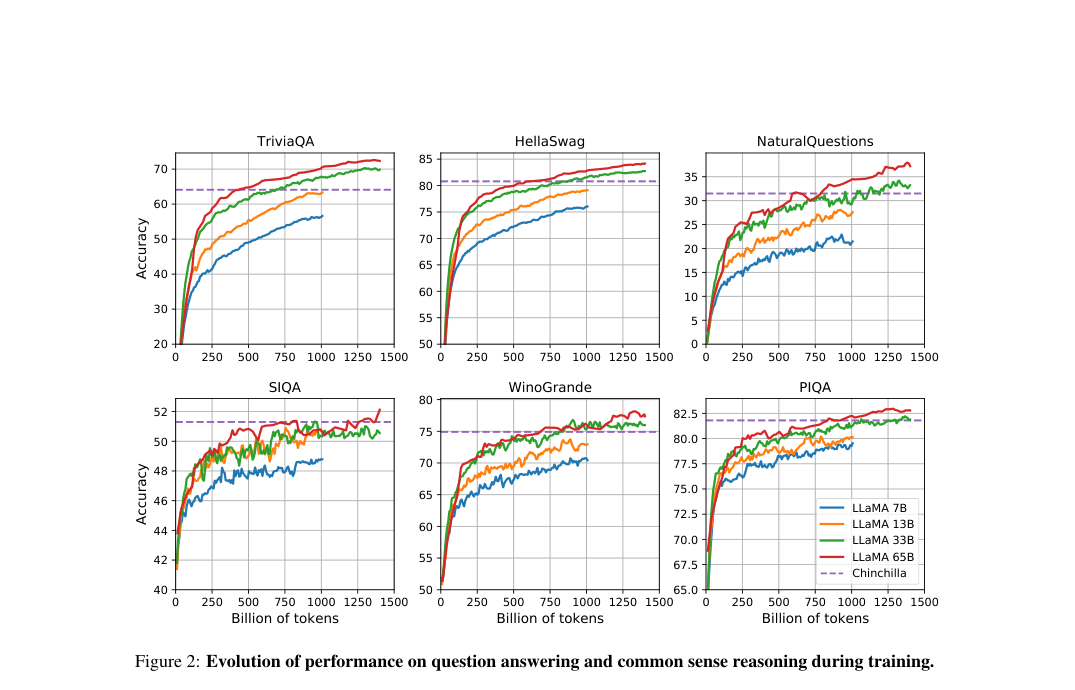
- NaturalQuestions, 1-shot trend: LLaMA-65B rises above the Chinchilla reference during training.
- TriviaQA, 1-shot trend: LLaMA-65B reaches about 72 accuracy by 1.4T tokens.
- The paper reports that 13B outperforms GPT-3 175B on most benchmarks, and 65B is competitive with Chinchilla-70B and PaLM-540B.
Ablations
- Model size: larger models improve monotonically on most tasks during training.
- Token budget: 33B and 65B continue improving through 1.4T tokens.
- Small-model training length: 7B still improves after 1.0T tokens.
- Benchmark sensitivity: WinoGrande saturates; gains correlate less cleanly with training loss.
Method Strengths and Weaknesses
Strengths
- Strong quality-per-parameter: 13B surpasses GPT-3 175B on many benchmarks.
- Public-data training recipe makes the results reproducible in principle.
- Simple architecture changes improve efficiency without exotic routing or retrieval.
- Training curves show 7B–65B models remain undertrained at smaller token budgets.
Weaknesses
- No architectural novelty beyond careful transformer simplifications.
- 2048-token context is short for many downstream uses.
- Evaluation is still benchmark-centric, with limited task adaptation analysis.
- The paper reports toxicity and bias issues that instruction tuning does not solve.
Suggestions from the authors
- Extend training beyond 1T tokens for smaller models.
- Improve instruction tuning for stronger zero-shot usability.
- Reduce toxicity and social bias in open foundation models.
- Study larger-context and broader multilingual evaluation settings.
Links
Prior Papers
- @brownGPT3_2020 — establishes the dense autoregressive scaling baseline that LLaMA rebalances with more tokens.
- @hoffmannChinchilla2022 — provides the compute-optimal scaling law that directly motivates LLaMA's token budgets.
- @suRoFormer2021 — supplies rotary positional embeddings, one of LLaMA's key architectural ingredients.
Further Papers
- @jiangMixtral2024 — extends the open-LM line with sparse MoE scaling after LLaMA-class dense backbones.