Video Diffusion Models
Video Diffusion Models
Problem
Framing
Diffusion models had not shown strong, temporally coherent video generation across unconditional, predictive, and text-conditioned settings. The paper closes this gap with a 3D U-Net video diffusion model plus reconstruction-guided conditional sampling, reaching UCF101 FID and BAIR FVD .
Currently Used Methods
Foundational
- @oordWaveNet2016 — autoregressive likelihood modeling with strong local structure.
- Limitation in context: sequential decoding makes long coherent video generation slow.
- @DenoisingDiffusionProbabilisticModels2020 — denoising diffusion for high-quality image generation.
- Limitation in context: operates on images, not factorized space-time video tensors.
- @songScoreSDE2020 — score-based generative modeling with predictor-corrector sampling.
- Limitation in context: no video architecture or video-specific conditional extension rule.
- @nicholImprovedDDPM2021 — improved diffusion training and faster sampling variants.
- Limitation in context: does not address temporal coherence or video conditioning.
- @ClassifierFreeDiffusionGuidance2022 — guidance without an external classifier for conditional diffusion.
- Limitation in context: alone it does not solve long-horizon video extension.
Proposed Method
Architecture
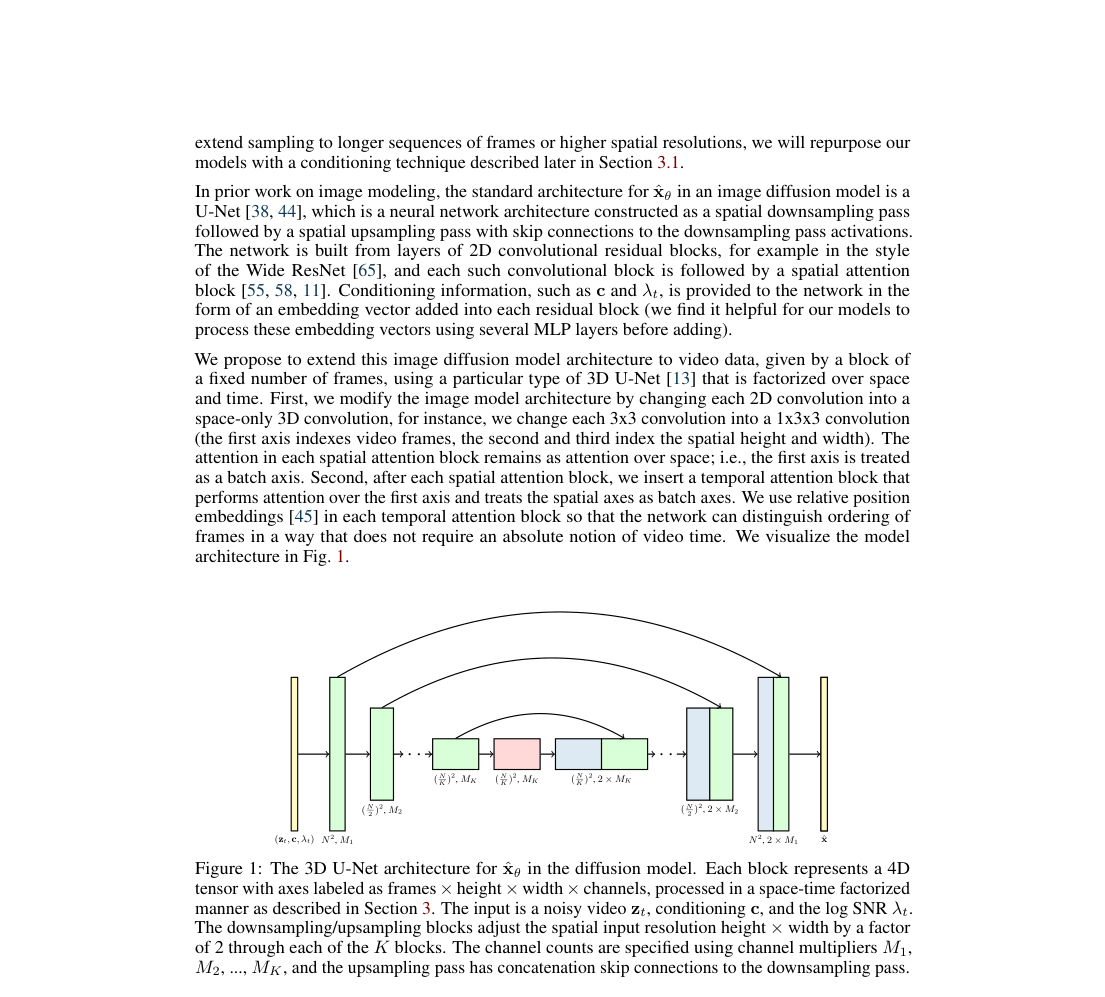
The model is a 3D U-Net over tensors shaped as frames height width channels. It replaces each 2D convolution with a space-only 3D convolution, then factorizes attention into spatial attention and temporal attention with relative position embeddings. Conditioning and log-SNR are injected through residual-block embeddings.
Loss / Objective
Training uses the standard denoising regression objective over noisy videos:
Sampling Rule / Algorithm
The ancestral sampler starts from and steps from to by
Training Procedure
- Optimizer: Adam, , .
- Learning rate: or .
- Batch size: 128 or 256.
- EMA: 0.9999.
- Dropout: 0.0 or 0.1.
- Attention resolutions: 8, 16, 32.
- Attention head dimension: 64 or 128.
- Conditioning embedding dimension: 1024.
Evaluation
Datasets
- UCF101: unconditional generation, 16 frames at .
- BAIR Robot Pushing: predict 15 frames from 1 frame at .
- Kinetics-600: predict 11 frames from 5 frames at .
- Text-to-video dataset: 10 million captioned videos.
Metrics
- FVD.
- FID.
- IS.
- FID-avg / IS-avg: frame-averaged image metrics.
- FID-first / IS-first: first-frame image metrics.
Headline results
- UCF101 unconditional: FID , IS .
- BAIR prediction: FVD with Langevin sampler, 256 steps.
- Kinetics-600 prediction: FVD , IS with Langevin sampler, 128 steps.
- Text-to-video, joint training with 8 image frames: FVD , FID-avg .
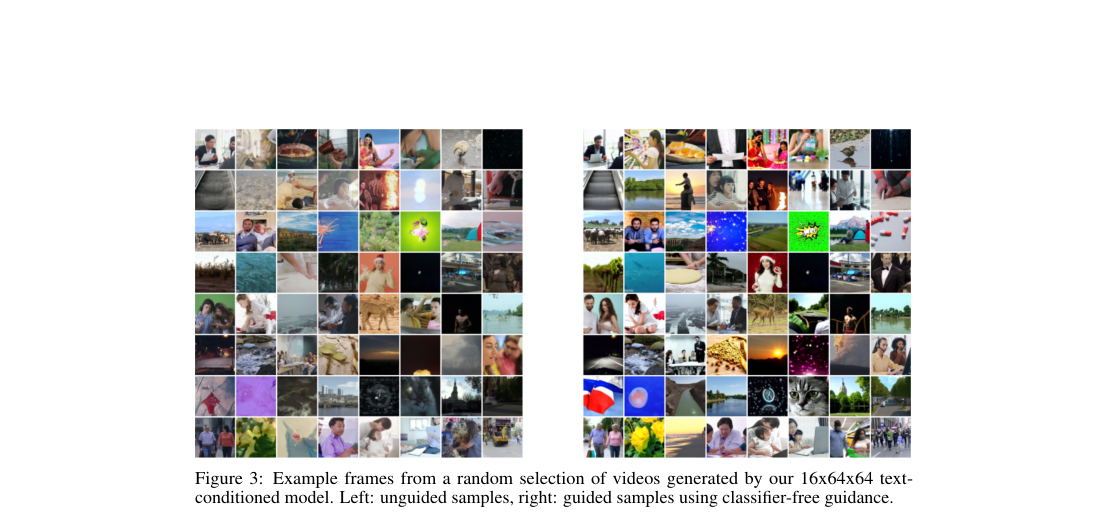
- Text-to-video, guidance weight 2.0, frameskip 1: FID-avg , IS-avg .
Table 1: Unconditional video modeling results on UCF101.
| Method | Resolution | FID↓ | IS↑ |
|---|---|---|---|
| MoCoGAN [52] | 16x64x64 | 26998 ± 33 | 12.42 |
| TGAN-F [26] | 16x64x64 | 8942.63 ± 3.72 | 13.62 |
| TGAN-ODE [18] | 16x64x64 | 26512 ± 27 | 15.2 |
| TGAN-F [26] | 16x128x128 | 7817 ± 10 | 22.91 ± .19 |
| VideoGPT [62] | 16x128x128 | 24.69 ± 0.30 | |
| TGAN-v2 [41] | 16x64x64 | 3431 ± 19 | 26.60 ± 0.47 |
| TGAN-v2 [41] | 16x128x128 | 3497 ± 26 | 28.87 ± 0.47 |
| DVD-GAN [14] | 16x128x128 | 32.97 ± 1.7 | |
| Video Diffusion (ours) | 16x64x64 | 295 ± 3 | 57 ± 0.62 |
| real data | 16x64x64 | 60.2 |
Ablations
- Joint image-video training: adding 4 or 8 image frames sharply improves FVD and FID.
- Classifier-free guidance: IS rises with guidance weight, while FID improves then worsens.
- Reconstruction guidance vs replacement: reconstruction guidance preserves temporal coherence and lowers FVD.
- Sampler choice: Langevin sampling beats ancestral sampling on BAIR and Kinetics-600.
Method Strengths and Weaknesses
Strengths
- Reaches UCF101 FID , far ahead of prior reported results.
- Strong conditional prediction results on BAIR and Kinetics-600.
- Joint image-video training materially improves text-to-video sample quality.
- Reconstruction guidance fixes temporal incoherence from replacement conditioning.
Weaknesses
- Long videos require block-autoregressive extension, not single-pass generation.
- Text-conditioned metrics still degrade at high guidance weights.
- Reported training uses large TPU-v4 budgets.
- Core text-to-video architecture details sit in Appendix A, not main method.
Suggestions from the authors
- Explore training with independent images from larger image-only datasets.
- Improve conditional extension for longer and higher-resolution videos.
- Scale text-conditioned video generation beyond the initial reported results.
- Study better evaluation protocols and preprocessing consistency for video metrics.
Links
Prior Papers
- @oordWaveNet2016 — early autoregressive generative modeling baseline for sequential data, relevant as a pre-diffusion alternative.
- @DenoisingDiffusionProbabilisticModels2020 — establishes the core diffusion framework extended here from images to video.
- @songScoreSDE2020 — provides score-based sampling ideas that connect to the predictor-corrector sampler used here.
- @nicholImprovedDDPM2021 — improves diffusion training and sampling, forming part of the immediate image-diffusion foundation.
- @ClassifierFreeDiffusionGuidance2022 — guidance mechanism directly evaluated here for text-conditioned video generation.
Further Papers
- @rombachLatentDiffusion2022 — extends diffusion generation to more efficient latent spaces, relevant for scaling video models.
- @peeblesDiT2022 — explores transformer backbones for diffusion, a natural architectural successor to 3D U-Nets.
- @songConsistencyModels2023 — targets faster diffusion-style sampling, relevant to the slow multi-step generation bottleneck.
- @karrasEDM2022 — refines diffusion design and sampling choices that could improve video diffusion quality and efficiency.