Neural Machine Translation of Rare Words with Subword Units
Neural Machine Translation of Rare Words with Subword Units
Problem
Framing
Word-level NMT with fixed vocabularies collapses rare words into or brittle dictionary back-off, which hurts names, compounds, and transliterations. The paper closes this gap by encoding words as subword units learned with byte pair encoding, yielding open-vocabulary translation and better rare-word accuracy on WMT15 EnglishGerman and EnglishRussian.
Currently Used Methods
Foundational
- @bahdanauAttention2014 — attention-based encoder-decoder NMT with fixed target vocabulary.
- Limitation in context: rare words still map to shortlist tokens or .
- @choGRU2014 — GRU sequence models for conditional neural translation.
- Limitation in context: recurrent architecture alone does not solve open vocabularies.
- @sutskeverSeq2Seq2014 — end-to-end sequence-to-sequence learning with word tokens.
- Limitation in context: word-level tokenization explodes vocabulary and sparsity.
- "Addressing the Rare Word Problem in Neural Machine Translation" — back-off dictionary replacement for unknown targets.
- Limitation in context: copies or substitutes words without modeling subword composition.
- "Linguistically Motivated Vocabulary Reduction for Neural Machine Translation from Turkish to English" — syntax-based segmentation for vocabulary reduction.
- Limitation in context: language-specific preprocessing is less simple and less portable.
Proposed Method
Architecture
The translation model is the standard attention-based encoder-decoder with a bidirectional GRU encoder and a GRU decoder. The novelty is not a new network block; it replaces word tokens with variable-length subword units, learned either separately on source and target or jointly across both vocabularies.
Loss / Objective
The training objective is the standard conditional log-likelihood over the target sequence.
Algorithm
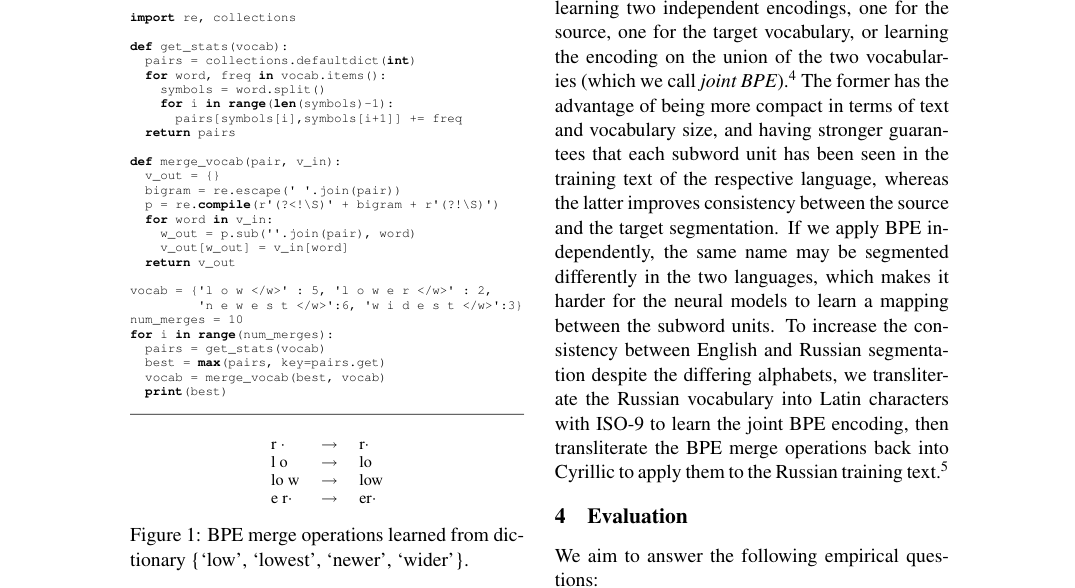
BPE starts from character symbols and repeatedly merges the most frequent adjacent pair.
Training Procedure
- Encoder: bidirectional GRU.
- Decoder: GRU with attention.
- Training toolkit: Nematus.
- Source/target shortlists compared at 30k, 50k, 60k, 90k, 300k, 500k.
- BPE learned either independently or jointly over source and target vocabularies.
- Evaluation uses single models and 8-model ensembles.
Evaluation
Datasets
- WMT15 EnglishGerman newstest2015.
- WMT15 EnglishRussian newstest2015.
Metrics
- BLEU.
- CHRF3.
- Unigram for all words.
- Unigram for rare words.
- Unigram for OOV words.
Headline results
- EnglishGerman, syntax-based baseline: BLEU 24.4, CHRF3 55.3.
- EnglishGerman, WDict: BLEU 23.2, CHRF3 52.7, OOV 26.5.
- EnglishGerman, BPE-J90k ensemble: BLEU 24.7, CHRF3 55.6, OOV 38.6.
- EnglishRussian, phrase-based baseline: BLEU 24.3, CHRF3 53.8.
- EnglishRussian, BPE-J90k ensemble: BLEU 26.0, CHRF3 54.7, OOV 15.6.
Ablations
- Joint vs independent BPE: joint BPE improves consistency and rare-word accuracy.
- Vocabulary size: smaller subword vocabularies can outperform larger word vocabularies.
- Word frequency rank: subword models degrade more smoothly on rare words.
- Back-off dictionary vs subwords: subwords beat dictionary replacement on productive word formation.
Method Strengths and Weaknesses
Strengths
- Drops language-specific morphology rules; BPE is simple and data-driven.
- Improves OOV translation over dictionary back-off in both language pairs.
- Joint BPE reduces segmentation mismatch across source and target.
- Smaller vocabularies reduce sparsity while keeping competitive BLEU.
Weaknesses
- Gains over strong phrase-based or syntax-based baselines stay modest in BLEU.
- Transliteration errors remain when segmentations differ across languages.
- Performance variance across random seeds reaches about 1 BLEU.
- The method changes tokenization, not the underlying seq2seq architecture.
Suggestions from the authors
- Reduce training instability and variance across model runs.
- Improve transliteration and segmentation consistency across alphabets.
- Test better architectures, training algorithms, and stronger ensembles.
- Study vocabulary-size selection instead of fixing it heuristically.
Links
Prior Papers
- @bahdanauAttention2014 — supplies the attention-based NMT backbone that this paper keeps while changing tokenization.
- @choGRU2014 — provides the GRU recurrent unit used in the encoder-decoder architecture.
- @sutskeverSeq2Seq2014 — establishes end-to-end sequence transduction with neural encoder-decoders.
Further Papers
- @vaswaniAttentionAllNeed2017 — replaces recurrence with attention, but still inherits the subword-tokenization regime this paper popularized.
- @radfordGPT2018 — large language models adopt BPE-style subword vocabularies for open-vocabulary text modeling.
- @devlinBERT2018 — WordPiece continues the subword-tokenization line for bidirectional pretraining.
- @brownGPT3_2020 — scaling autoregressive language models retains byte-level or BPE-style subword segmentation.