Adding Conditional Control to Text-to-Image Diffusion Models
Adding Conditional Control to Text-to-Image Diffusion Models
Problem
Framing
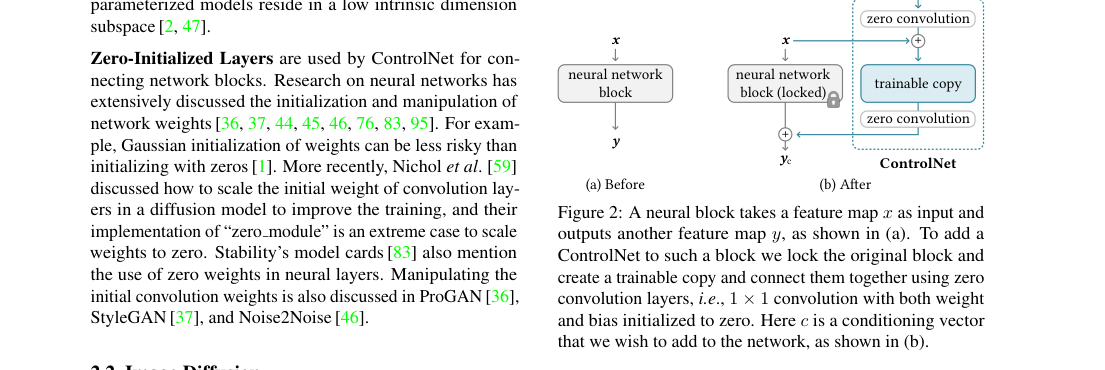
Spatial conditions like edges, pose, or depth were hard to inject into large text-to-image diffusion models without destroying pretrained generation quality. ControlNet closes this gap by cloning locked U-Net blocks into trainable branches linked by zero-initialized convolutions, yielding robust control across canny, depth, segmentation, and pose conditions.
Currently Used Methods
Foundational
- @rombachLatentDiffusion2022 — latent diffusion enables strong text-to-image synthesis with frozen pretrained backbones.
- Limitation in context: lacks a dedicated pathway for spatial condition injection.
- @DenoisingDiffusionProbabilisticModels2020 — denoising objective for iterative generative modeling.
- Limitation in context: does not address structured control signals like pose or edges.
- @nicholImprovedDDPM2021 — improved diffusion training and sampling for higher-quality generation.
- Limitation in context: improves generation, not condition fidelity under spatial guidance.
- @ClassifierFreeDiffusionGuidance2022 — mixes conditional and unconditional scores for prompt guidance.
- Limitation in context: text guidance alone cannot enforce pixel-aligned structure.
- @ronnebergerUNet2015 — encoder–decoder with skip connections for dense image prediction.
- Limitation in context: no locked-copy design for safe finetuning of diffusion backbones.
Proposed Method
Architecture
ControlNet augments each pretrained Stable Diffusion encoder block and middle block with a locked copy plus a trainable copy. The trainable branch consumes condition features and merges back through zero convolutions, so control starts at exactly zero and grows during finetuning.
Loss / Objective
ControlNet keeps the base diffusion objective and optimizes the conditional denoiser with text condition and spatial condition :
Sampling Rule
Sampling reuses the Stable Diffusion reverse process with the ControlNet-augmented noise predictor:
Training Procedure
- Base model: Stable Diffusion finetuning with locked backbone copy
- Control connectors: zero-initialized convolutions
- Prompt dropout: 50% text prompts replaced by empty strings
- Cost: about 23% more GPU memory than Stable Diffusion finetuning
- Regime: trained on both small-scale and large-scale condition datasets
Evaluation
Datasets
- COCO
- ADE20K
- OpenPose-derived human pose conditions
- Depth, normal, canny, HED, M-LSD, scribble, and sketch condition sets
- Small custom condition datasets and large-scale general-domain data
Metrics
- Average User Ranking (AUR) for result quality
- Average User Ranking (AUR) for condition fidelity
- Reconstructed IoU for segmentation controllability
- FID
- CLIP-score
- CLIP-aesthetic score
Headline results
- User study, sketch control: ControlNet ranks first in both image quality and condition fidelity.
- ADE20K segmentation: reconstructed IoU exceeds LDM and PITI baselines.
- Image quality benchmark: ControlNet improves CLIP-score and CLIP-aesthetic over Stable Diffusion.
- Robustness: usable control appears with small datasets and scales further with millions of images.
Table 1: Image quality metrics comparing Stable Diffusion variants
| Method | FID ↓ | CLIP-score ↑ | CLIP-aes.↑ |
|---|---|---|---|
| Stable Diffusion | 6.09 | 0.26 | 5.54 |
| ControlNet-lite | 5.57 | 0.28 | 5.70 |
| ControlNet | 5.16 | 0.29 | 5.83 |
Ablations
- Zero convolutions: stabilize finetuning by preventing harmful initialization shocks.
- Dataset size: 1k images already teaches control; 50k and 3M sharpen reliability.
- Prompt dropout: empty-text training improves no-prompt controllability.
- Architecture choice: locked backbone plus trainable copy beats naive direct finetuning.
Method Strengths and Weaknesses
Strengths
- Adds spatial control without retraining the whole text-to-image model.
- Zero-initialized connectors make finetuning stable from pretrained weights.
- Works across many condition types with one architectural recipe.
- Improves FID, CLIP-score, and CLIP-aesthetic over Stable Diffusion.
Weaknesses
- Adds about 23% training-time GPU memory over plain Stable Diffusion finetuning.
- Quantitative comparisons are concentrated on a few control settings.
- Quality depends on external condition extractors such as pose or edge detectors.
- Extra control branches increase engineering complexity at deployment.
Suggestions from the authors
- Transfer pretrained ControlNets to other diffusion backbones and stylistic checkpoints.
- Study richer combinations of multiple conditions in one generation pass.
- Scale training data further to probe controllability gains.
- Explore more task-specific adapters for additional spatial modalities.
Links
Prior Papers
- @rombachLatentDiffusion2022 — ControlNet is a condition-injection finetuning scheme built directly on Stable Diffusion's latent U-Net.
- @DenoisingDiffusionProbabilisticModels2020 — the training objective remains the standard diffusion noise-prediction loss.
- @nicholImprovedDDPM2021 — ControlNet inherits the improved DDPM-style denoising framework used in modern latent diffusion.
- @ClassifierFreeDiffusionGuidance2022 — prompt dropout with empty text connects directly to classifier-free guidance practice.
Further Papers
- @songConsistencyModels2023 — another 2023 diffusion paper that targets practical generation improvements with altered inference behavior.
- @peeblesDiT2022 — extends the diffusion model design space beyond U-Nets, relevant for future controlled backbones.
- @karrasEDM2022 — refines diffusion training and sampling, complementary to ControlNet-style conditioning modules.
- @luDPMSolver2022 — accelerates diffusion sampling and naturally pairs with controlled generation pipelines.